Extreme Networks CTO On Slashing AI ‘Sprawl’ And ‘Democratizing’ AI Via Upcoming Exchange
Extreme Exchange will be a ‘curated catalog’ of AI components and tools that will include offerings from the networking specialist and its partners, Extreme Networks CTO and President of AI Platforms Nabil Bukhari shares with CRN.

Extreme Networks CTO and President of AI Platforms Nabil Bukhari has unveiled his vision around Extreme Exchange, a place to find, share and deploy AI innovation powered by AI agents for enterprises and channel partners.
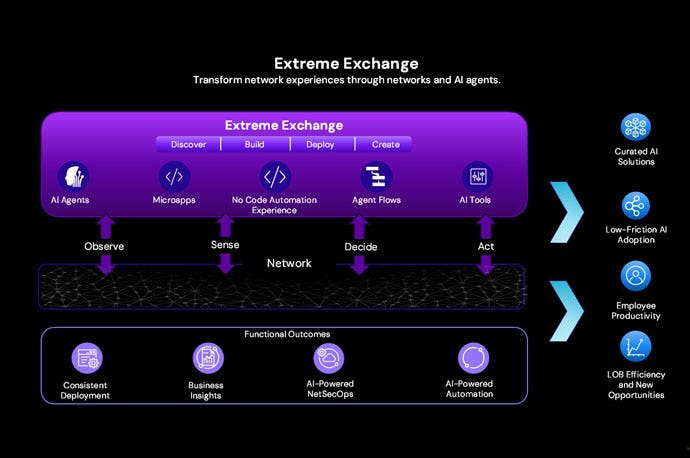
Extreme Exchange is the second offering from the networking specialist that’s fueled by the company’s own AI Core technology, with the first being Platform One for AI-powered network and security management that Extreme Networks made generally available in the summer. Exchange, however, aims to manage AI sprawl and lower the barrier of entry to AI by providing a “curated catalog” of AI components and tools, including agents and integrations. The platform is going to support community contributions from partners and will focus on solving business problems quickly and efficiently.
The new era of networking includes AI, but it’s not just about underlying technology. AI-powered networking will require an ecosystem in which multiple vendors and partners can come together to contribute specialized agents and carry out integrations. Ahead of the official launch of Extreme Exchange, Bukhari spoke with CRN about the motive behind Extreme Exchange, the opportunities it will expose for partners and what’s next for Extreme AI Core.
Here is more of the conversation.
What was the rationale behind the creation of Extreme Exchange?
When I talk to enterprises, what they want from AI is very different from what you and I want from a consumer point of view. [Things like] ChatGPT and Gemini, they work really [well]. We ask a question, it gives us some answer and makes up the rest, and that’s OK. Life is great. But when it comes to enterprise AI, there’s three things that are absolutely critical … domain-specific expertise, context for the use case, and then control and governance on top of it. Those are really the three things that we built on AI Core. Now, we exposed most of it for network management use cases and security management use cases through Platform One, but we wanted to expose it in a slightly different way as well so people can actually take advantage of it, and that’s really where Exchange comes in.
The first thing that I see when I talk to enterprises is there’s just too much AI out there. Instead of hype, I call it an ‘AI sprawl’ because even if you get rid of the hype part, there are just too many agents, and too many chatbots, and every product has their own AI. So how do you manage and bring order to that AI sprawl? I really thought that there needs to be a curated place for your specific domain where you can go in and find agents and integrations and tools that are meant for your specific space and are actually going to work. Now, that’s not mind-blowing at all. That’s just the curated catalog, or whatever you want to call it. These AI components, whether they are integrations or tools or AI agents, they are ones that are published from us, but you can bring your own as well. The second thing that we really wanted to accomplish was that while everybody talks a big game on AI, if you really look at our customers and you listen to them, one of the biggest things that they want to do is still just automation. ‘AI is going to change the world.’ Yes, it will do that tomorrow. Today, it still needs to do better automation. That’s just what reality is. So we wanted to bring automation to that, but we’ve been doing automation for 30 to 40 years [so] what we wanted to do is we wanted to bring cross-domain automation [in] and add agentic systems into it, and we wanted it to be a no-code environment. Automation can be smart, but those smarts are based on rules. If this, then that. If those rules change, or the dynamic changes, you have to go and update your automation. But that’s where we thought one of the biggest powers of AI is that it can reason, so when you give it inputs it can reason. I like to [say] we’re bringing automation from the world of rules to the world of reasoning. So that’s where we introduce agent flows. Agent flows are a no-code environment. You can plug and play, and you can connect agents. You can connect tools. You can connect your own scripts that you have built. You can connect anything together to create an end-to-end environment. Because it’s a no-code environment, it’s very easy to do—drag and drop and attach them together. The third one is the core components that are available in Platform One—think about AI Expert, think about Service Agent—they are now available outside of Platform One for [enterprises] to integrate into whatever automation they want. This is about community. This is about bring your own agents. This is about exposing the capabilities of AI Core directly to the customers so they can build it in their automation.

What kinds of opportunities will Exchange unearth for partners?
One of the areas of the community that I feel has a huge amount of interest in [Exchange is] the partners. This is the first time they can actually take their expertise that they have related to the customers, and very quickly turn [it] into something that can be productized and monetized. We have a lot of partners that are super, super excited about that.
We are planning on building an entire community program around {Extreme Exchange]. My vision on that is, I do not want to have too many guards on this. One way is as part of the community, members can just come in, start playing with it and start publishing stuff as a community. But then we will have a concept of a partner publisher. Obviously, we'll put some restrictions on this, and those would be in terms of [being] able to support it and having a certain level of expertise, but that’s really how I envision it. There should be a community area, which is a low-hurdle playing ground for people, but then they should be able to publish their stuff in there as well, but then there’s a little bit more certification required for that. I talk to a lot of these partners, and there are two to three things that they run into trouble with. No. 1 is most of them do not have the expertise. No. 2, a lot of them don’t really have the investment—building AI Core is not a cheap thing. There’s only a few companies that can build that and are building it. The third one is that even if they are able to do that currently, they’re not going to spend that much money for the few customers that they have. They do not have the broad scale or the reach to a broader market. Exchange really fixes all three for them. The barrier to entry is very low because we have created those no-code environments. Your people don’t need to know anything about coding, or AI coding at all. That’s No. 1. No. 2 is we have already made the investment in it, so you don’t have to make all that big investment as a partner. And the last part is, if you do have expertise, let’s just say, in a few customers that belong to an industry, Exchange could technically give you access to that entire industry. This is the first time I think a lot of partners really can scale with very little hurdles in the way. There’s always a few partners at the tippy top that maybe have the investment and stuff to do it. But what about everybody else? I see some of my competitors, and they are consolidating their partnerships in the partner space with just a few at the top. For this reason, we started going the other way. We were saying, ‘Hey, let’s just democratize this.’ Because in the end, you don’t want the entire market on the channel side to sit with five [partners]. That’s not good for anybody.

What use cases do you envision Exchange enabling for partners?
One of the biggest problems that the partners have is that vendors don’t like to work together. The second thing that happens is that [a partner’s] customer, who is using both Vendor A and Vendor B, they come to the partner and say, 'Hey, these vendors are not doing it. I want you to do it.' The partner says, ‘Sure,’ and they build automation and integrations, but maintaining that is almost impossible. It costs too much to maintain that. So,most of the use cases that they are really looking at is building these integrations and building these automation workflows that go across multiple vendors and doing it very quickly. So now with agents and with MCP [Model Context Protocol] servers and stuff, you are not dealing with the underlying APIs. Now you are not scripting these things exactly as they work. Now you’re building these reasoning workflows on top of it, which is a lot easier to do compared to deep integrations. Use cases that they are thinking about, or at least the conversations that they are having, are the same ones that they have been trying to support their customers on for the last 15 years. ‘Hey, when something happens, this is my internal help desk app. But I want this help desk app to be able to take data from the networking side, from the security side, from the storage and the application, and actually give something meaningful as a response to the users of my company.’ It sounds so easy, but it can take you years to build that. In today’s world of Exchange, we actually showed it live on the stage in a running production environment. It took five and a half minutes to build. How far the partners can go on this is [based on] how far is their understanding of the workflows of their customers. If they can think of a workflow, they can build it. Then it goes back to the more you know your customer, the more you know their environment, their workflows, the more valuable you are because you can go and pinpoint those problems and automate that. That’s really the value chain for me, between the vendor and a partner. Some vendors want to take out the partners and go direct to the customer, and some partners are like, ‘We really want to build this AI technology.’ I think both of those ideas are crazy because a vendor can never, ever have that deep understanding of a specific customer’s environment. We will never be able to scale that. And most of the partners are not in the job of productizing tech. To me, the value chain really is that we give the scalable technology that reduces the investment and the barrier for the partner, and the partner shares that deep expertise about that specific customer. You bring these two things together, and that’s really what delivers value to the customer. To me, that’s the future, and it’s a little bit different than what some of my peers in the industry are doing, but we at Extreme are very clear about it.
What’s the next step for AI Core?
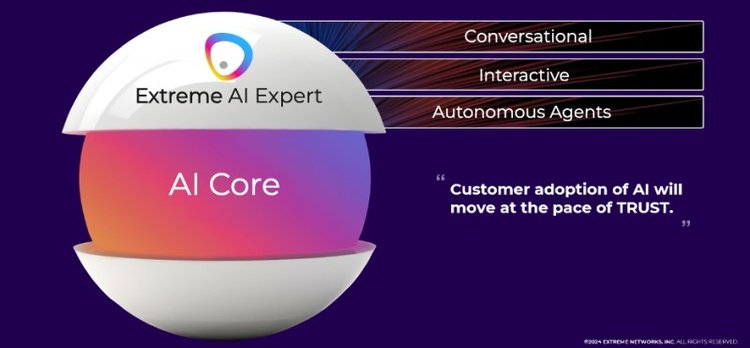
We GA-ed Platform One [in July]. That was the first thing that came out of AI Core. We just announced Exchange, the second thing that has come out of AI Core. So, you can imagine that we are going to be moving very fast, and there’ll be other ways in which we will bring out the capabilities of AI Core as well. Building something that scales across thousands and thousands of customers and billions of devices and still providing that expertise and context and with control? That’s not easy to build. You can’t throw money at it. As a big company, you have to clean up your entire data pipeline, you have to unify all of that stuff to be able to get anywhere close to it. And if you’re a small company, you don’t have the data. One way or another, you’re going to either spend time building the scale with the customers, or you’re going to spend time cleaning up the scale that you already have. The good thing for us is that we really started this six years ago when we started Universal [Platforms] so we have been unifying and cleaning up [stuff] for so long that we find ourselves in this unique place where what people are thinking about and what people are putting on slides? We’ve already done it, and now we’re going to productize it in multiple different ways. Platform One, everything is built in for network management and security management. Now we took all of those capabilities out and threw it into Exchange. And in Exchange, those components are available for you as a customer or a partner to integrate into other things. Now, this is not just around network management. Wherever you need networking capability, wherever you need data capability, you can drag and drop it and build it.
There’s two things that I say to the company. One is, ‘Move first, move fast, that’s the only strategy in the AI,’ and the second one is, ‘Don’t tell me, show me.’ We just get the people into the product and show them what it can do. You can imagine that we will continue to push further and further on both of these.