Extreme Networks ‘In A Good Space’ As HPE-Juniper Combination, Cisco Partner Program Changes Loom, Says CEO
‘A lot of the partners of HPE and Juniper intentionally do not want to be a Cisco partner. We look at Extreme as the logical choice and an interesting alternative for partners that want to have an alternative now that HPE and Juniper are coming together … that’s where we think there’s just big opportunity. We’re seeing more and more people open to the dialogue,’ Extreme Networks CEO Ed Meyercord says of the disruption in the networking market.

Extreme Networks is feeling confident after another strong fiscal year that included a growing volume of customers globally, deals worth north of $1 million, and more large partners considering adding the networking specialist to their repertoires, according to Extreme Networks President and CEO Ed Meyercord.
The company last week reported its fourth-quarter and full-year 2025 earnings, marking the its fifth consecutive quarter of revenue growth with revenue up 19.6 percent year over year. Extreme’s SaaS ARR, which is increasingly making up more of its revenue, also climbed about 24 percent year over year. The Morrisville, N.C.-based company expects to continue its path to revenue growth thanks to its development of AI networking capabilities and its new flagship Extreme Platform One offering that just became generally available in July.
A major part of the reason why the company feels so confident heading into its fiscal 2026 year is because of the disruption that’s hit the networking space, according to Meyercord. Cisco Systems is making sweeping changes to its beloved channel partner program over the next six months, some of which have not been popular with partners, and Juniper Networks is now part of HPE, introducing some uncertainty for existing Juniper partners and customers. It’s this upheaval that is creating upside for Extreme Networks, he said.
The CEO spoke with CRN following the company’s fourth-quarter 2025 earnings to talk about its recent wins, its new AI-powered Extreme Platform One offering and new areas of opportunity that are opening up for the company.
Here are excerpts from the conversation with Meyercord.
How did partners contribute to Extreme’s overall growth in FY 2025?
First, we’ve had a change in leadership at the partner level. Joe Spencer has come in, and he’s done a great job [as senior vice president of global channel and strategic initiatives]. He’s got a lot of experience [in networking] coming in from Juniper and having been at Cisco and is very knowledgeable [about] the channel. We’re excited about how he’s going to help us improve our channel program, especially in light of the upcoming disruption that is going to be happening naturally when two companies combine—HPE and Juniper—and then there’s a lot of anticipation around the changes coming to the Cisco partner program. We feel like we’re in a very good space. If I look back at key wins for us, partners are very much a part of that. We’re talking about moving upmarket, and the volume of opportunities that we see in our funnel that are over $1 million continues to grow. The quality of those opportunities—meaning, from a quality standpoint, how would we handicap our odds of winning?—the quality is going up as well, and a lot of that has to do with our relationship with the channel and the kind of partners that we’re dealing with.
I can give you an example. We created a very unique solution for the government of Japan. This goes back for several years, and I would say we learned a lot from a loss, and our partner learned from a loss, because we [were] thinking that we had won a contract for one of the government agencies there. At the end, we lost to a larger competitor. We felt like we were somewhat outflanked, and it was kind of a last-minute deal. So we regrouped and, working with this partner, we were able to work together to help enable the customer with our technology to create a solution [that] is leveraging our fabric, which is truly unique, and then extending the fabric across the wide-area network, a la our SD-WAN, and creating this unique, secure, remote connection. Then, from a security standpoint, we stood up a private cloud. All of this we’ve done with our partner, and our partner replicated the environment. So, we have our own test case. Our partner has built their own lab to replicate the customer environment, so now we have two sources working with a very large customer and we had the largest win in company history in Asia-Pacific. It was an eight-digit win with a system integrator and then a series of partners. It also took the largest potential partner in Japan, [which] got confidence in Extreme, and now we are their de facto choice for these government projects. So partners are really leading the way with us, and that’s just one example of things that are happening globally. We’re going to replicate this playbook. This is part of us again moving upmarket with our current partners and with new partners that can open the doors to bigger opportunities.

How do you anticipate the changes coming to the Cisco partner program to impact business for Extreme?
You can understand Cisco saying, ‘We want to incentivize solution selling [and] selling everything on the truck,’ and that’s where we see opportunities because maybe [a partner is] not qualified to sell everything on the truck, or maybe how you differentiate with customers is a little more specialized, and that’s where we’re seeing some opportunities. Our fabric technology is very unique, especially in these campus environments. At the end of the day, you’re talking about an environment that’s very secure inside, very static, [with] redundant power, redundant connectivity, etc. But when you get onto a campus environment, it’s very diverse, [there are] constant moves, adds, changes, indoor, outdoor and a variety of different configurations and physical locations. That’s where the fabric that we have is completely unique and designed for that environment. This is where we’re seeing a lot of success and our customers who are on board with the fabric are really helping us open doors. I mentioned on the [fourth-quarter 2025 earnings] call we have a huge customer prospect who is actively testing our technology against Cisco, and the quote is, ‘It takes Cisco six hours. With your fabric, it takes six minutes.’ And because people don’t know about it, and this is where the channel can be so helpful because the channel partner is [saying], ‘No, this is legit. These are the customers. You need to check this out.’ So, customers will say, ‘OK.’ And then when they actually get their hands on the technology and they try it out, they’re kind of blown away. This is where we get a quote like this. There are a lot of disbelievers, and then they become believers.
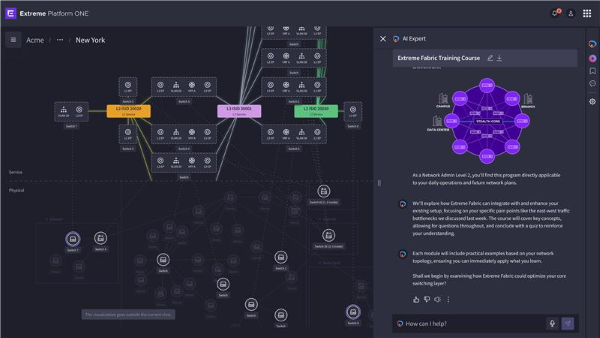
We want the Cisco CCIE [Cisco Certified Internetwork Expert]. We want Cisco-certified engineers because it’s incredibly easy for them to become Extreme-certified. With Extreme Platform One, you have an AI expert by your side that can translate everything for you, and then you’ve got a service agent that can actually perform tasks for you, and everything can be mapped out, or you can actually say, ‘If I were to perform this task, let’s say in a Cisco environment, how would I do that in an Extreme environment?’ It’s conversational, so boom, you’ve got your answer. It’s like you’ve got the answer key to a test that you’re taking all the time, and that’s a fundamental shift in what’s going on in networking right now. If you go back in time, [you] take a four-month class like a college course, take a test lab, and then you get a badge for wireless. You go through that whole exercise. Now you don’t have to. We’re not going to knock people that have been trained on Cisco. We’re not knocking that at all. We’re saying, ‘Hey, take the knowledge of the tools you have and come on to what is the most modern, advanced platform in the industry, and leverage and enhance your skillset on this platform.’ We’re pretty excited about that because of what I’m describing where everybody's trained up on one technology and [are wondering], ‘How do we get to the other [technology]?’ The bridge has gotten much shorter and much easier to cross.
How is the now-closed HPE-Juniper merger affecting the networking market and business for Extreme?
[Things are] happening at three levels. One is happening at the employee level. We’ve been able to hire some great talent, like Joe Spencer. And then it’s happening at the partner level. A lot of the partners of HPE and Juniper intentionally do not want to be a Cisco partner ... but they might want to offer an alternative for their customer. So we look at Extreme as the logical choice and an interesting alternative for partners that want to have an alternative now that HPE and Juniper are coming together. Now, [Juniper] is HPE, and make no doubt about it, they’re now HPE, so if you want to have an alternative, who do you go to? And that’s where we think there’s just big opportunity. We’re seeing more and more people open to the dialogue. It helps that our fabric is so differentiated. It helps that we have this cloud differentiation, and then it helps that we have Extreme Platform One that everyone’s really curious about. It’s creating a lot of activity for us in the channel. The third layer is the customer. We have customers that may have been a Juniper customer or may have been an HPE customer, and they’re concerned about which direction the company is going to go. ... We’re seeing a lot of people saying, ‘Well, let’s open up the door to Extreme and let’s see what they have to say.’ They are usually surprised when we come in and we share our portfolio of solutions and where we’re going with everything fully integrated. Extreme is sort of the least risky alternative for, I think, channel partners as well as end-user customers.
What’s the next step for Extreme heading into fiscal 2026?
Right now, it’s all things Platform One. Unlike with a hardware release, we’re going to be continuously updating the platform with new features, functions and capabilities. We came out with our GA [general availability] release, which was wave one, and there’s going to be 1.2 and 1.3 before the end of the year. Wave two will be in the first half of calendar 2026. The excitement is around fabric and bringing full fabric orchestration and management into Platform One. What we brought is visibility. There’s a lot of excitement around what you can see now, which you weren’t able to see before, in terms of the network visibility and all the different layers of the fabric. We’re going beyond [that] and over the next few releases, as we turn the corner going into next year, you’ll see enhancements in terms of the kinds of analytics and the capabilities that you’ll have, and so across the board, across several pillars, you’ll see continued enhancements.
My message is, check out Platform One. Get into the platform and see what it’s all about. For partners, I would also encourage the multitenant platform for the managed services provider. Remember, we came up with consumption billing, with poolable licensing. We created a platform that creates very attractive economics. It also creates a lot of simplicity from an operation and an automation standpoint, and it’s the most modern platform in the industry, and then it also now ties into Platform One, with all the enhanced capabilities we have there.