HPE CEO Antonio Neri On Aruba-Juniper’s AI Advantage, ‘Amazing’ Network Switch Innovation And Partner Growth
‘We have true differentiation through the AI Ops of both platforms whether it's Aruba Central with agentic AI or Juniper Mist with Marvis and Large Experience Models,’ said Neri. ‘We have already integrated (Juniper Networks) Apstra with OpsRamp as a part of GreenLake for observability. That gives full stack observability compared to Cisco.’
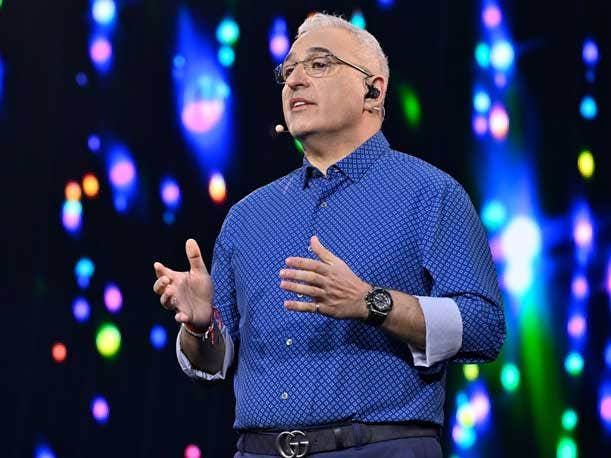
HPE President and CEO Antonio Neri says “no one in the market” has the AI capabilities that the company is providing across its portfolio, including with its newly combined Aruba and Juniper Networks products.
“We have true differentiation through the AIOps of both platforms, whether it’s Aruba Central with agentic AI or Juniper Mist with Marvis and Large Experience Models,” said Neri in an interview with CRN. “We have already integrated [Juniper Networks] Apstra with OpsRamp as a part of GreenLake for observability. That gives full-stack observability compared to Cisco.”
The AI advantages HPE is providing are translating into “huge, huge productivity savings for customers” with as many as 90 percent of network trouble tickets being reduced by adopting the HPE networking stack, said Neri.
“The return is very obvious,” he said “Some customers will see higher numbers but some may see slightly lower, but in the end the results are very, very tangible. That is why customers are interested in working with us because they are looking for a modern approach and an alternative. That is why we are building a new networking leader in the market.”
Neri’s comments came after HPE raised its revenue forecast for its networking business to mid-single-digit growth for the fiscal year to $11 billion in the wake its “momentum” integrating the $13.4 billion acquisition of Juniper Networks.
“In the five months since closing the transaction, we have brought together our teams, technologies and go-to-market strategies and the response from our employees, customers, partners and the industry at large has been overwhelmingly positive,” said Neri on the conference call with analysts. “They are already seeing the benefits of our combined portfolio, the innovation we are driving and the cohesive customer experience we now deliver. Across the industry, stakeholders have expressed enthusiasm for the combined companies’ ability to accelerate innovation, deliver greater value and help organizations build secure, modern and high-performance networks for the future. The new combined networking team is performing exceptionally well.”
Overall for its fourth fiscal quarter ended Oct. 31, HPE reported non-GAAP earnings per share of 62 cents on a 14 percent increase in sales to $9.7 billion. That compared with the Zacks consensus estimate of 59 cents per share on sales of $9.96 billion.
HPE’s sales through partners were up 37 percent in the quarter year over year, accounting for 65 percent of HPE revenue.
The strong partner results came as the company this week at HPE Discover Barcelona unveiled a new innovation-packed combined Aruba and Juniper Networks networking portfolio.
The new combined HPE Aruba and Juniper product blitz moves key AI networking capabilities from Juniper Mist to HPE Aruba Networking Central and at the same time moves HPE Aruba AI technology to Juniper Mist.
Under the cross-pollination strategy, HPE Juniper Networks’ renowned Mist AI Large Experience Model and Marvis AI virtual assistant will be available in the first quarter next year on HPE Networking Central.
In addition, HPE Aruba’s AI-based client profiling capabilities and AI organizational insight functionality will move in the first quarter next year to HPE Juniper Mist.
The product blitz also includes what HPE is calling the “world’s highest-performance Ultra Ethernet Transport Ready” network switch: the 100 percent liquid-cooled HPE Juniper Networking QFX5250, which will be available in the first quarter.
“It was a great event at HPE Discover [Barcelona],” said Neri. “We had over 5,000 customers. The partner community showed up in force. They were very excited about the latest innovation. It shows the tremendous momentum we have across all our businesses, and how quickly we integrated Juniper.”
Here is more of CRN’s conversation with Neri.

You just returned from HPE Discover in Barcelona. What was the mood from customers and partners there?
It was a great event at HPE Discover. We had over 5,000 customers. The partner community showed up in force. They were very excited about the latest innovation.
It shows the tremendous momentum we have across all our businesses and how quickly we integrated Juniper.
We made a number of breakthrough announcements in networking. People were concerned how quickly we could do that.
But it was not just networking announcements. It was hybrid cloud and across the board whether it was storage or private cloud, or GreenLake and software with additional features in Morpheus and VM essentials.
How did the partner community perform for HPE in the fourth fiscal quarter?
So in Q4 our HPE partner business grew 37 percent year over year and accounted for 65 percent of the Q4 [revenue] contribution.
Networking grew 37 percent [through partners] and if you exclude Juniper, it would have grown 6 percent year over year. In networking you have a higher level of contribution from partners because it represents 88 percent of our revenue in networking.
In servers the growth in Q4 was 14 percent year over year, and the partner orders represented 56 percent of our total server contribution.
In hybrid cloud, obviously Alletra MP continued to grow double digits, and the partners are driving most of that. Also the partners continue to embrace our private cloud. And in private cloud we grew 20 percent year over year, but the partners represented 77 percent of the total contribution in the hybrid cloud business.
Our [channel] strategy obviously is through the Partner Ready Vantage. It is focused on three things. No. 1: continue to unlock greater relevance through our innovation. Partners were super enthusiastic yesterday [with the blizzard of new announcements at HPE Discover Barcelona].
Second is to obviously continue unlock a high level of expertise with our partners. That’s where training, certification and enablement all come together.
Third is helping partners unlock higher levels of margins. That’s the goal. You can be a Triple Platinum Partner now selling all three areas of our portfolio [compute, hybrid cloud and networking].
Overall, it was another great quarter with our partners. You don’t achieve that level of growth without commitment on both sides. And that’s what I sensed yesterday. It was strong commitment, great enthusiasm.
On the Juniper side, everybody wants to be part of that journey. Remember, there was only 10 percent overlap between us and Juniper. There is a huge opportunity there working with our partner community.
So all in all I am very, very pleased because of our momentum with the results in Q4 with obviously revenue up 14 percent and profits up higher at 26 percent. Gross profit was up 550 basis points.
Because of our momentum in our integration with Juniper, we are raising our networking revenue guide from the 2 [percent] to 5 percent to the mid-single digits. We are raising our non-GAAP EPS by 5 cents at the midpoint. And we are raising also our free cash flow, both the low end of the range and the midpoint of the range, by $100 million.
Is the story that the transformation into a networking company at its core is paying off?
Exactly right. This company in 2026 will be at the core a networking-centric company, which is the core foundation by which we deliver both cloud and AI solutions for all segments of the market, whether it’s sovereign, enterprise or service providers.
You saw the number of announcements [from HPE Discover Barcelona this week] that play really nicely there in the data center with the QFX5250 switch, the first 1.6-terabit- [per- second] switch that is liquid-cooled. That is super fast out of the gate. Nobody has announced anything like that. We also announced the AMD Helios stack, which includes the first scale-up Ethernet switch from Juniper. We had an announcement with Nvidia with our routing products. We announced the new MX router.
We provided very strong clarity about the convergence of Mist and Aruba by cross-pollinating features and the first set of products that are supported by both platforms. We announced a security firewall. So there are multiple areas where we are very, very strong. And look, 2026 is all about execution.
What kind of opportunity do you see to gain share in campus and branch by moving Juniper Mist into Aruba Central?
We are already the largest company in units shipped in Wi-Fi 6 and Wi-Fi 7. So that tells you we are clearly a market leader. We have true differentiation through the AIOps of both platforms whether it’s Aruba Central with agentic AI or Juniper Mist with Marvis and Large Experience Models.
We have already integrated [Juniper Networks] Apstra with OpsRamp as a part of GreenLake for observability. That gives full-stack observability compared to Cisco.
The data center switches will find [their] way to rack-scale integration on the server side and on the private cloud and storage side. In fact, we announced the integration of software-defined networking—which came from Juniper—to our VM Essentials.
So we provide customers best-of-breed modern networks on a stand-alone basis and then best of breed at the solution level because we integrate not just the hardware components but also the software and AIOps to provide a full integrated experience. GreenLake is the way we deliver all of that.
Is there any way to net out the difference in return on investment when you stack the combined HPE-Aruba-Juniper networking portfolio against Cisco?
Well, it’s about productivity. If you can cut 90 percent of the trouble tickets [received by network administrators] using our technology, that’s a huge, huge productivity savings for our customers because they don’t need people managing networks. And as we put more AI into this then you can automate and empower AI to take actions for you. That means less downtime, less Opex to run these networks. Then, ultimately, we are building modern networks that are secure because the security is built-in—not bolted on. That in itself with performance and security also provides benefits from a Capex and Opex perspective.
The return is very obvious. Some customers will see higher numbers but some may see slightly lower, but in the end the results are very, very tangible. That is why customers are interested in working with us because they are looking for a modern approach and an alternative. That is why we are building a new networking leader in the market.

Where are you going to see the biggest impact in terms of revenue growth from the new QFX5250 switch?
The 5250 is an amazing piece of innovation. Juniper got the benefit of our direct liquid-cooling.
I think the other networking vendors who have never done direct liquid-cooling will have to spend quite a significant amount of time on that because it doesn’t come from the reference architectures from the chipset providers.
Secondly, that switch is not just for service providers. It is also for sovereign clouds and neoclouds. And it will be easy for us to integrate in the rack-scale architecture with our great products both [the Cray] EX and [the Cray] XD and even the ProLiant, which are also already liquid-cooled.
So for partners, even though they may not sell AI at scale, the fact that we give them infrastructure ready for AI allows them to spend less time and investments in getting ready because we give it to you all prepackaged. So they can focus on deployment and serviceability, which obviously are components of profitability. With the Partner Ready Vantage program we allow them to sell our stuff or they can sell their own services on top of it, which is a source of profit for them when they have the capability to do so. Those are all differentiators that are going to play out as we go forward.
I am proud of what [HPE Networking President and General Manager] Rami [Rahim] and his team have done in less than five months. And I am excited about what they will do in 2026.
AI is a big differentiator for us. No one in the market has the AI capabilities that we have deployed across the portfolio not just in networking, but also now with compute operations management for servers. [HPE General Manager, Hybrid Cloud] Fidelma [Russo] has done it now with Alletra MP and for a long period of time whether it is with NCP [Network Control Protocol] adoption, the AI data pipeline acceleration with GPU nodes, or with InfoSight before, and even with OpsRamp observability and also with Zerto—all of that has played out in our favor.
What was the key to being able to quickly bring together the Aruba Network Central and Juniper Mist platforms?
Both platforms were built as modern architectures. Both are microservices, API-driven, cloud-native, and AI was used from the beginning on both sides of the fence. You have an advantage there so you can cross-pollinate very, very quickly both platforms.
When you have a platform that’s legacy, monolithic and so forth, you have to disaggregate everything. You have to rewrite the entire code. Here we are leveraging code and cross-pollinating that code.
What kind of differentiation is there with regard to how open HPE’s virtualization strategy is with VM Essentials and Morpheus versus the Broadcom VMware approach?
We took an open approach. Inside HPE Morpheus enterprise we support all the hypervisors, including ours obviously. We provide true cloud brokering and orchestration, supporting the public clouds. We integrated with OpsRamp to provide full-stack observability and then inside VM Essentials we offer live ESX to HVM migration, which means customers don’t need to do anything. They can take one VM and it runs on the next hypervisor.
On top of that we added software-defined networking from Juniper. Now we have completed the stack so we have a true alternative. Another differentiation is we charge on a socket basis not on per-core basis. That is why you see this level of savings. We already had 100 customers in Q4 adopting it. One key customer deploying at scale is Danfoss across 65 remote sites.