Cisco’s AI Play: Turn Security, ROI Challenges Into Partner Growth
AI is becoming a bigger business for partners, but security gaps, ROI concerns and escalating token costs continue to slow adoption. Cisco says its agentic AI strategy and Cloud Control platform can help partners capitalize on the opportunity while tackling the complexity.

Cisco’s latest AI readiness survey paints a mixed picture: Partners expect AI to account for a growing share of their revenue, but customers are still struggling with awareness around AI security issues, measurable returns and the rising cost of running autonomous agents. With that in mind, Cisco is positioning its end-to-end AI strategy and Cloud Control platform as a way for partners to secure infrastructure, simplify operations, and build new managed services.
Partners are increasingly excited about AI’s potential and use cases, and the tech giant believes that partners can help close the gaps for customers while creating custom agents, managed services and new recurring revenue opportunities. Meanwhile, Cisco is making the case that its reach across networking, security, observability and infrastructure sets it apart from vendors. Central to that is Cloud Control. Unleashed for general availability in June at Cisco Live, Cloud Control is Cisco’s unified platform for agentic AI that spans the company’s networking, security, collaboration and observability portfolios that’s built on the Cisco Data Fabric and powered by the Splunk Platform as its unified data layer. It’s this platform that Cisco believes will give partners a place for managing IT complexity and bring new services to market faster.
Alex Pujols, Cisco’s vice president of solutions engineering for global partner sales, recently sat down with CRN to discuss the company’s latest AI readiness findings, the security and ROI hurdles still confronting customers, Cisco’s end-to-end AI advantage and how Cloud Control could help partners build new managed services and recurring revenue streams.
Here are excerpts from the conversation.

What are the biggest takeaways from this year’s AI readiness data, and were there any results that ran counter to what you expected?
I would honestly say, for me, the big one was security awareness. It actually dipped down this year. It was the first time that we saw that. And security awareness, as it relates to AI-specific use cases and AI-specific security threats, you would think with the post-Mythos era it would be much higher. Last year it was 35 percent. This year it was 29 percent. We were thinking about how that is actually possible? And I think the reality is because agentic has taken off and security has, in a way, sort of trumped the capability of AI and people are more concerned around the security implications, it’s actually forced people to explore it at a deeper level, and I think they’re realizing it’s far more complex than they originally thought. That 35 percent went to 29 percent. We were really struggling with that until we thought through it a little bit more. You don’t know what you don’t know, and then eventually, when you get exposed to it, it kind of catches you off guard.
We [also] saw a lot of numbers that showed the trending around ROI still being challenged for a lot of AI use cases. Less than half of the partners reported that customers were exceeding expectations around ROI, which I think is relatively consistent. Obviously, we would have hoped that would have reversed a little bit. I think some of that is probably anchored in the use cases, and you could argue maybe unrealistic expectations of what AI would be able to do in the enterprise. It’s going to be interesting to see how that shifts as agentic continues to push forward.
Then, in terms of top-line impact for partners, I think it was 25 percent of our partners; currently over 50 percent of their revenue attributed to AI, and then 55 percent of the partners believe that would be the situation for them over the next five years. So, the wallet share, so to speak, of AI within our partners seems to be expanding considerably. Partners seem to be pretty optimistic about it as well. Those were a few things that really jumped out at me, and I think a lot of it honestly validates the position that we put forward on agentic security and a lot of the investments that we made.

Where do you think the biggest gaps are that partners still can help close when it comes to AI security?
Right now, there’s a lot of cycles. Some of them are being driven by panic. Some of them are being calculated and strategic around what frontier models mean for cybersecurity. This is all post-Mythos stuff. I think some of it is old behavior with a new spin. Obviously, patching has been around forever, but patching has generally been manual and human-driven for the most part, and so I think we finally have crossed that point where humans, probably moving forward, will never be good enough to defend against security threats in real time. We’re at this point where we actually need AI to defeat AI vulnerabilities. So, for a lot of our partners, there’s a huge opportunity in developing these vulnerability ops practices because it’s no longer suitable for them to have a human-manned SOC. We talk about agentic SOC as a longer-term or conceptual idea, but very few companies have actually put that into practice. Now it’s basically mandatory if you want to defend in this new horizon.
For partners, the immediate response is getting customers patched, building their own service offers, which is in essence a managed service capability, so that they can defend the threats in real time. There’s obviously a huge last day of support opportunity. Obviously, [partners are] not going to issue patches for devices that are that are end of service, and so there’s a huge opportunity there.

What are you seeing as the biggest real-world challenges that customers are telling partners about as they move some of this stuff into production?
I don’t think it’s as much technical. There’s geopolitical concerns [and] legislative concerns. There’s a lot of conversations taking place, and I think most customers want to make sure that they’re positioned for wherever that future settles, and then back to the technology and the software and hardware, are the investments that they have made or the investments that they need to make that are going to carry them through a lot of the uncertainty that’s currently out there around AI. I think those are some of the bigger concerns that I hear, but there’s still a little misinformation in the system around what AI can do from an enterprise ROI perspective.
I think the other thing that’s emerging significantly is with tokenization, you’re kind of introducing a variable cost into the enterprise, and a lot of companies haven’t quite figured out how to account for that. In some situations, how to even track it. It’s one of the reasons why we’ve invested in our Splunk agent observability and the token tracking capabilities there, because that’s increasingly becoming a pretty significant line item on the balance sheet for a lot of customers.
Partners are also trying to contend with that. I had a conversation with a partner and we were talking about AI cybersecurity post-Mythos era, but the conversation was almost entirely financial, just around token costs and managing token consumption from autonomous agents, which isn’t an easy thing to do, and then subsequently forecasting that because a lot of companies are having to forecast that back into the business. It’s an interesting sort of collision of technology and finance, but it’s happening right now.
How is Cloud Control gaining traction with partners, particularly around the new Cloud Control Studio and Marketplace capabilities?
Cloud Control is GA primarily in the U.S., expanding to EMEA and then subsequently APJC. We’ve got tons of customers and tons of partners that have been onboarded onto the system, and the feedback … it’s nothing short of amazing. It’s been extremely positive. Truthfully, this is something that I think our partners and customers have been asking for some time. Obviously, we’ve got such a big portfolio, and so it’s not as simple as creating one management layer for three products. We’re doing it for a lot of different products and product families.
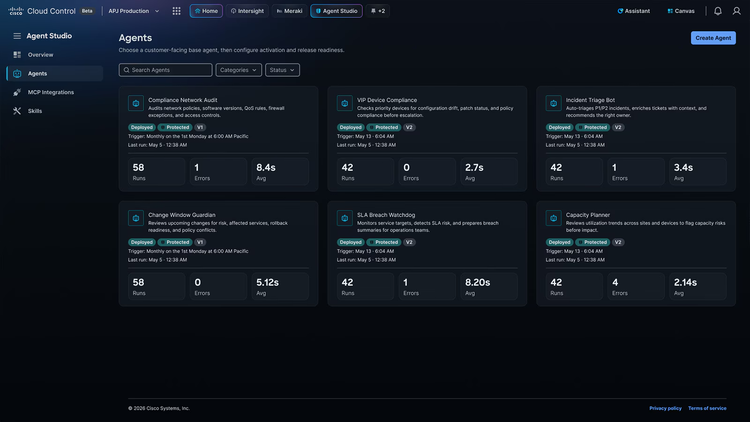
The launch has been super successful. Partner feedback has been fantastic. We work very closely with the development team, so the product is intentionally being built with partners top of mind, especially as potentially a managed offering. But I think one of the things with Cloud Control that we did announce and launch was our Cloud Control Studio, which is a really cool capability. It actually allows partners to create their own workflows, their operational playbooks, and custom agents, and then they can use those custom agents, which basically become intellectual property for them, and they can post those agents if they want to within Cisco’s Cloud Control Marketplace. It’s a really cool way to lessen the burden or the expertise that’s required to create an agentic enterprise infrastructure. They can just do it natively on our platform and then leverage that to scale across an entire enterprise infrastructure.
In addition to what partners are doing, we also have tons of other companies, third-party providers [and] technology alliance partners of Cisco that have also posted in the marketplace … that has also been exploding as well. The overall ease of management, ease of operation that Cloud Control brings to an enterprise infrastructure, plus the turnkey agentic element with Cloud Control Marketplace, has been pretty hot with partners.

Nearly every networking and security vendor is pitching an AI-driven platform strategy. Why does Cisco believe it’s uniquely positioned to deliver on that vision?
I think it’s one of the things that we’ve seen, and we can use agentic security as a good example -- there’s a lot of vendors that are approaching it from one segment, maybe edge devices, or maybe core networking devices, or some type of SaaS application. There’s a million different places. But the reality, whether it’s security threats or end-to-end observability, is that all of these require the entire infrastructure, from the laptop, to the server, to the network, to the firewall, the entire end-to-end piece, to be communicating effectively, to be able to enforce changes across the entire infrastructure, to be able to defend that enterprise infrastructure.
All of that stuff has to communicate seamlessly. Where I think a lot of other companies are attempting to do this, they’re also doing it in pockets. The thing from a Cisco perspective, because we play in so many areas, I believe it’s the only true capability that actually could bring together the end-to-end enterprise infrastructure. It’s challenging to do because we’ve had so many products and product families, and so while the idea might be the same, I would argue that the effectiveness in the approach is probably pretty unique when it comes to Cisco.

How can partners use Cloud Control to build new service offerings, and where are you seeing the biggest opportunities emerge?
There’s a lot of opportunities here. I think one of which is going to be pretty close to managed service providers because one of the challenges that managed service providers have had historically is as they try to develop their own service offerings, they’ve been challenged dealing with multiple parts of our portfolio that all have their own restrictions, approaches, or different APIs. That inconsistency has created friction, and it’s made it a little bit challenging for some of our managed service providers to build out these new service offers. With Cloud Control, because they’re in essence using that as a gateway to the entire portfolio, it actually lessens their time to create these new services and allows them to create more robust services because they’re able to bring more customer data to build out those capabilities. I know our managed service providers absolutely love it.
For our partners [that are] maybe non-managed service provider partners, it actually makes it much easier for their customers to grow into Cisco’s portfolio. That expansion isn’t a separate project. It could be as simple as literally turning on a few capabilities within Cloud Control and enabling that across their infrastructure. Just [the] ease of standing up services, operational efficiencies, makes it a much more seamless way to expand into new areas within the portfolio. All of that stuff makes partners’ lives easier and helps improve the quality of the infrastructure and the outcomes that they’re driving toward.