Extreme Networks CEO: AI, Network Refresh Super Cycle Trigger ‘Biggest Opportunity’ For Partners
Extreme Networks CEO Ed Meyercord sees AI, network modernization and a growing network refresh cycle opening major opportunities for channel partners to displace competitors, move upmarket and capitalize on Extreme Platform ONE and agentic AI.

Extreme Networks is building momentum as AI and network modernization requirements fuel fresh demand from existing and new customers alike.
And the Morrisville, N.C.-based networking specialist is entering that cycle with double-digit growth. During its latest fiscal quarter that ended Sept. 30, Extreme’s revenue climbed 10 percent while its SaaS annual recurring revenue grew 22 percent, driven by its enterprise fabric technology, Wi-Fi 7 portfolio and agentic AI management platform introduced in December 2024, Extreme Platform ONE, according to the company.
President and CEO Ed Meyercord in an exclusive interview with CRN broke down why Extreme believes the network refresh cycle is just getting started, how agentic AI is changing network management and where partners can make money as customers modernize.
Here are excerpts from the conversation.

As AI and modernization needs accelerate the network refresh cycle, how big an opportunity is that for partners to win new business and displace incumbent networking vendors?
That’s working well for us because as people are going through an upgrade [and] wanting to modernize infrastructure, we’re really one of three [networking competitors] today. Our story is we’re moving upmarket and we’re winning with our fabric technology. We have [an] example of the largest state government and Province in Canada, working with one of the largest [managed] service providers in Canada, who left our [competitor], ‘The Big Company,’ and they came to Extreme because of our MSP platform and because of our fabric technology and the differentiation of [the] fabric. That, all of a sudden, is going to be $40 to $50 million of business for Extreme. So, we picked up a very large service provider, which is providing managed services to a very large governmental agency that is in need of a refresh. They provide a lot of services to different government agencies, and I would say it’s kind of the same government playbook as the Japanese government with GSS [Government Solutions Services] where NTT, which was never really a partner of Extreme, is now one of our largest partners—a Diamond Elite partner for Extreme. They’re bringing their team over here [and] they’ve trained over 300 engineers, and we’re winning all these government projects because of the fabric technology and the extension of our fabric across the wide-area network. It’s all about security and the ability to segment the network, the ability to create different networks for different agencies that have their own SLA, where it’s super easy to provision. It’s a very resilient network. We have a data center fabric, and everyone has a data center fabric, which is very unique to what you’re trying to accomplish inside of a data center. Then, when you pull that out and you put it out on a campus that is messy because you’re indoors, you’re outdoors, you’re in multiple buildings, you're in closets, you’re not in this protected data center. That’s where this differentiated technology really comes into play, especially when people try it out.
For our channel partners, this is the biggest opportunity for them to make money because it’s not that often in the networking world where you have truly highly differentiated technology. One of the largest government contractors, who is moving away from a very large networking company to Extreme, said, ‘What takes them six hours takes Extreme six minutes.’
By the way, this is happening around the world, and so it’s particularly valuable when you’re moving upmarket into complex enterprise networks. On the wireless side as well, we have some unique capabilities. We do very well in complicated wireless environments … and we also have some unique capabilities in terms of power consumption. We have a light sensor, for example, on our access points [and] we’re the only one that has this technology where if you notice that the lights are turned off in a retail shop, you don’t need to power all your networks at full speed so you can actually power down your networks to minimum power mode, and then turn it back up when you’re opening up the store. And you can use AI to do this automatically where a light sensor goes off, you can actually bring power down and save power. But these are just a variety of ways that we’re differentiated with this network upgrade cycle. You’re seeing Extreme move upmarket, and we have some unique capabilities. And we’re out in front as it relates to our AI stack and our customers’ ability to leverage AI for managing the network.
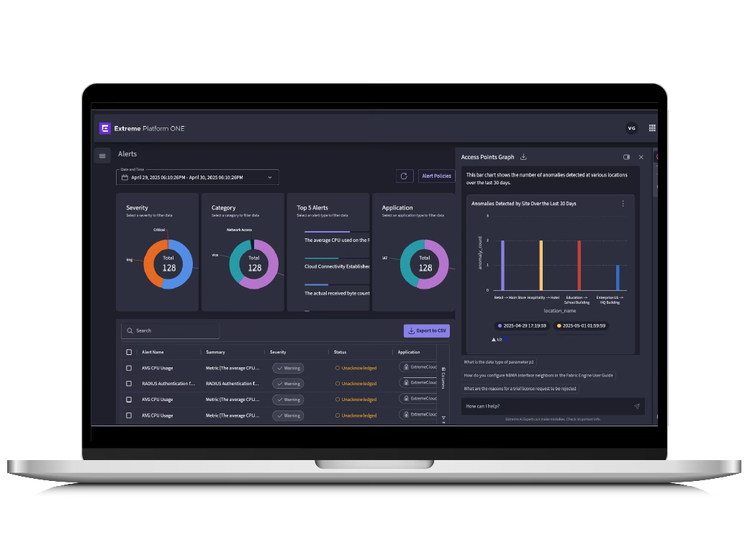
What’s new with Extreme Platform ONE, and how are capabilities like Extreme Zones driving customer adoption and creating opportunities for partners?
We announced Zones [in October], which is really important. Basically, what we’re able to do is localize data so we can keep our AI on-prem, and that’s important. It’s important to customers where data sovereignty matters. This is a big deal for European customers and becoming a bigger deal in the U.S., etc., from a regulatory perspective about where data resides. From a localization perspective, with Extreme Zones, for example, Kroger could decide, ‘We’re going to keep all the data in the store, or we’re going to keep it in a region,’ or however you decide, you create the Zone. There are cost savings because going out to the cloud and storing data in the cloud can be expensive, and then, in the event cloud goes down, from a survivability perspective, having localized operations matter.
We also announced Coworker and ambient AI—the idea that we have a proactive agent with always-on context, but the big difference from the first version to our second version, because we’re already on version two, is that it gives you a nudge. There’s this nudge feature that says, ‘Hey, we notice an issue. You need firmware upgrades in your network. Would you like me to do this for you? Here’s the suggested path.’ But it always brings context. It brings a lot of information. If there’s trouble in the network, it alerts you to trouble, and it brings you all the logs and the information you need. If you can’t solve the issue, you can just forward that to our GTAC [Global Technical Assistance Center], and they have all the information they need.
Literally, we have 10 times the engagement from version one, and our competitors are still at version one where you have an AI expert that you actually have to ask. We’re the first ones with a nudge, and that’s built into Platform One today. We’re seeing the adoption take off. We’re beating our plans. We had pretty aggressive plans, and we’re ahead. When launched [in July 2025], we had 10 percent [of our customers on Extreme Platform ONE]. We’ll have over 50 percent this year. In the following year, we’ll have over 80 percent of our customers. When we were moving people to cloud, we had 250,000 cloud licenses over the course of three years, and last quarter we had 290,000 migrations to Platform One. So, a quarter is like three years at this pace of change.
It’s pretty cool. People are so excited because all the technology that we’re building is being embraced by the market, and from a channel perspective, as we continue to move upmarket and as customers continue to embrace our platform, it just becomes a great way for partners to participate in this new technology wave that we’re in front of.

How does ambient AI change the conversation partners can have with customers and open the door to new use cases beyond networking?
Well, our partners are doing a lot more than networking and network management. They’re [also] having security conversations [and] broader conversations about how we can leverage AI, and this is what I would say we’re very excited about because with our Operator mode of Platform One that we’ve announced, we can start plugging in network data and start using network data in other applications beyond just network management.
I would say, ‘Hello partners. Here is a platform that gives you an opportunity to expand your dialogue and your relationship with your customers beyond just network management use cases, but to other use cases.’ And partners will be able to participate in the consumption of tokens, which for us are agent actions, but partners will be able to make money on the journey. So, it’s not just direct to Extreme, but partners participate. We’ve highlighted some of the use cases where you’ll see location data is really important in stadiums, for example. We’re working very closely with one of our large stadium partners in creating use cases sort of beyond the network, where people will want to effectively consume agent actions that involve the network.
Trust is still a major concern around AI. How can partners help customers become comfortable with greater automation while maintaining control and governance?
Everything is built for human control. You control your automation. I was quite surprised, but we have a large customer who [said], ‘Too many humans in the loop. I want less humans in the loop.’ I said, ‘Well, that’s great. You control that.’ The governance engine sits in Exchange [a marketplace and management platform from Extreme Networks], where you set the rules, you control your agents, you control agent actions, you control what they’re able to do, and you kind of set the boundaries. We’re putting the tools in the hands of customers, so they’ll move at their own pace. Some customers are going to want to move more slowly. They’re, let’s just say, less trusting. I already gave you one example of you get a nudge that says, ‘Hey, there’s three firmware upgrades required in your network, so should I do that?’ You might say, ‘Well, I might want to investigate a little further. Show me what you’ve got.’ Maybe you spend some time to review the evidence you collected, and then you say, ‘Well, OK, I’ll upgrade the firmware,’ and then maybe the next time you say, ‘OK, I’ll let you upgrade the firmware at such and such a time, but upgrade one access point. Let me see how this goes. All right, that went really well. Let’s do that again now, and now you can upgrade all the access points in the firmware.’
So now you’re an enterprise that’s no longer dealing with firmware upgrades, but you have a record of everything. If you want to go back and find out what’s happened, you have a complete audit trail of everything that’s gone on. In the beginning, you just got notified, I’m aware, and that was it. And then you [can take] the step to say, ‘Try one, and then maybe try all three,’ and then you take the step to, as these things come along, you allow it to upgrade, and at some point you have the confidence because of the performance to say, ‘All right, any firmware upgrades on my access points, upgrade them, but not my switches.’ There’s a lot of different examples of how tasks will come into play and will become automated. And we are 1,000 percent behind [customers and partners] that you’ve got to have all the tools built-in so that you can move at your own pace.

Do you believe we’re in a network refresh super cycle, as your industry peer and Cisco CEO Chuck Robbins has said, and what are you seeing that gives you confidence it will continue?
Yes. I don’t know if we’re the industry bellwether, but I would say yes. We completely agree. … What gives me confidence that this is going on and that this is continuing comes from all the opportunities that I see getting created every day that’s in our funnel, the growth of the funnel of opportunities, and at Extreme, the quality of the funnel in terms of how we convert and how we’re winning, [which is giving] me a ton of confidence.
I would tell you, if you were at Extreme Academy Live [earlier this month], you would feel the confidence of that group because when you have happy sellers and motivated sellers, you know things are going well, and that’s clearly the case at Extreme now. Obviously, everything we do spills through the channel and through our partner communities. So, the same is true for our partners.
What comes next for Extreme partners as AI becomes a bigger part of the enterprise network and traditional networking tasks become increasingly automated?
The next step for partners is going to be our enterprise stack, and it’s the ability to leverage the most modern technology, which is AI, and deliver that value to your customers. We’re [in the] early innings there, so that is the future, but we have a complete stack. We’re end to end in the enterprise network, and there’s more ways to win with Extreme within the network than any other vendor. [We’re] widening the aperture for partners to support their customers, and we’re out in front in our ability to support customers and partners on the journey.
I think for partners, more and more of the traditional networking tasks will be automated, and more and more our partners will become business partners with end users. From a competitive standpoint, if you just did a comparison of how Extreme stacks up to other players in the industry in terms of the percentage of the customers that are in their AI platform, we’re way out front. That customer adoption is actually quite helpful to us in in our development of the platform and of these new use cases.