HPE Showcases ‘Complete’ Secure Networking Portfolio At RSA With Juniper Firewalls, AI Upgrades
‘Right now, [partners] can sell every single thing related to security, network and storage. When we were HPE Aruba Networking, this is one area we did not have—we were not leading with a true firewall-focused business so this is really exciting for us, our customers and for our partners,’ Jeff Olson, director of SASE and security marketing at HPE, tells CRN ahead of RSA 2026.
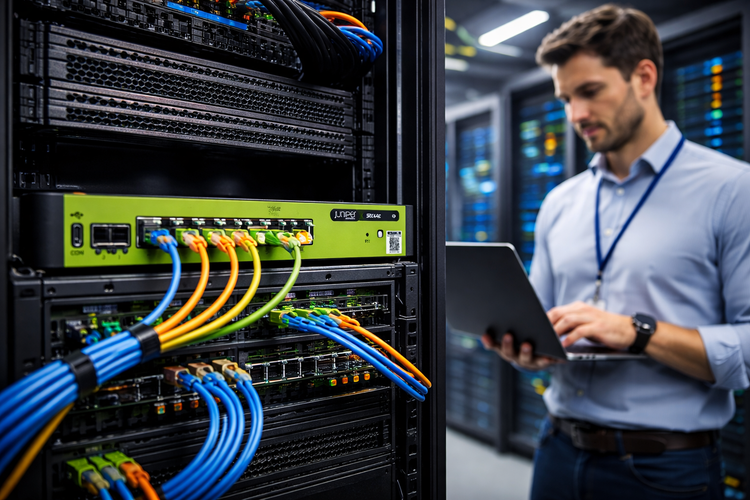
HPE took to RSA 2026 to show off the new entrant to its firewall series and tout its now “complete” secure networking portfolio with the addition of Juniper Networking technology.
“Partners now have a complete portfolio with HPE,” said Jeff Olson, director of SASE and security marketing at HPE. “Right now, they can sell every single thing related to security, network and storage. When we were HPE Aruba Networking, this is one area we did not have—we were not leading with a true firewall-focused business so this is really exciting for us, our customers and for our partners.”
Specifically, the company is expanding its security portfolio with the new HPE Juniper Networking SRX400 Series Firewalls, rolling out a broader hybrid mesh security architecture and AI-powered enhancements aimed at extending consistent protection from cloud, to core, to edge for enterprises, according to HPE.
[Related: HPE Aruba’s Retail Portfolio Is Now Infused With Juniper Mist For AI-Powered Networking]
The Juniper Networking SRX400 series, the smallest form factor yet for remote sites and space-constrained environments, gives these businesses the enterprise-grade security they need across their entire environment, complete with hardware-rooted protections that help defend against tampering and establish trusted device integrity, HPE said.
“It’s very, very powerful in that it has all of the carrier-grade capabilities that you would expect with the rest of our product line we have all the way up to the campus [and] large data centers, but in a small form factor that’s built for the branch, built for distributed enterprise,” Olson said. “It’s fanless. It’s very small and really built to extend our AI-driven capabilities all the way down to the branch.”
Also being expanded is the company’s hybrid mesh security architecture. The new enhancements will let businesses control and protect internal AI usage thanks to better visibility, access management and policy control across distributed environments, but without completely blocking emerging AI tools. The updates will let security teams carry out prompt-level inspection to filter keywords and manage file uploads to external AI tools, while still allowing productive access to approved applications. These new security features can be applied across all environments, including physical, containerized and virtual to follow the users and workloads, rather than just the device, HPE said.
“From the security ops perspective, you have one place to define your policy. With the hybrid mesh firewall architecture, you can manage that across your entire estate very easily and have the visibility you need,” Olson added.
Customers and channel partners can manage their secure AI environments via HPE Security Director, the company said.
The HPE Juniper Networking SRX400 series firewalls and the new AI governance features for the hybrid mesh firewall are available as of the second quarter of 2026, according to HPE.
HPE Signals More Juniper‑Fueled Innovation As It Expands Threat Labs
HPE also this month revealed that it is expanding HPE Threat Labs, which offers continuous cyber research and threat hunting, with the addition of networking telemetry and expertise to deliver real-time, AI-native threat insight, HPE said.
“This is really about us providing research-driven cyber threat intelligence that not only do we use internally in our products, but we’re giving back,” he said. “This is very much [us] participating in and sharing the latest threat intel that’s happened, things that we’re detecting and seeing [and] best practices. This is really exciting for us—we haven’t had a full threat lab in the past, and having this capability really benefits our customers, our partners and everyone using our products.”
As for the company’s continued road map with Juniper Networks’ technology now in the fold, “just give us even a little more time,” Olson said.
“We haven’t even gone a full year [since the Juniper acquisition],” he said. “Just wait until HPE Discover. You’re going to see a lot of innovation on all levels, not just security, at HPE in the coming months.”