Palo Alto Networks CEO: 5 Biggest Statements On $25B CyberArk Deal
The massive deal to acquire identity security powerhouse CyberArk would give Palo Alto Networks offerings in practically every major category in cybersecurity today, CEO Nikesh Arora says.
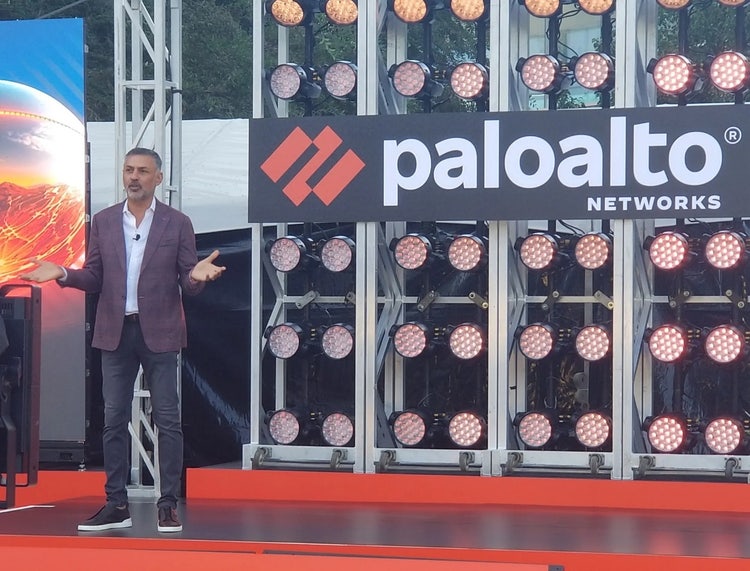
Palo Alto Networks is looking to accelerate its platformization push with its unprecedented $25 billion deal to acquire identity security vendor CyberArk, in a move that also aims to position the company at the center of providing security for agentic AI, according to Palo Alto Networks CEO Nikesh Arora.
The deal is expected to close during the second half of Palo Alto Networks’ fiscal 2026, which ends July 31, 2026, and represents Palo Alto Networks’ entry into the identity security category. CyberArk specializes in privileged access management as well as identity and access management, identity governance and other categories related to protecting identities.
[Related: Palo Alto Networks To Acquire CyberArk For $25B In Identity Security Push]
The cash and equity deal represents a 26-percent premium over CyberArk’s 10-day average share price prior to media reports posted about the negotiations Tuesday, according to a Palo Alto Networks news release.
“We feel confident that this is the right strategy for Palo Alto at this moment,” Arora said during a call with analysts Wednesday following the announcement of the deal. “This is the right answer for our customers from an industry perspective [and] in terms of we want to deliver, from a multi-platform, comprehensive security perspective.”
What follows are Arora’s five biggest statements on the Palo Alto Networks-CyberArk deal.
Platformization Opportunity
While Palo Alto Networks has deliberately avoided entering the identity security market previously, the vendor’s “platformization” push and the rising demand from customers and partners for a complete security platform has necessitated a move such as this, Arora said.
“We believe the platformization opportunity has to arrive in the identity space,” he said.
One major area for integrating CyberArk into the Palo Alto Networks platform is around Cortex XSIAM (extended security intelligence and automation management), Arora said. XSIAM is the vendor’s AI-powered alternative to traditional SIEM (security information and event management) and has seen surging growth for the vendor, executives have said.
Acquiring CyberArk would provide a “phenomenal playing field and opportunity” in terms of integrating the vendor’s technologies with Palo Alto Networks’ XSIAM system, Arora said.
The combination aims to enable “both of us to go address this space with a novel set of solutions, once this deal is closed — and actually finally solve the identity security market and deliver the much-needed platformization that is going to be required in this space,” he said.
Overall, upon the expected completion of the acquisition of CyberArk, Palo Alto Networks will have offerings in practically every major category in cybersecurity today, Arora said.
“That allows us to cover the majority of the [total addressable market] in cybersecurity,” he said.
Not A Space For Startup M&A
The acquisition deal that Palo Alto Networks has reached with publicly traded CyberArk also marks a major shift from the cybersecurity giant’s M&A strategy in the past, Arora said.
“There’s a fundamental difference [from] the way we’ve done acquisitions the past,” he said.
The vendor’s approach around most security categories in the past has been to expect emerging vendors to arrive and replace existing, legacy players, Arora said. That has fueled Palo Alto Networks’ string of at least 17 acquisitions over the past seven years, which have never before exceeded an $800 million price tag.
However, when it comes to identity security, “this is not going to be a new vendor space,” he said. “We believe the current players in identity have tremendous technology, have tremendous assets.”
Customers Want Established Players
Another key part of why Palo Alto Networks wanted to acquire an established player in the identity space is that customers are often reluctant to adopt emerging technologies when it comes to something as interconnected and mission-critical as identities, according to Arora.
“If you ask a customer, ‘Which part of the infrastructure are they comfortable overhauling and revamping?’ — they’re petrified of taking the identity infrastructure and replacing it. Because they don’t know what’s connected to what,” he said. “They don’t know what it’s going to shut down. They don’t know what’s going to stop working.”
Ultimately, within the identity security space, “it’s more than likely that an existing vendor who can deliver best-of-breed and world-class capabilities is going to have the opportunity to expand in their customer bases,” Arora said.
Protecting Agentic AI
Arora told analysts during the call Wednesday that CyberArk’s capabilities for protecting identities and privileges in the emerging world of AI agents is among the other key drivers behind the acquisition deal.
“CyberArk allows us the opportunity to go ahead and plant the flag in the future market of agentic AI,” Arora said.
CyberArk’s specialty around protecting machine identities—gained through its $1.54 billion acquisition of machine identity security vendor Venafi in 2024—has set up the company to become a top player in protecting the identities associated with AI agents, he said.
Through combining capabilities for privileged access management and machine identity security, “we believe that CyberArk is well-positioned to expand into the opportunity that is going to be presented by agentic AI,” Arora said.
A ‘Non-Contentious’ Combination
Analysts have suggested there is a low likelihood for substantial antitrust scrutiny of the deal, given the minimal overlap in the security categories served by Palo Alto Networks and CyberArk.
Indeed, the two companies are very complementary overall in terms of their offerings, Arora said during the call Wednesday.
CyberArk is “non-overlapping with our product portfolio. It is non-contentious,” he said. “So that’s not going to create stress in our system.”