10 Browser Security Vendors Making Moves In 2026
As the surging use of AI tools and agents brings greater risk to the browser, industry giants and fast-growing startups have been making a major browser security push this year.

Browser Risks Escalate
Amid the surging use of AI tools and agents around the workforce, massively heightened risk has come to the web browser for many businesses. Without a doubt, these accelerating browser-based risks represent a growing area of focus for many security teams, according to GuidePoint Security’s Gary Brickhouse.
For instance, many organizations are facing intensifying threats in 2026 involving plug-ins and malicious code executing within browsers, said Brickhouse, CISO at Herndon, Va.-based GuidePoint, No. 32 on CRN’s 2026 Solution Provider 500. Increasingly, “that’s an attack path. And if we’re not addressing that in our organization—or if I don’t have other controls to help mitigate that—we’re going to be in trouble,” Brickhouse said. “So we’ve got to put some prioritization around that aspect.”
[Related: Why Rogue AI Agents Are A Wake-Up Call For Security Teams: Experts]
In response to the escalating threats driven by AI and agents, industry stalwarts and fast-growing startups have been making a major browser security push this year. As part of CRN’s Cybersecurity Week 2026, we’ve pulled together details on 10 key browser security vendors that have unveiled major product updates, acquisitions in the space and funding rounds.
The big moves have come from prominent vendors including CrowdStrike and Zscaler, both of which unveiled major browser security acquisitions to expand their offerings in the segment in 2026, as well as Palo Alto Networks, which debuted an SMB-focused version of its secure browser this year. Meanwhile, other key browser security announcements have been unveiled in 2026 by industry giants such as Google and Microsoft and by venture-backed rising stars such as Cyera.
What follows are the details on 10 browser security vendors making moves in 2026.
Atakama
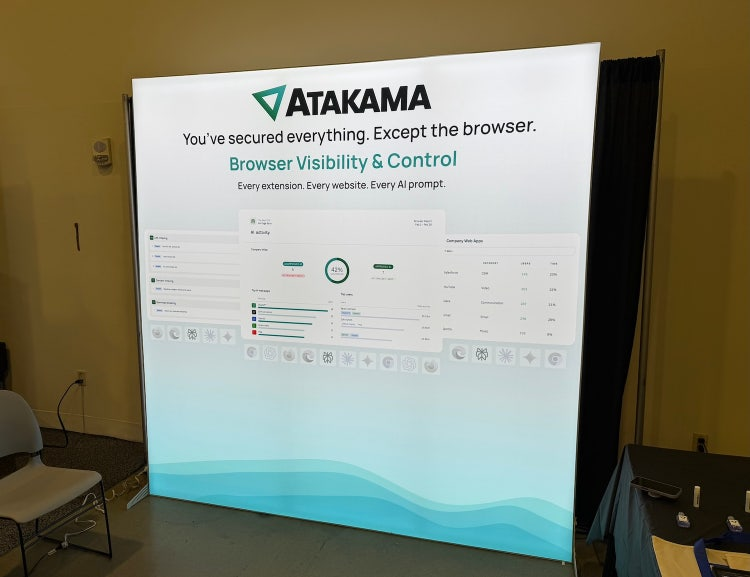
In 2026, Atakama has expanded its MSP-focused browser security platform through updates including a September release that added SaaS login controls. Earlier, in May, the New York-based company introduced controls that can block pasting into specified websites along with an AI controls wizard for configuring tenant policies.
Atakama’s browser security platform aims to address a major gap in endpoint protection, according to CRO Scott Glazer. “The browser running on the device is truly the new endpoint,” Glazer told CRN. “The gap that we solve for is, noting users spend 90-plus percent of their time in a web browser—that’s the same browser they use at home—and they have no visibility.” Atakama provides visibility around user activity, risk, undesired usage and non-business usage, Glazer told CRN. The same platform also offers remediation capabilities such as blocking websites through DNS as well as data loss prevention (DLP) through restricting uploads, downloads and clipboard actions, Glazer said.
CrowdStrike
In January, CrowdStrike unveiled its deal to acquire browser security technology startup Seraphic for $420 million in a move to expand browser protection as part of its strategy in 2026. The resulting Falcon Seraphic Enterprise Browser now offers support for browsers including Chrome, Edge, Safari, Firefox and agentic browsers.
Advanced browser protection is increasingly crucial, given that for many organizations, the browser has “become the new front door of the enterprise,” CrowdStrike Chief Business Officer Daniel Bernard told CRN. Previous approaches have often involved forcing employees to use a specific enterprise browser with built-in security or deploying a browser plugin, Bernard noted. With the addition of Seraphic, however, CrowdStrike’s offering means “you can use any browser you want, and turn any browser into a secure browser,” he said.
In September, meanwhile, the Austin, Texas-based company disclosed that it is combining enterprise browser security with expanded privileged access capabilities. The approach involves connecting users to resources—including SaaS and cloud, as well as on-premises—while only granting the permissions required for a particular task, according to CrowdStrike.
Cyera
In March, Cyera announced the launch of its new Browser Shield tool as part of a set of new capabilities for protecting AI adoption. The offering delivers real-time visibility and discovery for AI used within browsers—whether those tools are managed or unmanaged, Cyera said. Browser Shield also provides visibility into identities and connected accounts and ultimately provides “prompt-level alerting and blocking” that can prevent leakage of sensitive data and unethical AI usage, the company said in a news release.
In September, New York-based Cyera completed its $1 billion acquisition of Oasis Security, adding technology for protecting non-human identities to its data security portfolio. Also in September, Cyera announced raising $400 million in new funding, adding to the $600 million it raised in June at a $12 billion valuation.
In September, Google disclosed forthcoming updates to Chrome Enterprise Premium that will enable IT departments to deploy new rules for data loss prevention (DLP) as a way to prevent sensitive data from being copied to a device’s clipboard. The Mountain View, Calif.-based tech giant also unveiled updates to Chrome Enterprise’s reporting around GenAI that let administrators respond to risky usage from within the report itself. Options now available to administrators include preventing access to an application or redirecting employees toward an AI service their employer has approved, Google said.
The announcements followed an April update from Google that added information about the behavior of browser extensions to help security teams with investigating risky or suspicious AI activity. Those findings can be sent to Google Security Operations or another SIEM (Security Information and Event Management) tool, the company said.

Island
In September, enterprise browser vendor Island announced raising $400 million in new funding as part of its Series F round, which brought with it a $6.4 billion valuation. The funding—which was led by Evolution Equity Partners—is aimed at helping to enable the company’s expansion as customers adopt AI agents, Island said. The Dallas-based company also reported that it had reached 1,000 employees.
In terms of key product updates, the vendor announced its expanded Island Enterprise Platform in March that brings its security policies to more of the tools used by employees beyond its enterprise browser. Along with a browser extension, the platform also includes a tool for applying security policies to desktop applications, Island said.

Menlo Security
In March, Menlo Security unveiled its new Browser Security Platform with capabilities aimed at protecting employees and AI agents during interactions on the web. The platform includes the Menlo AI Agent Security, which is intended to prevent agents from treating malicious hidden text—such as concealed instructions in a document—as a valid request to change tasks or disclose information, the company said.
The Mountain View, Calif.-based company also unveiled universal connectivity capabilities aimed at helping agents to work with applications that lack adequate APIs, through preparing information from their web interfaces for an agent to utilize.
Microsoft
In March, Microsoft expanded protections for AI tools covered by its Purview inline protections, with newly added capabilities for inspecting prompts and file uploads—in real time—for sensitive information. The Redmond, Wash.-based tech giant also extended sensitivity-label enforcement to Outlook on the web, when accessed via Edge for Business.
In May, Microsoft unveiled new agentic browsing capabilities within Copilot as a way to enable Copilot users to navigate pages and enter information while also completing multistep tasks on approved sites. The goal, ultimately, is “helping users save time without turning to unsanctioned AI,” said Lindsay Kubasik, partner product manager for Microsoft Edge, in a blog post.
Netskope
In April, Netskope expanded support for mobile users of its Enterprise Browser, making the browser platform generally available for iOS and iPadOS. The Chromium-based browser enables secure browsing for web as well as SaaS, along with private access support and core security controls such as copy, paste and print prevention, the Santa Clara, Calif.-based company said.
Other 2026 updates have included the introduction of a connection between the Netskope Enterprise Browser and AI Gateway, which aims to provide security teams with greater control over employees’ interactions with LLMs, the company said.

Palo Alto Networks
In March, Palo Alto Networks announced the debut of an SMB-focused secure browser, the Prisma Browser for Business, providing a simplified way for small businesses to protect against browser-based threats. Such threats increasingly include risks related to AI application usage, Palo Alto Networks CEO Nikesh Arora said during a media briefing. “We think that part of the market is most susceptible” to threats and risks related to AI adoption in browsers, Arora said. Key capabilities offered by the browser include built-in protection against phishing, ransomware and fraud, the Santa Clara, Calif.-based company said. Additional data security controls prevent leakage or theft of data, the company said.
Palo Alto Networks also unveiled additions to its standard Prisma Browser in March, aimed at keeping AI agents from taking unauthorized actions or exposing company information.

Zscaler
In February, Zscaler announced the acquisition of browser security startup SquareX, which offered what the startup had called the industry’s first “browser detection and response” platform. Then in April, Zscaler announced a pair of additions to its Zero Trust Browser offering, including a dedicated browser for business use and an extension for browsers customers already have. The options complement the vendor’s cloud browser, which processes web activity outside a user’s device, Zscaler said.
In a news release, Zscaler founder and CEO Jay Chaudhry said that “legacy” VPN and VDI systems are “fundamentally flawed and laden with security risks”—creating a need for the type of zero -rust approach that Zscaler is looking to bring, both across its core platform and in the realm of browser security.