CrowdStrike SafeMind Gives Frontier AI To Defenders That Doesn’t Just Create ‘More Work:’ Partners
The new SafeMind agentic system, unveiled this week by CrowdStrike CEO George Kurtz, stands out by using frontier AI to help cyber defense teams with the relentless volume of new threats, top solution and service provider partners tell CRN.
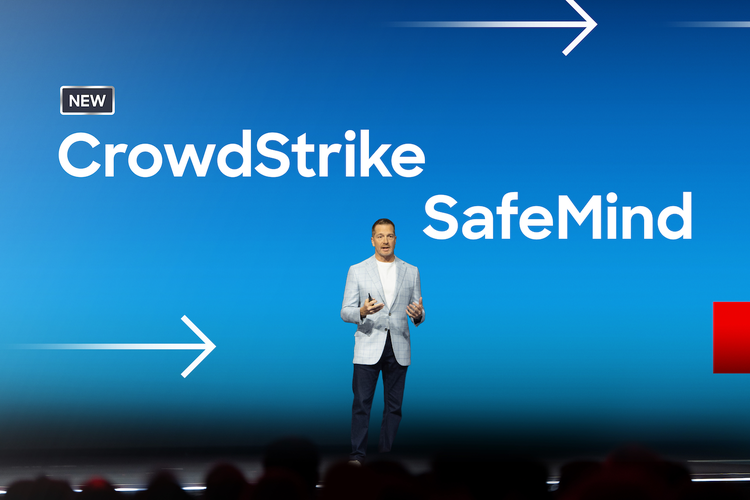
Following a massive wave of frontier AI advances this year that have largely served to make life more challenging for cyber defense teams, the launch of CrowdStrike’s new SafeMind agentic system represents a highly welcome shift toward using the technology to reduce the burden on defenders, top solution and service provider partners told CRN.
SafeMind—which was created through a collaboration with Nvidia—combines newly developed offensive and defensive AI models to bring a more autonomous way for cyber defense teams to protect against accelerating attacks powered by the same LLM technology, CrowdStrike co-founder and CEO George Kurtz (pictured) said while unveiling SafeMind this week.
[Related: George Kurtz’s 5 Boldest AI Statements At CrowdStrike Fal.Con 2026]
Frontier AI models such as Anthropic’s Claude Mythos and OpenAI’s GPT-5.5-Cyber have so far proven to be highly effective at discovering vulnerabilities and exploits. But the arrival of such capabilities has mostly left defenders with an even longer list of issues to investigate and fix, according to Bill Fryberger, principal and Americas cybersecurity advisory leader at EY, a major CrowdStrike partner.
By combining offensive and defensive frontier models in a continuous loop, however, CrowdStrike’s SafeMind system has the potential to move from simply identifying problems to enabling security analysts to actually remediate them, Fryberger said.
The bottom line is that SafeMind is “going to help the analyst,” he told CRN. “With everything that’s come out—especially from Mythos or [GPT] 5.5-Cyber—it’s just put more pressure on a defender.”
With SafeMind, on the other hand, “we actually get some tools that’ll help us—versus just giving us more work,” Fryberger said.
CrowdStrike’s SafeMind system—which was created using Nvidia’s Nemotron open models—combines new AI models for offensive security (Red Tempest) and defense (Blue Solano), while also incorporating specialized harnesses.
The SafeMind models work by continuously attacking and deploying protections within a digital replica of an organization’s environment, the company said. For security analysts and other defenders, the SafeMind system is targeted at helping with prioritizing findings, rapidly developing protections and making faster decisions.
SafeMind is ultimately the industry’s “first complete agentic system for cybersecurity, including the first frontier models [that are] purpose-built for defenders,” Kurtz said Tuesday during a keynote at CrowdStrike’s Fal.Con 2026 conference in Las Vegas.
During the recent autonomous compromise of AI model platform Hugging Face by rogue OpenAI frontier models, for instance, the fundamental lesson was that the agents that carried out the compromise utilized frontier AI—while the defenders didn’t, he said.
“That changes now,” Kurtz said during the keynote. “[CrowdStrike is] giving the power back to the defender. Adversaries have frontier capabilities. Now you do too.”
During a media roundtable at Fal.Con this week, Kurtz said the potential is also there for SafeMind to “elevate” the company beyond its role as a cybersecurity platform vendor.
“I think it takes the company in a whole different direction,” he said in response to a question from CRN. “Obviously, we’ve been one of the pioneers in security. But [with SafeMind] you now elevate CrowdStrike at a level which is frontier AI.”
SafeMind is slated to operate within the CrowdStrike Falcon platform, while access to stand-alone models and harnesses will also be provided to partners through CrowdStrike’s Project QuiltWorks frontier AI initiative, the company said.
The arrival of models trained specifically for cyber defense could make a massive difference for Security Operations Center (SOC) analyst teams, which have been struggling to keep up with a relentless volume of new threats and vulnerabilities—and the issue has been widely predicted to only worsen going forward, EY’s Fryberger said.
“It’s not to say that [existing tools] don’t work. It’s about the people,” he said. “You’re not going to replace the human at the end—but you can make it a little easier. You can make the decision faster.”
Many security analysts are already overextended based on their existing workloads, according to Fryberger. “Seriously, they’re tired. They can’t keep up with the patching. They can’t keep up with the vulnerabilities that are there,” he said.
‘An Advantage We Didn’t Have Before’
From what has been disclosed so far about CrowdStrike SafeMind, its ability to feed findings discovered by offensive models directly into defensive operations appears to be a major advancement, according to Jordan Hildebrand, global cyber practice director at St. Louis-based World Wide Technology, No. 10 on CRN’s Solution Provider 500 for 2026.
“Finally, we’re leveraging offensive operations to feed the defenders, the defense operations,” Hildebrand said.
In truth, “I think that is what’s supposed to happen in a perfect organization. You have threat hunting, which feeds detections. You have the red team, which feeds the blue team,” he told CRN. “That’s what’s supposed to happen. And if we can do that—in a machine-speed sense—I think it puts us at an advantage that we didn’t have before.”
There’s also no question that SafeMind could improve quality of life for SOC analysts by reducing some of the major burdens traditionally involved in the job, such as manually building and validating detections, Hildebrand said.
“All of a sudden, you’re building detections from what was found from the red team,” he said. “And if you’re doing that at machine speed, it takes a burden off—and we can focus on other work.”
Crucially, SafeMind’s approach of utilizing a digital-twin architecture could be highly valuable, since it could enable exploit paths to be validated without taking these types of risks in a live, real-world IT environment, according to Chris Ebley, CTO at Annapolis, Md.-based Blackwood, No. 96 on CRN’s 2026 Solution Provider 500.
With SafeMind, “they’re taking 100 percent of telemetry that CrowdStrike knows about to be able to create a simulated environment to prove things out—which is really nice,” Ebley said. “Because candidly, there is real risk if you’re going to leverage [live environments] to prove out that an exploit chain exists by actually going through the exploit chains.”
CrowdStrike can thus deploy its deep knowledge and data about customers—spanning identities, directory systems, endpoints, configurations, software and vulnerabilities—to reproduce the relevant conditions, he noted.
“We already know all this, so we don’t have to do it for real,” Ebley said.
Partner Services Opportunity
For solution and service provider partners of CrowdStrike, SafeMind also appears positioned to generate services opportunities, according to Joseph Lentine, director of security partners at Somerset, N.J.-based SHI, No. 12 on CRN’s Solution Provider 500 for 2026.
Those service opportunities could include helping customers to adopt SafeMind and interpret its findings, as well as enabling actions taken on SafeMind’s recommendations, Lentine said.
“We know there’s going to be customer interest. [So it] is definitely something we have interest in—because we know there’s going to be some sort of services drag there,” he said.
Kurtz said during the media roundtable that while the frontier AI labs have clearly excelled at producing general-purpose models, SafeMind represents a huge step forward in making frontier AI relevant to cyber defense.
“[The frontier labs] are doing great stuff,” he said in response to a question from CRN. “But to apply that same science into security—that takes the company up [to a new level]. Nobody’s doing that. And I think it opens up just tremendous opportunities.”
Without a doubt, CrowdStrike will continue working with frontier labs such as Anthropic and OpenAI, as well as continuing to support open-source models, Kurtz noted. Enabling customer choice when it comes to AI models is a core goal, he said.
“Ultimately, if the customer gets the right outcome at the lowest cost—if they’re using our model, someone else’s model or a composition of those—fantastic,” Kurtz said. “But it’s a much broader monetization opportunity. When you’re in the token flow, that’s a different trajectory [for a company].”
Achieving improved security outcomes at a lower cost is another potential advantage with SafeMind, CrowdStrike partners told CRN. Frontier cyber models such as Mythos and GPT-5.5-Cyber have been singled out as particularly expensive by security experts in recent months.
On the other hand, by combining Nvidia’s Nemotron open models with CrowdStrike’s specialized training and agent harnesses, SafeMind appears poised to make frontier AI available for cybersecurity at a lower cost than the proprietary models, partners said.
“At the end of the day, for any of this to be sustainable, the use of open models—the use of non-premium frontier models for costing purposes—is huge,” Blackwood’s Ebley said.
Along with the potential business and cost-saving opportunities, SafeMind’s quality-of-life impact for cyber defense teams could be among its biggest legacies, according to CrowdStrike partners.
Within the SOC, “there's a ton of stress from a responder position. It’s been getting worse and worse,” EY’s Fryberger said. “So you get more burnout, you get more frustration. We have to do something to get better.”