Palo Alto Networks Execs: Platformization Is The Key In Frontier AI Shift
The coming acceleration in cyberthreats from AI and agentic technologies is creating a massive need for a fast-moving, tightly integrated platform in security—exactly what Palo Alto Networks is offering in a comprehensive fashion, according a top Palo Alto Networks partner.
The emergence of powerful frontier AI models that are adept at vulnerability discovery and exploitation is giving another massive boost to platformization in cybersecurity, with many organizations realizing they need a security platform that can move just as quickly as AI-powered threats, according to Palo Alto Networks executives.
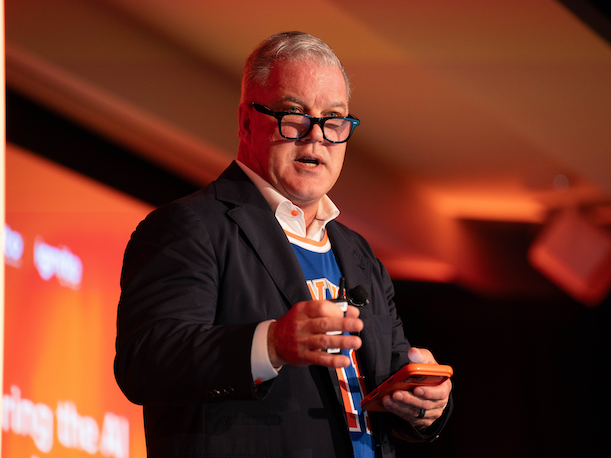
Speaking at the cybersecurity giant’s Ignite on Tour event in New York Wednesday, executives including Dan Campbell (pictured), president for North America sales at Palo Alto Networks, told partners and customers that the vendor has spent years preparing for the type of challenges posed by rapid discovery of software flaws by AI-enabled threat actors.
[Related: Palo Alto Networks CTO Lee Klarich: ‘Still Optimistic’ AI Will Help Defenders More Than Attackers]
There’s no question that the coming acceleration in AI-powered cyberthreats is creating a huge need for a fast-moving, tightly integrated platform in security——exactly what Palo Alto Networks is offering in a comprehensive fashion, according to Optiv’s John Hurley.
“Their focus is around speed and being able to solve bigger customer challenges—because they have a tighter ecosystem based on the pieces they’re putting together,” said Hurley, CRO at Denver-based Optiv, a top Palo Alto Networks partner and No. 28 on CRN’s 2025 Solution Provider 500. “They’re trying to get ahead of [the threats]. And I think they’re doing all the right things to do that.”
Hurley pointed to recent moves by Palo Alto Networks such as the launch earlier this month of an expanded set of identity security capabilities, in connection with the unveiling of a new name for its identity security offering, Idira. The Idira offering is based on the company’s $25 billion acquisition of CyberArk that was completed in February.
Idira is just one example where Palo Alto Networks is seeking to break down siloes between cybersecurity tools in a way that can substantially improve security outcomes for partners and customers, Palo Alto Networks executives said Wednesday.
“That’s the only way that we’re going to be able to stay ahead of things that are happening at machine speed,” Campbell said during the Ignite on Tour event in New York. “The platformization concept is simply that we’ve done all the integration around [different tools].”
This is pivotal amid disclosures about proficiency of frontier AI models for vulnerability discovery, he said, which include Anthropic’s unreleased Claude Mythos Preview model and Opus 4.7 model, as well as OpenAI’s GPT 5.5.
While both Anthropic and OpenAI have shown a commitment to preventing their models from misuse, the existence of the models suggests threat actors are likely to soon find a way to utilize similar capabilities, security experts have told CRN.
‘You’re Not Going Fast Enough’
As an original participant in Anthropic’s selective Project Glasswing initiative, Palo Alto Networks has had a rare level of access to the Claude Mythos Preview model, Campbell noted. The company has utilized Mythos and other frontier models, including from OpenAI, to scan code in its own products—with the result that the company disclosed 26 CVEs (Common Vulnerabilities and Exposures) on May 13.
That’s in comparison to the typical release of five or fewer CVEs in its products for its monthly release of security updates, the company has said.
The big takeaway from those stunning findings, according to Campbell, is that everyone needs to be moving faster to secure their systems.
“However fast you’re going to secure your environment, relative to AI models and agentic [technologies]—I promise you, you’re not going fast enough,” he said.
However, being able to rapidly detect and respond to threats—across the wide variety of tools and IT environments used today—is exactly what Palo Alto Networks has been driving with its platformization push in recent years, Campbell said.
And because frontier AI models excel at stitching together vulnerabilities and exploits in novel ways, the speed of detection and response based on whether their systems are well-integrated will to a large degree determine the organization’s cyber resilience, he said.
To make all of that possible, “we’ve done that integration for you,” Campbell said.
‘Preparing For This Moment’
Even with all of the anxiety around the potential impact of AI on the threat landscape, there are good reasons to be confident that a strong cybersecurity posture is still possible—particularly if your organization has embraced platformization, according to Thomas O’Brien, president for strategics East at Palo Alto Networks.
“The good news is, everyone in this room has been preparing for this moment,” O’Brien said. “The frontier models, the evolution of Mythos, has changed the risk that we’re all being faced with.”
And yet, while the change in cyber risk from frontier AI is unprecedented, “I’m optimistic—because we’re ready. We’ve been preparing,” he said. “We’ve been preparing. There’s 21,000 employees of Palo Alto Networks who are going to help us together get through the challenges we’re going to face in the coming months.”
Ultimately, “everything we’ve been doing to prepare for this moment today—building platforms [and] resilience, building zero-trust architectures—are going to help us get through this frontier model moment,” O’Brien said.
Crucially, Palo Alto Networks is deeply committed to work with its solution and service provider partners around meeting the growing customer needs from AI-supercharged threats, according to Anar Desai, vice president for North America channel sales at Palo Alto Networks.
The cybersecurity vendor is working with partners on a daily basis to “mobilize” around improving the security readiness of end customers, Desai said in an interview with CRN.
The major question, he said, is often, “‘What is the impact of needing to build a defense system that operates at machine speed, not human speed?’”
As a result of this unique moment in the market, for both vendors and partners, “the role is going to change—and it’s going to evolve based on the dynamics of what our customers need,” Desai said. “There’s going to be a shared learning [between vendors and partners] as it’s all evolving.”
‘A Great Partnership’
Without a doubt, the notion of adopting a centralized security platform as an antidote for the increased risk from AI-driven threats is strongly resonating with customers, Optiv’s Hurley said.
“From our perspective, we love it—because we can take that whole platformization story, and because we have a very strong bench of service capability, that really puts us in a really enviable position in comparison to our competitors,” he told CRN.
All in all, the arrival of the AI era of security is only serving as the next chapter in Optiv’s history of teaming with Palo Alto Networks, and giving even more reasons to collaborate closely for the benefit of customers’ security, Hurley said.
“Together we have done a really nice job of designing, deploying and really successfully implementing Palo [Alto Networks] architectures,” he said. “We’re all-in. It’s a great partnership.”