Cloudera Leverages Tech Partnerships, Acquisitions To Expand Its Data/AI Platform
Cloudera’s technology ecosystem, including recently announced alliances with Dell Technologies and ServiceNow, are key to the company’s goal of positioning its platform as an “enterprise intelligence center” for data and AI operations.
Data management and AI platform provider Cloudera is expanding its “enterprise AI ecosystem,” striking strategic alliances with ServiceNow and a trio of startups in a bid to develop complete, production-ready AI systems for partners and customers.
Cloudera also has integrated its software with Dell Technologies’ Dell ObjectScale object storage system to create the Cloudera Private AI platform, a jointly developed “AI-in-a-box” that provides quick access to data for AI tasks.
And Cloudera has updated its flagship Cloudera flagship platform with new capabilities, including Cloudera Iceberg REST Catalog and Cloudera Lakehouse Optimizer, and leveraging technologies the company obtained through several acquisitions.
[Related: The AI Data Problem: Bridging The ‘AI Activation Gap’]
All this comes as Cloudera looks to position itself as a solution to how businesses and organizations can overcome the problems of complex data architectures, siloed data platforms and inconsistent data governance that are hindering AI initiatives.
“Leaders across every major industry use Cloudera as their data platform to power AI projects that help them use their data to run their businesses better,” Cloudera CEO Charles Sansbury said last week in opening the Cloudera Evolve 25 event in New York City.
Sansbury, who took over as CEO in August 2023, noted that Cloudera has more than 25 exabytes of data under its management, making it a major player in managing and providing data for AI applications, agents and other AI tasks.
“What we’re seeing across telecommunications, financial services, public sector, manufacturing, is a massive uptake [among] business users and their use of data and their use of AI,” Sansbury said. “And in fact, as many of you know, the business users are moving faster than IT is able to keep up and it’s important that all of us recognize that dynamic.” He added that “the opportunity for AI is massive,” but “the complexity of data is probably greater than most customers realized initially.”
Cloudera positions itself as “the hybrid data company” with a platform that’s better architected than competitors to provision AI workloads with data that’s spread across multiple public and private cloud systems.
“Where data and where workloads will end up is going to be across multiple computing platforms,” the CEO said. “Hybrid is now emerging as the end-state architecture of choice for most large organizations,” which he said are building the technology foundations to manage data and AI “across multiple computing environments.”
Frank O’Dowd, Cloudera chief revenue officer, said at the Cloudera Evolve25 event that more than 250 customers are using Cloudera for AI projects, and he expects that to double over the next 12 months.
Technology Partners Spur Cloudera Platform Expansion
To achieve its goals Cloudera is putting a great deal of emphasis on leveraging its technology partnerships to help provide complete, production-ready AI solutions built on the Cloudera lakehouse platform.
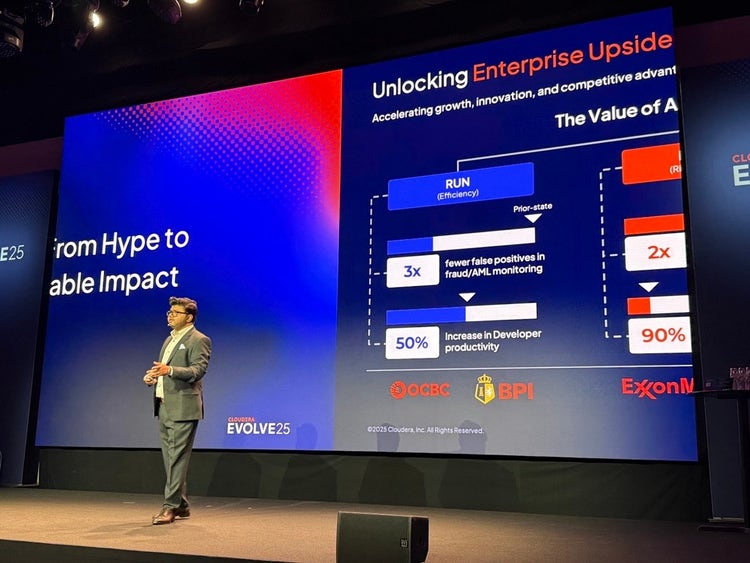
“We’re only as good as our ecosystem and we take pride in that in a lot of ways,” said Abhas Ricky (pictured at Evolve25), Cloudera chief strategy officer, in providing a roadmap of the company’s technology strategy.
Cloudera is in the process of integrating its AI-powered lakehouse with ServiceNow’s Workflow Data Fabric zero copy connector, a move that Cloudera said will allow customers to access real-time enterprise without duplication across IT, human resource, finance, customer service and compliance systems. That will provide predictive insights that can be fed back into ServiceNow workflows to prioritize tasks, automate approvals, proactively resolve issues and streamline operations, according to Cloudera.
Cloudera also has linked its lakehouse platform to prediction engine software developed by startup Fundamental.ai, a move Cloudera says will allow customers to rapidly deploy predictive models within their governed Cloudera environment for use with structured enterprise data. The vendor also has integrated its lakehouse with a document processing engine from startup Pulse that makes it possible to bring unstructured data into the Cloudera environment. And a new link to AI observability tools from startup Galileo.ai provides visibility into AI-driven workflows built on Cloudera.
The overall goal, Ricky said, is to achieve “intelligent autonomy” with the Cloudera platform by allowing AI agents to utilize knowledge hubs, under unified governance rules, to create what he called an “enterprise intelligence center.”
“The Enterprise AI Ecosystem has become a cornerstone of our strategy to help large enterprises navigate the complexities of AI adoption,” Ricky said. “Our newest partners bring specialized capabilities that directly address the biggest challenges our customers face today: operationalizing AI and agentic workflows at scale with ServiceNow, ensuring transparency, reliability, and accuracy with Galileo.ai and Pulse, and unlocking the next generation of AI on structured data with Fundamental.”
Cloudera-Dell Alliance
The Private AI platform, the fruits of the Cloudera-Dell alliance, simplifies the process of locating and accessing structured and unstructured data for AI tasks, delivering scalability and economic benefits, according to the two companies.
The Cloudera-Dell ObjectScale link provides a “fully validated and integrated data platform” that makes it possible to organize data with clear rules, security and governance, and run all of Cloudera’s compute engines directly against Dell ObjectScale storage, Cloudera said in the alliance announcement.
The integration allows Cloudera users to leverage Dell ObjectScale storage as an S3-compatible object store for AI workloads such as the Cloudera AI Workbench, Cloudera Inference Service and Cloudera Agent Studio. It resolves the challenges of moving data, simplifies managing AI tasks, and helps deploy AI agents with more trust and efficiency, according to the companies.
All these new alliances come as Cloudera continues to expand the capabilities of its platform—through both internal development and acquisitions.
Cloudera, for example, has integrated the Iceberg REST Catalog, an industry standard API specification, across its data and AI platform. That allows third-party systems to access Cloudera-managed data directly without the need to copy or move it, enabling data sharing while maintaining data governance policies.
At the Evolve25 event Cloudera debuted Cloudera Lakehouse Optimizer, a new intelligent service that provides automated optimizations and table maintenance capabilities for Apache Iceberg tables within the Cloudera Lakehouse. The vendor said Lakehouse Optimizer eliminates the need for manual data management tasks and lowers operational costs.
Key to Cloudera’s unified data governance strategy is incorporating into its platform the data lineage and metadata management technology the company acquired when it bought Israel-based Octopai in November 2024. (Cloudera also has incorporated into its platform operational AI technology, acquired from Verta.ai in June 2024, used to accelerate GenAI application development.)
And at Evolve25 Cloudera played up the importance of its August acquisition of Taikun, a developer of technology for managing native Kubernetes and cloud infrastructure across hybrid and multi-cloud environments. With the Taikun tech, Cloudera executives said, the company can accelerate the deployment and delivery of the complete Cloudera platform, including data services and AI, across public clouds and on-premises data centers.
Cloudera’s channel operations, meanwhile, are under the management of Michelle Hoover, a three-year Cloudera manager who was promoted to senior vice president, global alliances and channels, one year ago.
In an interview with CRN at Evolve25, Hoover said Cloudera is transitioning into a partner-first organization with the VARs, ISVs and regional systems integrators it works with. “I believe we have an incredible opportunity for our [channel] ecosystem,” she said. The company has increased partner funding by a factor of three in recent years and is building out an AI certification program for partners.
Currently about two-thirds of Cloudera’s business is impacted by the channel with about 90 percent of new business involving the channel in some way (and about 25 percent of that sourced by the channel), according to Hoover. She said the company is now identifying partners that want to go “very deep” in their partnership with Cloudera.