Hammerspace CEO On Its New AI Data Platform For Nvidia AI Environments
‘We don’t accept that data gravity is a necessity. We can eliminate data gravity. We can allow data to transcend these silos through orchestration and a single global namespace,’ says Hammerspace co-founder and CEO David Flynn.

Hammerspace is looking to grow its presence with channel partners and customers that need to prepare data for use with AI inference applications. The company, whose name comes from the ability of cartoon characters to pull a hammer or anything else out of thin air, is very much focused on making data available from anywhere as it’s needed for AI, said co-founder and CEO David Flynn.
Flynn, in an exclusive interview with CRN, discussed Hammerspace’s expanded relationship with Nvidia, including Monday’s news about the Hammerspace AI Data Platform based on Nvidia’s new AI Data Platform reference architecture.
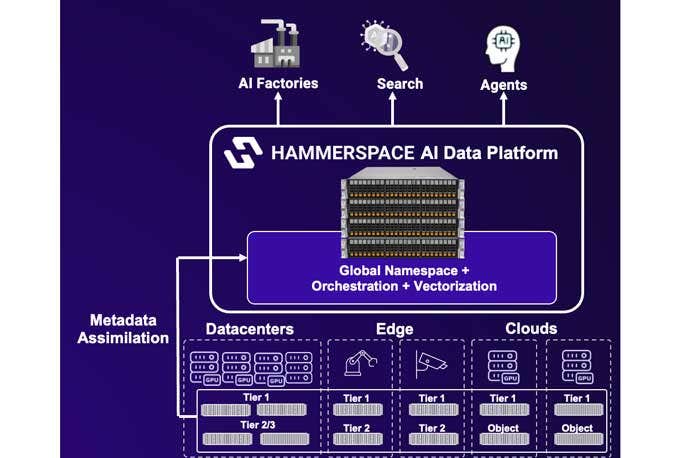
“Hammerspace is able to unify data across all the disparate systems within an environment and bring it into a single logical name place, allowing the data to be moved to different data centers and presented uniformly,” he said. “That data can then be processed through a vector database, preconditioned, and available to be used at an AI level with inference.”
[Related: The 50 Coolest Software-Defined Storage Vendors: The 2025 Storage 100]
The news about the Hammerspace AI Data Platform caps a busy few weeks for the Redwood City, Calif.-based company. Hammerspace recently said that SK Squared, a Korean investment firm related to memory and SSD powerhouse SK Hynix, made a strategic investment in the company.
Hammerspace also unveiled a new partnership with Secuvy that Flynn said dovetails nicely with the Hammerspace AI Data Platform news.
“Secuvy looks for data that needs to be governed like financial data, things like that, within the PDF content,” he said. “We’re tightly integrated with them so that we can be sure once you put our AI Data Platform into place, you can use the correct data with the correct models in the correct places and manage your enterprise data security and AI security properly.”
Here is more of CRN’s conversation with Flynn.
Define Hammerspace.
Hammerspace in pop culture is that alternate universe where you can pull things out of thin air. That’s where things are. And the term has actually started to be used in and around superhero comics. “Spider-Man: Into The Spider-Verse” used it. We use the concept to represent data that exists independent of the infrastructure storing it and is available anywhere. So it solves three very important needs. No. 1 is high-performance delivery of data into systems, especially GPUs that are very expensive and you don’t want them sitting idle. The second is the safe, long-term retention of data over time, which has become even more important as we start generating more and more data. And AI can make value out of anything, so we have to remember everything, and it generates a lot of data. The third is decentralized operation. With Hammerspace, you have all of your data available within any data center with rapid local access without ever having copied it. That’s why this seems magical. How can you have data in multiple places without ever having copied it? For Hammerspace, it’s the same data. It’s the same namespace. You don’t see the fact that it’s moving around behind the scenes, but you get the full performance of local access, and you’ve never had to copy it. It’s just the same file in the same place.
So Hammerspace is a magical place. Lots of stuff that is instantly accessible. In many ways, this is the antithesis of storage. It’s the virtualizer of data across your storage.
Hammerspace has some news at Nvidia GTC. What’s happening there?
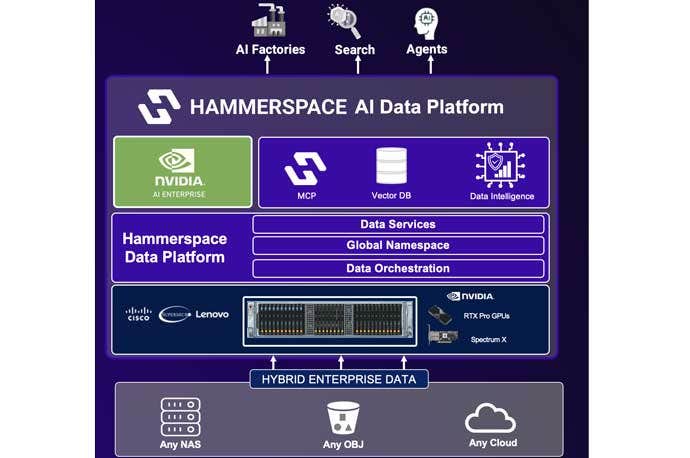
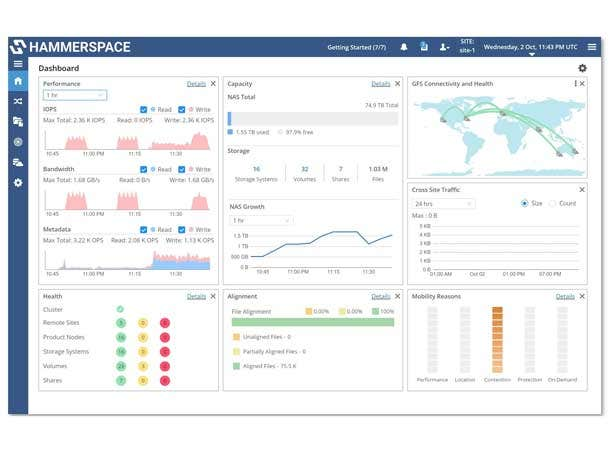
We are announcing our AI Data Platform. The AI Data Platform incorporates the technology necessary for preconditioning and inference of data in the environment. Hammerspace is able to unify data across all the disparate systems within an environment and bring it into a single logical namespace, allowing the data to be moved to different data centers and presented uniformly. That data can then be processed through a vector database, preconditioned, and available to be used at an AI level with inference. That’s in one direction. In the other direction, it also includes the MCP [Model Context Protocol] interfaces so that AI can be put in charge of the orchestration of data. Let me try to explain. In a physically decentralized world, AI is forcing us to be decentralized. Because of the power requirements for AI, you can only put so much in one location. So neoclouds tend to be much more fractured, much more physically distributed geographically. So with Hammerspace, we can orchestrate your data and present it in this decentralized fashion. And via our MCP interface, you can have the AI itself control how the data is laid out in that decentralized environment. This is a game- changer. Not only is it incorporating the stuff for doing the AI inference with the data in the environment, but it can also empower the system to automate the movement of data across geographies to have the data present where you need it.
Given that Nvidia likes to make announcements with several of its partners, this time centered on its new AI Data Platform reference architecture, several storage companies will also likely unveil something similar to your AI Data Platform. What’s different about Hammerspace’s offering?
Nvidia is going to announce lots of partners. The reason for this initiative, in their own words, is to deal with the reality that data has gravity, and data exists in different storage silos. Therefore, you need to put the GPUs and the processing close to the data. So in an effort to make AI more accessible to data which is fragmented and siloed, you push the GPUs and the AI processing down into the storage layer.
So you’re going to see a bunch of storage vendors who are incorporating this technology and building data platforms. Hammerspace is different. We don’t accept that data gravity is a necessity. We can eliminate data gravity. We can allow data to transcend these silos through orchestration and a single global namespace. So yes, you’re going to see a lot of other vendors talking about AI Data Platforms, and they’re going to be putting GPUs down inside their system. Hammerspace is unique because we reach inside of any system and bring the data to where it can be effectively processed.
So you’re saying no other storage vendors do that?
Other storage vendors do not move data across other storage vendors. They are silos. They only work with their own stuff.
When will Hammerspace’s AI Data Platform be available?
We have the Hammerspace Data Platform, which is the technology you’ve been familiar with. The AI Data Platform is a hardware-based, integrated solution that includes Nvidia enterprise and RTX GPUs. It’s announced Monday and is generally available immediately.
Hammerspace is a channel-only vendor. What is your company doing to get your partners ready for your new AI Data Platform?
This is very much channel-led. We are working with SHI and others who are at the forefront of building out AI systems. The truth is, these guys have a lot of in-house skills around it and, to a large degree, the AI Data Platform from Hammerspace. The adoption of the Hammerspace Data Platform to incorporate this AI functionality has been a natural kind of progression of what we’ve already been doing with these channel partners that are AI savvy.
Any new training or certification that channel partners will need to work with Hammerspace AI Data Platform?
We are releasing a new certification program through our Partnerspace channel program. I wouldn’t necessarily say it’s required. It’s more of an enabler. We have a lot of global partners very interested. In APAC, [partners are looking at] how would this be released on the appropriate Chinese hardware, things like that. So it’s more around enabling them and helping them to get going quickly [rather] than a requirement of the program. But yes, there are certifications.
Hammerspace recently had a new round of investment. What’s going on with that?
The announcement in [February] with SK Squared was part of the $100 million investment round that we did last year led by Altimeter Capital. [Altimeter Capital founder and CEO] Brad Gerstner has quite a name in and around the world of AI. His firm led the investment in Hammerspace. They were kind enough to let us leave part of that round open so that we could bring in some strategic partners, and so SK is really a continuation of that same financing.
SK Squared is related to Korean memory manufacturer SK Hynix. What does this strategic investment mean for Hammerspace? Is it a closer partnership between the companies? What’s the relationship with SK Hynix overall?
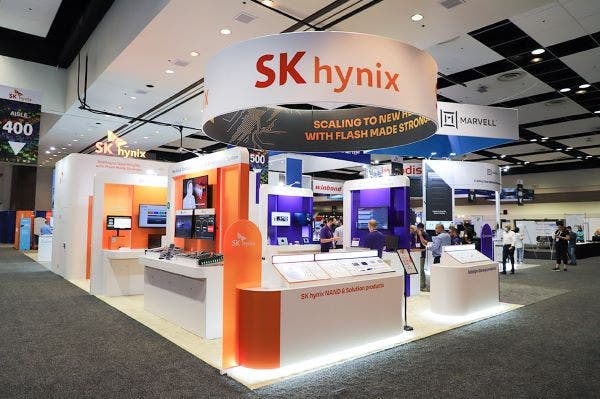
It’s a threefold thing. The first is the investment. The second is, SK is a substantial player in the solid-state world, building SSDs on the supply side. And then SK is a huge conglomerate that has massive initiatives around AI and neocloud services and so forth and is a client of Hammerspace. So we use their stuff, their flash devices, and they are increasingly using our product within their environment. And the investment just naturally makes sense.
Was there a value given to the investment from SK?
Not independent of the round that was previously done.
Speaking about SSDs, how is the situation for Hammerspace in terms of getting memory and SSD supplies?
This is huge. The SSD crisis has drawn a point on the fact that with Hammerspace, you can use your existing storage. We are not a storage vendor who’s saying, ‘Hey, you need to replace that old storage with our shiny new one because our new one is AI- capable.’ We’re saying, with Hammerspace, we can accelerate the performance of your existing storage, and we can make it more flexible by having that data available anywhere. It’s a game-changer that we’re not asking for a forklift storage upgrade. We’re saying, ‘Use what you come with.’ Second, with Hammerspace, you can use the flash inside of GPU servers themselves. We talk about that as tier-zero. It’s a game- changer. Third, with Hammerspace, you can use off-site storage. You can burst. You can have the bulk of your data stored in the cloud like Amazon S3 because we’re in the business of moving data transparently and giving the appearance of having your data immediately wherever you need it. Putting the bulk of that which is not currently being accessed off-site is very powerful. We can use off-site systems much more effectively. Fourth ... Hammerspace can use hybrid systems and can incorporate hard drives very effectively. Because we’re in the orchestration business, we can move data up and down tiers, and on- and off-site very effectively. So hybrid systems, disk-based systems, are a natural part of what we do. Fifth, which I think is really killer, because we unify data globally, we can also dedupe it globally. Global copy reduction. [Others] talk a lot about their data reduction technology, the ability to compress and dedupe the data and all of that. That’s grand, but it’s stuck in one system in one data center. The bulk of our copying is to get data in and across different data centers. And Hammerspace allows you to do the data reduction, copy reduction at a global scale that’s unprecedented.
Why is that a big deal?
It really points to concerns that you don’t need to do a forklift and implement an all-flash array. Both of those things are stupid in the current environment. To go and implement a fresh new system and to start immediately by copying everything you have out of the old into the new, that’s just yet another copy. So telling a customer, ‘Oh, you’ve got a challenge with storage capacity, so let’s start by making yet another copy of everything to move it out of your old system into this new one,’ makes no sense. And when that new system is a one-size-fits-all all-flash array, well, we’re starting to see where that breaks down as flash starts to become a premium because there’s not enough to go around. Wouldn’t it be nice to use hard drives or off-site storage? And it would be nice to be reducing copies, not making more of them.
So the Hammerspace technology itself does not use internal SSDs?
Sure, for metadata, but that’s a tiny fraction of the space. And our stuff can be deployed as a software-defined layer that runs on cloud infrastructure, so we can run wherever you already have your GPUs.
How about the supply of SSDs for Hammerspace then?
Well, this is where relationships like with SK and Samsung are handy.
Is Samsung also an investor in Hammerspace?
No. But last year we submitted IO500 benchmark numbers using Hammerspace and Samsung. Samsung was showing off the class-leading performance of its SSDs using the Hammerspace technology.
Hammerspace also recently unveiled a partnership with Secuvy. What’s the deal there?
Secuvy is a data intelligence platform. When it comes to how inference works, enterprises have a big challenge: How do I govern and secure and know the data that’s made it into my AI strategies is good? Secuvy looks for data that needs to be governed like financial data, things like that, within the PDF content. We’re tightly integrated with them so that we can be sure once you put our AI Data Platform into place, you can use the correct data with the correct models in the correct places and manage your enterprise data security and AI security properly.