Veeam CEO: We Have Defined A Missing ‘Data AI Trust Layer’
‘That is a layer which needs to bring together data security, privacy, compliance, governance and resilience in one substrate. Not a patchwork of applications or partnerships, but a unified fabric of data operating as a platform with a unified console working in tandem,’ Veeam CEO Anand Eswaran tells CRN in an exclusive interview.

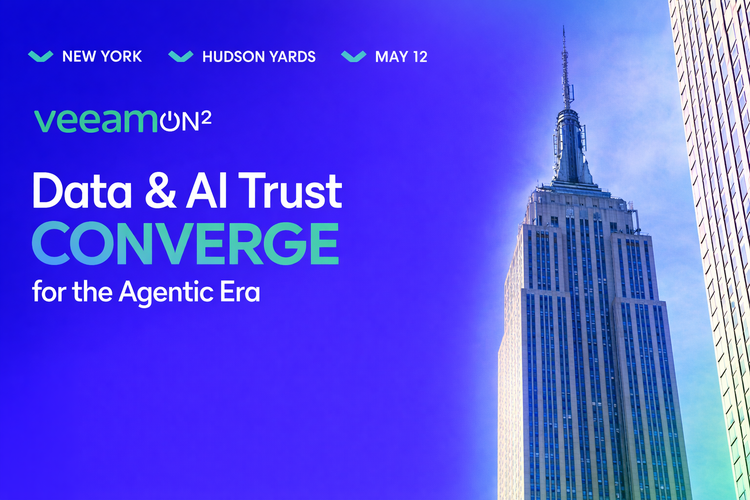
Data protection and resiliency technology developer Veeam is using this week’s VeeamON 2026 conference to show how important data security and resilience has become as businesses look at new ways to leverage their ever-growing amounts of data as a base on which to run AI.
Anand Eswaran, CEO of Kirkland, Wash.-based Veeam, told CRN in an exclusive interview that his company’s mission has transformed significantly over the past two decades from a focus on backup and recovery to being at the forefront of modernizing how customers manage and protect data, particularly with the advent of agentic AI.
Eswaran said that what he called the “agentic era” comes as data has become the primary fuel for AI and that the infrastructure for deploying AI is expanding exponentially as evidenced by massive investments from tech giants like Microsoft, Alphabet, Meta and Amazon.
[Related: Veeam Acquires Object First In Move To Expand Data Resiliency]
“Decades of enterprise software are being rewritten as agents can reach out to every system of record that runs your business,” he said. “And why is that a problem? Because the ratio of non-human identities or agents to humans is now expected to be 82 to 1.”
In response to these challenges, Eswaran said Veeam has defined a missing “data AI trust layer” that sits between the data/analytics layer and AI models/platforms. That is a unified fabric layer which needs to bring together data security, privacy, compliance, governance and resilience in one substrate, he said.
“We feel that is the key to how you make sure the data feeding AI is correct, clean and safe,” he said. “And that is the key to making sure every company’s AI transformation is going to be successful.”
Veeam this week is introducing a new Data and AI Trust Maturity Model to help channel partners and their customers assess how far along they are in getting data ready for the agentic era, 70-plus enhancements to Veeam’s flagship Veeam Data Platform v13.1, and Intelligent ResOps, or resiliency operations, to help speed businesses’ response to AI-driven or malicious changes in their data.
Here is more of CRN’s conversation with Eswaran.
How do you now define Veeam?
What Veeam is creating is not only essential, but it almost will be a category of one as companies think about resilience in the age of AI and what customers need to be successful in their companies’ AI transformation. Veeam 20 years back talked about backup and recovery. That was the first era, from the late ’80s through the second decade of the century, of backup and recovery and that transition. We feel we’ve done our bit to not just be a part of it, but to modernize it. That era transitioned to the next era, which was much shorter, focused on cyber resilience. The main trigger there was ransomware, and so security came into backup and recovery and sort of transformed what we stood for and what we did there. Now we are probably in the most pivotal, significant era of all time, which is the agentic era.
When I think about the agentic era, it’s not just one era or shift. It’s actually three things colliding in one. The first is the shift from structured to unstructured data. Ninety percent of all data is unstructured. It was always dark, but now that entire corpus of data becomes available. And that honestly is the fuel for AI. The second trigger is the infrastructure to deploy AI has become parabolic. You recently heard the Q1 earnings releases of the hyperscalers. Between Microsoft, Alphabet, Meta and Amazon, almost $450 billion is tied to AI in front just between the four of them. And the expectation is this balloons to $3 trillion in just a short couple of years. And the heart of it is that the infrastructure to deploy AI has become parabolic. Decades of enterprise software is being rewritten as agents can reach out to every system of record that runs your business. And why is that a problem? Because the ratio of non-human identities or agents to humans is now expected to be 82 to 1.
The second trigger is that the autonomous workforce is already operating in your environment with a different set of rules. And the infrastructure to trust AI hasn’t moved at all. In the world of business intelligence, you talk about network security, endpoint security, perimeter security. But when you bring AI to your data, the rules of endpoint security have completely changed. The infrastructure to trust AI hasn’t moved at all. And that’s why you see stories like PocketOS and how its AI agent deleted its entire production database in nine seconds. You hear about these every single day.
The third trigger is the infrastructure to trust AI hasn’t kept pace with what’s happening with all the efforts to deploy AI and create an option. And when I say ‘infrastructure to trust AI,’ I’m looking at four specific things. Do you have granular, multi-domain context across data, identity and all things AI? And when I say ‘multi-domain,’ it means you have context across data security through privacy, compliance, governance and resilience. The second is, after you create data, does that context across data, identity, AI, all the relationships around it travel with the data across its life cycle? The third thing is do you have the ability to create runtime enforcement with full context and identity awareness so that before the agent context window actually goes to actions, can you actually stop data which shouldn’t be seen by a certain agent without the right entitlements? Fourth, when bad things happen, because they will, do you have the ability to not just do classical restore, take data back 24 hours to a known safe state, but can you do precision remediation to that five seconds which went wrong or that one file which got overridden? And that is the key.
At the White House forum for AI, OpenAI CEO Sam Altman recently said the question stops being what can we do with AI? It becomes can we trust the data feeding it and the actions it takes?
Where does Veeam fit in?
There is a very critical layer missing, which I call the ‘data AI trust layer,’ which should sit above the data and analytics layer and below the models and platform. That is a layer which needs to bring together data security, privacy, compliance, governance and resilience in one substrate. Not a patchwork of applications or partnerships, but a unified fabric of data operating as a platform with a unified console working in tandem. We feel that is the key to how you make sure the data feeding AI is correct, clean and safe. And that is the key to making sure every company’s AI transformation is going to be successful. That’s the missing layer we feel we need to own, we need to stake our claim for. Everything we’re doing is to build that data AI trust layer. That is why we acquired Securiti AI. Securiti AI brings data security, privacy, compliance and governance meaningfully. We have been working with our customers and their data for 20-plus years. We have now built that unified data and AI command platform, and we are able to visualize the data and the full context of the relationships with the data at a very discrete level across all of these domains, using the Securiti Data AI Command Graph. And this is not a vision. This is product we’re actually showing at VeeamON. …
As part of the data and AI trust platform, we are filling it in now with product truth. We talked about Veeam Agent Commander in February, which is where the first element of these capabilities of the unified platform came to the table with the ability to detect, protect and undo with precision visually.
How far along is Veeam in terms of building the data AI trust layer?
We are there, and we’re demonstrating some of these at VeeamON. We already have the data and AI trust platform built out. We have data security, privacy, compliance, governance and resilience built into that platform already. We have one data fabric across all of these domains done already.
Does the work Veeam has done in terms of building its data and AI trust platform layer eliminate the need for specific storage or security technologies that are currently commonly used in the market?
Not storage. Eventually you have to store your data somewhere, whether in the cloud or on-premises. We’re going to work with our customers on that. The beautiful thing about our unified platform is it’s a hybrid platform where we can work with our customers based on their needs and their storage architecture, whether they want to have it on-prem or in the cloud. And we are one of the few companies, or maybe the only company, where when we talk about data security, classification and scanning all the data, we do not bring the data to our SaaS control plane because every enterprise is going to be very sensitive about that. We actually scan, classify and only bring the metadata to create the Knowledge Graph and the relationships across every data element to the SaaS control plane, which is a best practice. We have a hybrid approach, cloud or on-prem. We meet the customers where they are.
So this works with any data stored on anybody’s storage platform?
Absolutely. We don’t evacuate or copy data. There are solutions that copy and analyze. We do that without the heavy lift. And that is a differentiator.
What are some highlights from VeeamON?
We have a new five-level maturity model which ranges from ad hoc to industry-leading. The Data and AI Trust Maturity Model is the visual representation of the evolution of Veeam from backup and recovery to cyber resilience and data resilience to being a data and AI trust company. If you remember Veeam’s Data Resiliency Maturity Model, it was focused on resilience as the key pillar. The Data and AI Trust Maturity Model has four pillars linked to our evolution. First, do you understand your data, the intelligence on the data in great depth? Second, what is your security posture around the data, across identity and access, AI and agentic governance, data security, compliance and security? Do you have best practices? And are you evolving the right way? The third is resilience that doesn’t change across backup, recovery, data architecture, portability and AI. When you do these three well, the fourth pillar is how do you create momentum? How do you unleash this? The model also covers AI data readiness, AI development and AI enablement. The four pillars evolve into 12 dimensions and 49 sub-dimensions to give a complete enterprise road map for what partners need to provide the best posture for data and AI trust layer, which we think is super critical.
How do channel partners use that maturity model?
There are two ways to consume this model. One is going to be a self-service way where you can actually take an online assessment and get to understanding what your maturity level is across these four pillars, 12 dimensions, 49 sub-dimensions. For complicated enterprises and large enterprise customers, we actually sit down with them, and it becomes a four-week exercise working to lead them through this. Our intent is to work with any channel partner who has the ability and the capability to actually have this conversation with their customers. If you’re a reseller, maybe not, but the self-service survey is something which everybody can leverage. Our goal is to empower our partners as much as possible. We've always been a partner-first company. We are a partner-first company. And we will always be a partner-first company. We are enabling our partners to go take this and have this conversation with their customers.
In a lot of cases, will it be Veeam leading the conversation and then passing the opportunity to the partner?
No, our goal is to actually empower partners to have this conversation, especially as it comes to the self-service survey, which should be pretty simple. And even for the larger engagements, for the most sophisticated enterprises and large enterprise customers, our goal is to work with our partners, any partner who has the capability, who has a desire, who has the interest. I would love to work with them and enable them to drive this and lead with this. …
You will always see us keep the same focus and maybe double down on making sure that we have the absolute best capabilities pushing the innovation edges on every one of these domains, pushing the boundaries of what we need to do for our customers on every one of these domains. On data security and DSPM [data security posture management], privacy, compliance and governance, you expect to see what Securiti will do at a bigger scale because we are investing ahead of the curve on innovation and go-to market. Expect to see the same focus, if not more, on data resilience as well. And at the same time, when all of these come together, when we have that sophistication of intelligence around the data from the live systems and usage patterns, it makes our resilience posture even better because we are operating on a single data fabric and so we become better at every single discipline, and we become better together in the unified platform.
What are your strategic priorities for 2026?
My 2026 strategic priorities are pretty much the same, which is make sure that we enable every single customer and partner of ours to go on this journey of data resilience and data security, and then making sure that they can accelerate their AI transformation at scale safely. Everything else, all product innovations, fall behind that goal.
If I translate that to our business for a second, we are pretty excited about where we are. We finished last year at a shade over $2 billion in ARR [annual recurring revenue], and we expect our growth to accelerate this year. We are already a fast-growing company at scale in more than 150 countries where we have customers. We are highly profitable, if not the most profitable company in our sector. And I expect growth to accelerate even more in 2026 as I look forward on all of our individual disciplines. We already have a pilot group of customers signed up to deploy our unified platform, and we expect that to be a meaningful thing for us as we go forward.
Any plans for an IPO?
Of course, but we don’t talk about timelines or any of that. We're watching the macroeconomics. I always say we run our company like it’s a public company today. At scale, we’re highly profitable and growing really quick. We could go public tomorrow, but we don’t need to go public for liquidity. So we’re watching the macro. We are watching where things are. Expect it to happen, but we really don’t have any published timelines yet.
With the war in Iran and the economic issues caused by that, how is the macro impacting Veeam right now?
It is not really. Part of it is, as we saw when some missiles hit data centers in the UAE and brought them down, it actually exacerbates the need for resilience in an even bigger way. So we haven’t really seen an impact from that to the business. If anything, it has brought up the need for making sure that companies have extreme resilience in the face of incidents like this.
Given the shortage of data center space and how many companies are trying to build new data centers, does that hinder storage and resilience infrastructure development?
It hasn’t for us. This goes back to how we give customers choice. We work with every storage partner out there. We work with the hyperscalers. Our SaaS platform is completely integrated with the hyperscalers. Given all of that, it has not been an issue. Supply chain constraints have not been an issue.