WD Unveils Hard Drive Road Map: 100-TB-Plus Capacity, AI-Focused Innovations
‘We’re reinventing the hard drive that the cloud and AI depend on so that we can deliver more capacity sooner while doubling both bandwidth and I/O. And we’re introducing a class of drives that delivers 20 percent less power use with 10 percent more capacity. And we’re going to make it easier for the next class of customers, including the hyperscalers, to use all the technologies that we’re building,’ says Ahmed Shihab, WD’s chief product officer.
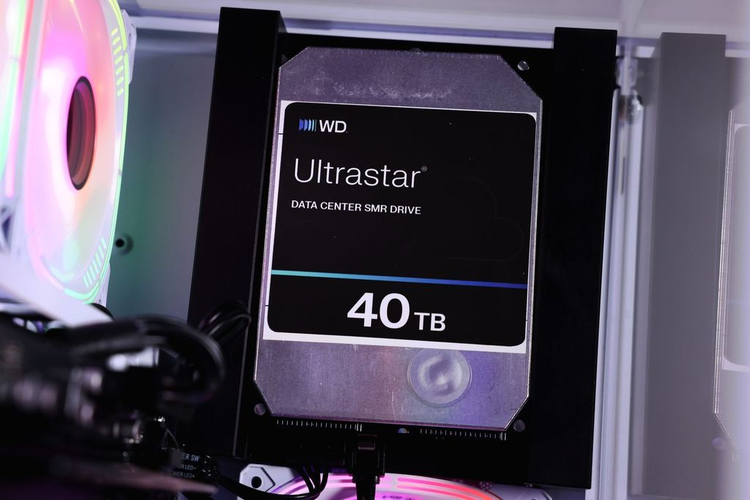
Hard drive manufacturer WD Tuesday unveiled its road map for producing drives with capacities of over 100 TB along with a new intelligent platform the company said will redefine the economics of storage.
WD, which until about a year ago was better known as Western Digital, said that its 40-TB UltraSMR ePMR hard drive, which it called the world’s highest-capacity drive of that type, is now in customer qualifications and that the company is on its way toward introducing HAMR-based hard drives with capacities to over 100 TB.
Ahmed Shihab, chief product officer at San Jose, Calif.-based WD, told CRN that the company is working to ensure that businesses have the hard drive technology needed for modern IT infrastructure.
[Related: The 2025 Storage 100]
“We’re reinventing the hard drive that the cloud and AI depend on so that we can deliver more capacity sooner while doubling both bandwidth and I/O,” Shihab said. “And we’re introducing a class of drives that delivers 20 percent less power use with 10 percent more capacity. And we’re going to make it easier for the next class of customers, including the hyperscalers, to use all the technologies that we’re building.”
WD’s new hard drive technology is aimed primarily at AI businesses, which not only need more and more capacity but also access to that capacity sooner than in the past, Shihab said. The company has qualified its first 40-TB drive, which he called an industry-first on ePMR (energy-assisted perpendicular magnetic recording).
“And we can extend that a little further because what I heard from my customers is as we transition to HAMR [heat-assisted magnetic recording], we want that transition to be smooth,” he said. “We don’t want an abrupt transition. Otherwise things will go slowly. They want the acceleration from both HAMR and ePMR to overlap so that we can get to 100 terabytes by 2029.”
Shihab said WD has all the technology needed to move to HAMR technology to increase areal density and potentially increasing the platter count inside the same 3.5-inch drive footprint.
“It plugs into today’s infrastructure,” he said. “It just continues to add more capacity.”
A big issue with increasing hard drive capacity is the fact that workloads are getting a little “hotter,” Shihab said.
“They need more bandwidth, and they need more I/O,” he said. “We put some of those drives in customers’ hands already. We’ve doubled the bandwidth of the drives. [Our new drives are] delivering 500 Megabytes per second and some change. Read, write, continuous throughput, no tricks. Just difficult engineering to make it work. And customers are really excited by that because now you can get more in and out of the drive while the capacity is increasing. It’s not just rebuild times but serving more traffic from those assets that they’re building. That’s important obviously for all the cloud workloads, but also important for AI as we need more and more data to feed it and more and more users continue to create more data.”
A big part of that increased bandwidth comes via WD technology that allows reading and writing of data from two heads at the same time, Shihab said.
“There are 22 heads inside, and normally we read from one,” he said. “Now we’re reading from 22. “You can imagine we can extend this. … We’ve been working on the technology for some time because we saw the time coming when performance was needed. … [Customers] want more performance, more bandwidth out of the drives. This is exactly the right time for the right idea. And we’re able to show it, and not just say, ‘Hey, we’ll figure it out.’ We actually show it.”
That ability to read and write data from two heads simultaneously will not be available with the new 40-TB drives, but is slated to be available as drives with 44-TB to 50-TB capacities enter mass production, Shihab said.
“Obviously I want to get it sooner, but that’s between me and my engineers,” he said. “The performance is about 500 Megabytes [per second] and change. So we saturate the SATA link that’s already in existence today. SATA is only capable of supporting 530 Megabytes per second. Our drives today in the labs and in customer testing are supporting 505 to 510 Megabytes per second.”
While that performance is double that of current hard drive technology, getting increased performance will require a new interface, likely NVMe, Shihab said.
“But that’s going to be disruptive to customers. … I don’t want to build it when customers can’t use it,” he said. “So we are working to figure out the road map because by the time we get to 100 Terabytes in 2029, they will want more performance. We can go eight times the performance to that’s roughly 2 Gigabytes per second, but that will not be with SATA. SATA cannot support that performance, and that’s why we have to work with customers because that’s a change to the infrastructure.”
The other issue impacting hard drive performance is the need to increase the number of transactions per second, Shihab said.
“There have been many attempts to double that using split actuators and a bunch of other things,” he said. “But the problem with all of those is that it required a bunch of changes to the software and the operational running of data centers. … We know we have to double the I/O. So we developed a technology called dual-pivot technology, which is a mechanical redesign of how the heads and the media are distributed within the drive itself using the same SATA interface so customers don’t have to change the hardware or the software.”
WD hard drives with dual-pivot technology are currently being developed in the lab and are slated to be available in 2028.
The amount of data generated by AI, analytics and other new workloads is increasing, and not all that data needs to be stored on the same capacity or performance tiers, Shihab said. WD’s response is a new series of power-optimized hard drives that reduce power consumption while maintaining sub-second access in the existing 3.5-inch form factor, which trades a small amount of random I/O performance for higher capacity and lower power consumption for AI data storage at scale, he said. Such drives are expected to be in customer qualification in 2027.
WD Tuesday also said it has expanded its Platforms business by developing an intelligent software layer with an open API as a way to help midscale customers take advantage of some of the benefits that hyperscaler cloud providers enjoy.
There is a class of big enterprise or scaling AI businesses that want access to the economics of hard drives to profitably run AI but don’t have the resources of the hyperscalers, Shihab said. WD has been packaging hard drives in JBOD (non-RAID, just a bunch of disk) enclosures, he said.
“What we’re doing now is putting a layer of abstraction inside the box,” he said. “That gives a very simple interface that will connect to a file system with open-source implementations and show customers how to do it very easily. We’re going to make it open so anybody can use it and make sure that we create competition, while allowing people to use UltraSMR and high-bandwidth drives, power-optimized drives, dual-pivot drives and capacity drives seamlessly so they don’t have to do the qualification work. We do the abstraction work that allows them to access all of that capability from a very straightforward and simple API.”
This platform expansion will also be extended to flash storage, a technology WD has not offered since it separated its flash memory and SSD business into a separate company, Sandisk.
“We won’t be making the flash, but because customers have asked, we’ll make it an easy transition for them,” Shihab said. “We make the transition for them very seamless, much like we’re doing for the hyperscalers on the hard drives.”