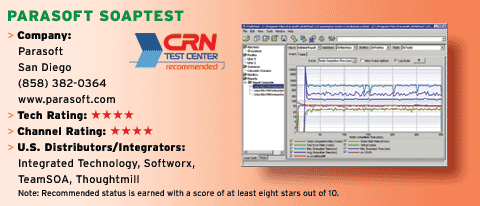
Parasoft's SOAPTest Validates Complex Services-Oriented Architectures
In addition to displaying XML directly, the new GUI shows XML in a formlike format that displays XML in a tree view. Forms are useful for displaying multiple elements in XML files. SOAPtest also supports scripted XML, allowing developers to write scripts in Java, JavaScript and Python.
From its inception, SOAPtest has been used to produce functional verification at the application level and to emulate server functionality. SOAPtest is used primarily to send requests to a service and wait for a response to validate the application logic of that service. The software also provides other powerful testing scenarios.
When applications consume Web services, developers can use SOAPtest to "dummy out" the service end points and test against a mock service. When the client application generates a request, SOAPtest can capture the request, validate it to make sure it is formed correctly, and provide a dummy response consistent with what the actual service does to make sure that the client application is able to process that response successfully. By abstracting end points when testing application logic with third-party Web services, developers do not hit any direct dependencies that might cause partner complaints or ban a client connection.
This technique is also useful when working with business processes. Developers can isolate logic from the server or client side by running tests without hitting services from business processes directly. Messaging between client and server can be abstracted even further. For instance, by placing SOAPtest between a client and server to ping-pong messages between those two instances, developers can test messages directly between client and server.
Placing SOAPtest at both end points helps developers test policies and XML transformations as well. In this scenario, SOAPtest can drive requests through intermediary transformations and capture messages at the other end, allowing developers to verify and configure policies before pushing a transformation into production. This technique helps developers when they deploy Web services security gateways or Web services management utilities into an infrastructure. Before deployment, developers must define and test policies.
SOAPtest now supports UDDI registries. UDDI is gaining momentum with organizations that are deploying SOAs because it provides central access to all the services available in intranets. That centralized access allows developers to enforce policies and govern from a single location, which simplifies testing. SOAPtest 4.0 can build custom rules and policies to check WSDL files. Developers can define custom policies and turn on and off rule sets that they want to check and enforce them as part of a WSDL verification test. SOAPtest can also create rules automatically based on XML files. Once a rule has been created, developers can fine-tune it so that it adheres to a set of policies. This feature provides the ability to customize and automate policies in an SOA.
Organizations that decide to expose policies in some particular structure and create all Web services with specific headers can now use SOAPtest's programmatic interface to verify WSDL files. This process is useful when checking line-of-business services before they are stored in a UDDI registry. Developers can invoke a process from UDDI that can start SOAPtest and verify WSDL files for compliance and standards that organizations have defined before WSDLs are provisioned out of a registry. In addition to compliance, SOAPtest can verify WSDLs for interoperability, links and semantics. Checking WSDL semantics is a comprehensive test that ensures files are built properly. By checking WSDL links, SOAPtest verifies that all the links are reachable. In addition to testing NTLM authentications, JMS properties and custom SOAP headers, SOAPtest now provides a security suite that tests common service vulnerabilities. The software automatically generates security tests that look for SQL injections, XML bombs and parameter overloading.
SOAPtest Professional is priced at $3,995. The company provides an average margin of about 38 percent to solution providers. To qualify as partners, solution providers have to demonstrate a capability to develop SOA solutions. In addition, Parasoft provides full collateral support, including co-marketing for regional markets and lead generation. Technical support is available from 8 a.m. to 6 p.m. PST.