New Scheduler Handles The Whole Batch
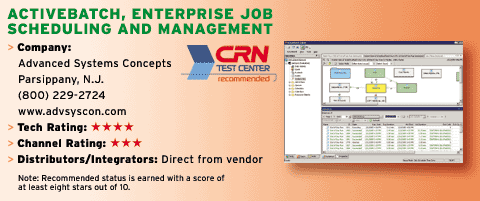
ActiveBatch's scheduling engine runs on Microsoft Windows. The engine is capable of running in a distributed environment and can manage load balancing, failovers, distributing jobs and job restarts. On the back end, ActiveBatch stores all of its job queues in Microsoft SQL Server or Oracle databases.
ActiveBatch also includes security features to ensure data integrity. The software can maintain user profiles based on credentials to secure job executions, and this same security extends to job schedulers. Although the software provides available schedulers based on a user's credentials, new authentication levels can be changed within ActiveBatch to access other execution machines for complex jobs. ActiveBatch's authentication mechanism is also flexible, allowing users to adjust settings based on job destinations. Job schedules are connected to processing machines through the machine's Active Directory name or an IP address. In Active Directory, the operation staff can maintain lists of published schedulers in a domain. Once connected to a scheduler, all execution queues are displayed in ActiveBatch. Jobs can also be distributed to dynamic queues, which act like virtual processors for multiple queues. In these generic queues, jobs can be executed randomly or sent to specific destinations by creating scheduling algorithms that control execution nodes.
ActiveBatch supports exit code values, making it possible to trigger jobs based on more than one condition. Values passed between jobs can be in the form of a range of numbers or even keywords, and it is up to engineers to select values that can be recognized by each job. Exit codes can also be forced between jobs to ensure that subsequent job steps will function properly during testing. Even in final production runs, failures that occur between steps should not stop entire jobs from running.
Exit codes in main jobs also can be passed to post-steps, which execute scripts or programs that move output files to their destination machines and clean up temporary files no longer needed by other jobs. A new checkbox feature allows engineers to automatically send scripts or programs for post-job executions to a scheduler machine, which will pass it to an execution machine.
A restart code is also available to create recursive steps within jobs. By running steps multiple times, engineers can create multiple output files without having to write recursive logic in programs, although record or file sequencing must still be managed by programs. This technique is useful when it is necessary to split up processing destinations due to large output files, as long as these files do not have execution dependencies.
Just as in the development world, ActiveBatch Namespaces must be unique within a certain scope. Namespaces refer to job schedulers within a program's plan. To receive correct access and execution destinations, scheduler names must be confined within a plan. Plans can inherit variables, policies and other plans, and can even be triggered by jobs. Plans allow engineers and operators to create complex job sequences that are not possible to do in OS schedulers.
ActiveBatch allows engineers to set execution constraints based on business calendars. The software allows for all variations of five-week months in a fiscal year, including the ability to skip certain dates based on holidays or custom dates set by administrators. In addition to adding fixed holidays, ActiveBatch allows users to create holidays based on relative conditions. Any holiday that falls on a specific day of the week—such as Thanksgiving, which is celebrated every year on the fourth Thursday in November—can be added as an expression without specifying an actual date. Users also can add date expressions for holidays that fall on weekends but are observed on the first or last working day of the week. Advanced Systems Concepts is planning to offer more connectors for ActiveBatch with third-party packaged ERP and CRM applications later this year. Developers and operators will benefit from this integration since it will allow different systems and platforms to pass information through ActiveBatch.
Advanced Systems Concepts' average solution provider margin ranges from 10 percent to 30 percent. The company is working on an improved channel program for ActiveBatch, which will focus on supporting technology integrators, ISVs and application providers. To participate, partners are expected to provide some pre- and post-sales support and meet sales quotas. The company is still developing technical and marketing support programs for its partners. ActiveBatch costs $2,995.