Two-Piece PC System Can Cut Down On Thefts
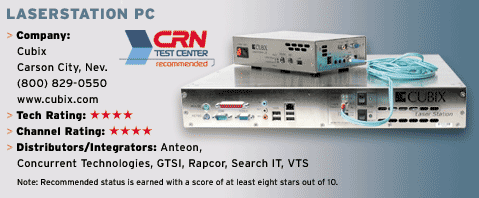
There's not a lot that solution providers can do with a conventional PC to prevent such theft, but an unconventional model such as the Cubix LaserStation PC can eliminate the problem. That's because the LaserStation separates the main computer from the graphics card and I/O ports using fiber-optic cable. The main computer can be kept under lock and key far from where users actually work. This lets resellers configure more physically secure computing solutions.
The product is ideal for environments where there's a lot of employee turnover or where temporary workers are frequently used. It could also find a ready home in public areas such as malls, libraries, airports and trade show floors.
The computer section of the two-piece LaserStation, which houses the motherboard, hard drive and memory, mounts in a rack. The tiny desktop portion, which houses the graphics card and I/O ports, sits at a user's desktop. The two parts of the system are linked together by fiber-optic cable over a maximum length of 250 meters. Multiple LaserStation computers can be rack-mounted in a locked climate-controlled room, where they can be administered and serviced without interference.
The technology is slick. The PCI Express bus is extended over the fiber and converted to a standard PCI bus so that a PCI graphics card, along with other peripherals, can be located far from the main computer. Video performance is unaffected by the fiber-optic cable because it's not the video signal that's extended over the fiber, it's the PCI bus itself. Another slick design point: USB ports on the desktop portion can be used to connect peripherals to the system, although Cubix also offers this component without USB ports to prevent users from connecting anything.
Benefits of this unusual configuration are many. For one, users don't have physical access to the computer itself, so they can't make off with hardware or data or spread viruses. It also means power consumption at the desktop is reduced to about 25 watts from 250, so the work area won't need as much cooling. With just one tiny cooling fan at the desktop, LaserStations run much quieter than traditional PCs, making them ideal for classrooms or computer training facilities. If a LaserStation fails in a classroom, a student can be switched to a different computer in seconds simply by moving a fiber-optic cable connection. Beyond the physical security angle, this flexibility also make LaserStations effective in financial, government and manufacturing environments.
LaserStations are configured with the latest hardware. The sample model C10, which was priced at $1,695, contained a 2.8GHz Pentium 4, although systems configured with Pentium 4s up to 3.8GHz are available. A model C20 LaserStation with dual Xeon processors is also available. The C10 comes with a 10/100 NIC, while the C20 has Gigabit Ethernet; additional Gigabit ports are optional on either model. The sample C10 also included 1 Gbyte of memory, a 120-Gbyte hard drive, serial and parallel ports, audio capabilities and four USB 2.0 ports. A DIP switch on the main unit enables or disables the fiber-optic extension; with the extension disabled, local keyboard and mouse ports can be used at the rack.
Roughly a dozen different models are available. The sample unit extended just a single PCI slot to the desktop, along with power and reset buttons, two USB ports, audio inputs and outputs, VGA out, S-video out and composite video out. The PCI slot was loaded with a Radeon 9200 Pro PCI graphics card. Another model is available with five PCI slots, as is one with a DVI output for digital flat-panel displays.
Cubix has been selling through resellers since 1975, but the LaserStations have been shipping for only two months. A single-level program gives all resellers equal support. Margins average from 10 percent to 12 percent. Cubix provides sales collateral at no cost and discounts on demo equipment. Training is free at its manufacturing facility in Carson City, Nev. Engineers are available via a toll-free number to provide technical assistance and consulting to solution providers.