Q&A: Bob Dutkowsky On What Tech Data's Avnet Buy Means For Solution Providers
The Hybrid Move
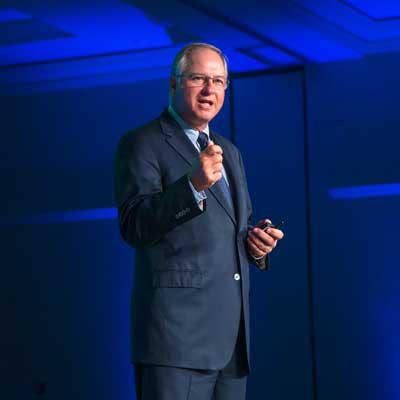
Bob Dutkowsky, chairman and CEO of Tech Data, said the $2.6 billion Avnet Technology Solutions buy means solution providers can fulfill all of their product and service needs in a single place.
Dutkowsky spoke with CRN about the cultural assets of each organization, navigating the move from the on-premise data center to the hybrid data center, and why it was so important to break into the Asia-Pacific region.

What feedback have you received on the Avnet TS deal from channel partners?
The legacy Tech Data and the legacy Avnet customers appreciate the potential this end-to-end story represents -- the idea that with 1-800-Tech-Data or techdata.com they can go to one spot and find a broad array of products with deep domain skills wrapped around those products. It's easier to do business with one player that has those deep skills than to manage multiple relationships with multiple distributors, and then they're the ones that have to cobble together the capabilities. They come to Tech Data, they speak to people that understand the products and understand the channel and understand verticals, and our people help them bring those solutions to their customers. There's deep value in that from the customer's point of view.

What about from vendors?
The vendor sees it the same way. The worst thing for a vendor is to get little puddles of inventory scattered across multiple distributors. They have to manage it, they have to get paid for it. If it gets obsoleted, they have to deal with it. It's much easier for a vendor to consolidate their inventory with one or two distributors, as opposed to multiple distributors. The feedback we've gotten from the partners and from the vendors has been overwhelmingly positive. They see the value, they see the strategic nature, they know the capabilities that Tech Data has to execute, and it's all been very, very supportive and confident across the board.

How receptive was the Technology Solutions workforce to becoming part of Tech Data?
TS really wanted to become part of Tech Data. Once they learned that the deal was there, the people of the company were really accepting and excited about the transition to Tech Data because they saw that Tech Data was a company that was focused in the space they were focused in. And Avnet, with the EM [Electronics Marketing] side of the business and the TS side—the EM side was kind of steering the ship, and TS was kind of along for the ride. When they came over to Tech Data, they saw that they were the ride. Without TS, the end-to-end story didn't work. So they became a really important part of our storyline to our customers and our vendor partners.

How do the cultures of Tech Data and Technology Solutions compare?
Avnet started out as a small company in New York City, and they sold radio components. And then over time, they found their way into tech. They were family-owned, they went public, they went global. Tech Data, same idea. Started out with office supplies, found its way into tech. It was a family-owned company, it went public, it began to go global. They two companies are almost like brothers from [another] mother. They had a lot of commonality amongst them. But there were places that were also very different. The secret, or the trick that we're working on in this integration process is to take the best of both pieces.

What are the key areas of cultural differences between Tech Data and Technology Solutions?
In a typical day inside the old Tech Data, we would do about 50,000 transactions. Fifty thousand times, our customers came to us and placed an order around Tech Data. And everything that it meant—the supply chain issues that it meant, the logistics it meant, the billing that it represented — 50,000 times a day, we did that. And Avnet TS would transact with their customers about 1,000 times a day. Now every transaction was bigger, but if you think of it that way, Tech Data is kind of a volume engine, and TS was more of a big-ticket engine.

How differently do those two engines function?
Underneath Tech Data, in that 50,000, there were big ticket transactions. So we know how to do it. It's just that we didn't have the same acute focus on how the larger transactions happen. So TS had invested a lot of time and energy and innovation around building IT systems and things that made those big-ticket transactions better. And Tech Data had spent tremendous amounts of money and time making the velocity engine work better. So now when we take that big-ticket mentality that Avnet had and the velocity mentality that Tech Data had and we put those two pieces together, we can do the end-to-end better than anybody can.

How have you gone about addressing the areas where TS was underperforming?
The data center is an environment that's in transition. TS has a dependency on the data center, and their performance is a reflection of the dynamic in the data center. The data center is transitioning from purely on-prem to more of a hybrid environment, with a combination of on-prem and the cloud. It's transitioning from servers and storage and networking to converged and hyper-converged platforms. It's transitioning traditional storage to flash and solid-state. All of those transitions are opportunities for Tech Data. They're not threats; they're opportunities. But we have to manage our way through them.

What are the keys to successfully making the pivot to a hybrid data center?
You have to build the skill base inside the company that understands these next-generation technologies. You can't take a person who understands printers and ask them to suddenly understand hyper-converged architectures. You can't just transition people that way. You can re-educate and train people to understand many more complex architectures. But you also have to go out and get new talent and new skills. And one of the ways we did that was bringing TS in, which was an influx of those talents and skills. And then we continue to recruit and attract top-quality people who are specialists in IoT, security, converged and hyper-converged, solid-state and flash, and big data and analytics.

What are the greatest technological assets Avnet TS brought to the table?
Back about a year before we did the deal, TS announced that they were going to reorganize themselves around these next-gen technologies—the data center, security mobility, analytics and big data, IoT. They had already begun to build skills and go-to-market capabilities around the next gen. So they fit right in with where we were strategically trying to take the company. They already had those pieces, and they had an Asia-Pacific business. We were able to get it in one big piece, and that makes it much easier to do.

Why was it important for Tech Data to get into Asia-Pacific?
If you look at where all of the world's population growth is going to happen in the next decade, the next two decades, it's in Asia-Pacific. It's not in the Americas, it's not in Europe. It's not in the mature markets. They've kind of tapped out. People like you and I are replacing ourselves, and that's it. There's population growth in Asia-Pacific, so consequently, there's more IT spending potential over the long haul in that geography.

What do Tech Data's growth prospects look like in Asia-Pacific?
Some of the legacy technologies that exist in the Americas and Europe -- think of landlines versus cellular. Some of those business environments in Asia-Pacific have skipped right over the legacy architectures and moved to the next generation of architectures. It's a very attractive, appealing growth environment that Tech Data believed we needed to be able to play in. And our most strategic vendor partners have been asking us to get an Asia-Pacific footprint because their customers -- the end customers -- have this global view of the world now. The Asia-Pacific business for Tech Data is small. It's a platform that we're going to be able to grow. It's not all vendors, it's not all products. It's very focused in a few countries. But it gives us the footprint to grow.

How far along are you in bringing Tech Data and Technology Solutions together?
This is a couple of years' journey that we're on. It's not a couple of weeks and it's done, a little tuck-in kind of deal like what typically happens in our industry. This is a transaction that the industry hasn't seen in 25 years, something of this magnitude. We're 1.5 quarters into a couple of years' journey. We understand exactly what we're trying to accomplish, we know where we're going, we're thrilled with what we've seen so far, and we think that over the next couple of years, we're going to continue to build a very attractive company for the channel to use, both vendors and customers.