How Solution Providers Are Monetizing the Modern Workplace: From Meeting Rooms to Large Venues
For much of the last decade, solution providers monetized the workplace one device at a time. Displays were sold as endpoints, projectors as line items and collaboration tools layered on as optional extras. That model is now being overtaken by a more outcome‑driven approach.
Rather than buying displays alone, today’s customers are investing in environments. Whether it’s enabling hybrid collaboration, driving engagement in learning spaces or delivering visibility in large venues, technology purchasing decisions are increasingly shaped around what a space needs to achieve, not which SKU sits on the invoice.
This shift in approach mirrors a broader trend across IT categories, where solutions are evaluated based on how well they deliver an experience rather than how advanced individual components appear on paper.
For the channel, this change is redefining where growth and margins sit.
The Three High‑Growth Workplace Environments Shaping Demand
While use cases vary by sector, most workplace investment is concentrating in three environments where standardization, scalability and manageability matter most.
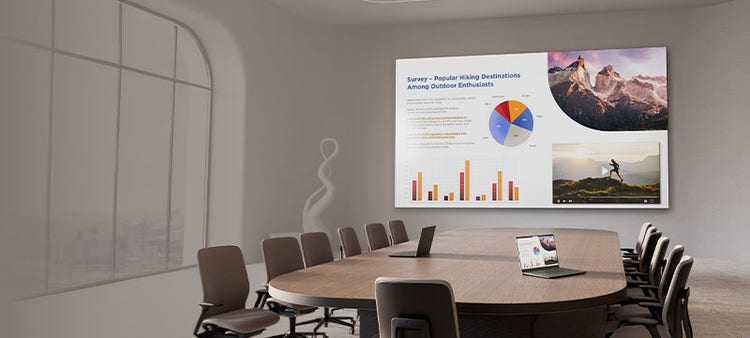
Meeting rooms have evolved into the essential anchor points for the hybrid era, but their success depends entirely on how well they play with others. Rather than forcing a "one-size-fits-all" approach, ViewSonic focuses on ecosystem-agnostic displays designed to integrate seamlessly into your existing Pro AV infrastructure.
Whether your organization is standardizing on a specific UC platform or maintaining a flexible "Bring Your Own Meeting" (BYOM) environment, these solutions are engineered to be the reliable centerpiece of the room. The high-performance "canvas" that fits into your preferred stack is provided—be it through sophisticated hardware integration with leading control systems or simplified wireless sharing.
Classrooms and campus environments continue to attract sustained investment, spanning education, enterprise training and shared learning spaces. Engagement is still critical, but centralized management has become the primary IT concern. Large fleets of interactive flat panels need to be monitored, updated and supported remotely, often with limited staff. Ecosystems that combine IFP hardware with platforms like myViewBoard are resonating with buyers because they prioritize manageability, visibility and control alongside classroom features, which aligns more closely with how modern IT teams operate.
Large venues represent the fastest‑growing and most underserved opportunity. Corporate town halls, auditoriums, control rooms and events spaces are increasingly turning to dvLED as an alternative to traditional projection. Customers are no longer buying displays for these environments. Instead, they are investing in scalable visual infrastructure that can adapt as spaces evolve. Modular dvLED platforms such as LDM and LDS allow partners to design high‑impact installations that support different formats, room sizes and use cases without starting from scratch each time.
Where Partners Unlock Ongoing Opportunity
The commercial opportunity for solution providers lies in connecting workplace environments under a single experiential strategy. As workplace expectations expand, partners are evolving from hardware resellers into experience integrators who design, deploy and support visual and collaboration environments that work consistently across multiple spaces.
This evolution naturally expands margins. Bundled solutions increase deal size, software and management tools introduce recurring revenue, and services such as installation, configuration and ongoing support deepen customer relationships. It also aligns with a core channel reality highlighted repeatedly in CRN research: solution providers continue to influence more than 70 percent of IT spend, shaping not only what customers buy, but how environments are architected end to end.
Increasingly, partners and customers alike are evaluating solutions using a consistent set of criteria:
What Defines a Scalable Workplace Solution?
Interoperability, including Microsoft Teams compatibility and wireless casting
Centralized management across devices, users and locations
Deployment simplicity that supports rollout at scale
A balanced cost‑performance profile across different environments
Vendors that are winning with the channel are those that align naturally with this checklist. They offer end‑to‑end portfolios that span meeting rooms, classrooms and large venues, with software and hardware designed to work together and scale over time.
That breadth matters. A single customer engagement may involve standardized meeting rooms, managed interactive displays across a campus and dvLED installations for large spaces. Working with vendors that can support all three environments through a cohesive portfolio reduces complexity, accelerates deployment and strengthens long-term value.
As the modern workplace continues to evolve, the most successful partners will be those who move beyond selling devices and instead monetize the experiences those devices enable.
Find out more about ViewSonic’s award-winning solutions: ViewSonic