Kaseya Exec: ‘MSPs Are Not Getting Their Fair Share’ When It Comes To Profit
‘The legal industry’s average profit margin is about 40 percent. Finance, 37 percent. Marketing, 25 percent. Any clue what MSPs are on average? 10 percent. This has to change. You guys are the lifeblood of the global economy. You guys make sure SMBs run. You are the superheroes of the global economy. But MSPs are clearly not getting their fair share. Ten-percent profit margin is not right,’ says Miles Walker, Kaseya’s channel development manager.
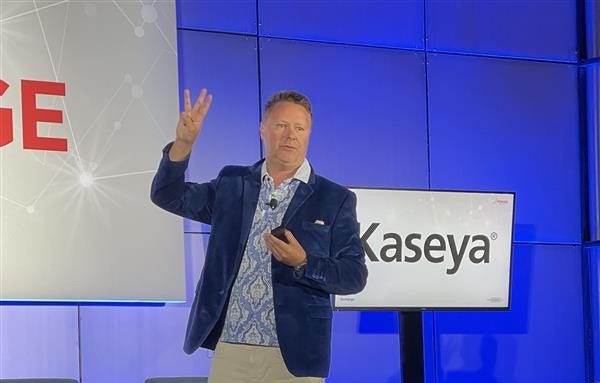
Managed service providers are the lifeblood of the SMB space, but they are not being properly compensated for the work they do on behalf of clients.
That’s the word from Miles Walker, channel development manager at MSP platform provider Kaseya, who told an audience of MSP executives at this week’s XChange 2025 conference in Denver, hosted by CRN parent The Channel Company, that profitability is definitely lacking in the business..
Kaseya, in a recent study it published, looked at common concerns among MSPs, Walker said.
[Related: Kaseya Taps Intuit, Google Vet Rania Succar As CEO]
“Had to work over a weekend, 64 percent,” he said. “Work consecutive 50-hour weeks, about half of you. Work all night, 43 percent. These are examples of something you’re dealing with.”
Despite the long hours and hard work, Walker said MSP profitability is not where it should be.
“I’m shocked that from our survey, 12 percent of the MSPs we talk to don’t know if they’re profitable, and 12 percent are in that negative to break-even area,” he said. “About 30 percent report 1-percent to 15-percent margins. Hopefully everybody is really doing a lot better than these figures here. Twenty-nine percent are in the 15-percent to 30-percent margin range, and 17 percent report over 30 percent margins.”
This all comes down to one thing, Walker said.
“MSPs are not getting their fair share,” he said. “The legal industry’s average profit margin is about 40 percent. Finance, 37 percent. Marketing, 25 percent. Any clue what MSPs are on average? 10 percent. This has to change. You guys are the lifeblood of the global economy. You guys make sure SMBs run. You are the superheroes of the global economy. But MSPs are clearly not getting their fair share. Ten percent profit margin is not right.”
Over the past year and a half, Kaseya has tried to help by saving partners $800 million and put that savings into MSPs’ profits, Walker said.
“That is something we’re really proud of,” he said. “We’re almost at the billion-dollar mark, which should come by 2026.”
Part of that savings comes from new offerings, Walker said. In 2024, Kaseya introduced two new editions of its Kaseya 365 platform, Kaseya 365 Endpoint to manage backup, and Kaseya 365 User with everything needed to prevent and respond and recover from user threats.
“You get everything there included in one price, with $5.75 per endpoint or $3.99 per user,” he said. “We can give you substantial savings. And when looking at the cost breakdown, you can save on average $12 per endpoint right off the bat. If you have 100 users, you’re saving about $1,200 per month.”
Kaseya at its May 2025 conference introduced Kaseya 365 Ops, which gives MSPs the ability to add capabilities such as AI-driven workflows and automated billing, and to easily generated automated QBRs and executive reports.
Kaseya has also responded to MSP margin concerns with enhancements to its Partner First Pledge over the last couple years, Walker said.
“We’ve heard what you’ve been saying to us in the blogs, on Reddit, on Facebook, that you need a little bit more help,” he said. “That’s why our Catastrophic Client Loss Protection is here. Our price lock guarantee is there. And we now have one-year pricing that is comparable or closer to our three-year pricing. You guys said you want that. We delivered it.”
Kaseya’s most important program is an MDF (market development fund) program with $3 million, Walker said.
“If you as an MSP hit the threshold, which most of you do, you have access to those funds for webinars, in-person events, sponsor conferences, or Chamber of Commerce calls,” he said.
Miller’s discussion on MSP profitability made sense, said Chess Lee, director of client services at Impact Business Technology, a Sandy Hook, Conn.-based MSP.
Lee told CRN that that 10-percent profitability estimate is definitely a low number.
“Walker had a good point that we support a lot of the aspects of the business including finance, legal, marketing, yet companies in those spaces are making two, three, and four times as much as MSPs.
While Impact Business Technology is currently not a Kaseya partner, such a partnership is worth exploring, particularly with the introduction of Kaseya 365 Ops, Lee said.
“I know he was pretty limited on time on what he could go into, but I found that very interesting,” he said. “I definitely want to learn more about the maximizing margins, but I think he did a good job. He was engaging. There were a lot of offerings and solutions to problems we’ve not figured out yet. It seems like we could be offloading a lot of the things that cause me stress.”
Walker also took time to discuss Kaseya’s biggest news of the last couple months.
“We have a new CEO, Rania Succar,” he said. “She came in a couple months ago. She’s taking over the helm at Kaseya. We are super excited about that.”
At Kaseya’s recent DattoCon Europe exhibition, Succar spoke about three of the things she’s focusing on with the company, Walker said.
“First was product innovation, hiring 200 new developers over the next six months,” he said. “Our AI enhanced focus has been big. Every solution that we have under our umbrella will have a big AI focus to make your life easier. And lastly, our customer obsession. We’re going to make, hopefully, your life better. We’re going to be trying to do that. We’re listing what you’ve said, and we’re trying to make those changes.