AI Gets Practical For MSPs As Tools Take On Sales, Service, Licensing: Panel
“Obviously, start with an AI in-depth use policy. ... We lean into ‘Let’s change the culture. Let’s create AI champions within your organization,’” says Corey Kirkendoll, president and CEO of 5K Technical Services.
For MSPs, AI has moved from hype to a practical operating tool that helps them boost employee productivity, surface missed opportunities and help clients rethink how their business runs.
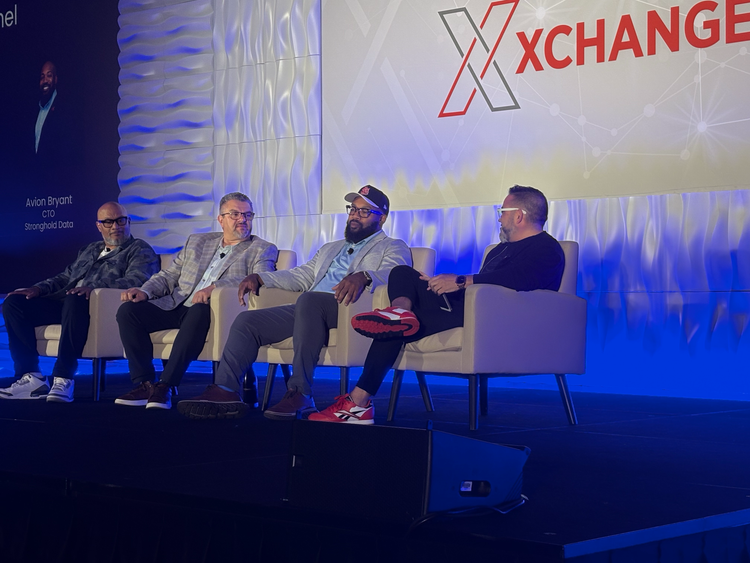
That was the message from Avion Bryant, Joe Ussia and Corey Kirkendoll, three MSPs who are well along their way with AI, ranging from customer service and sales agents to Microsoft licensing optimization to finding new sources of funding.
The three MSPs discussed their approaches during a panel moderated by Eric Torres, vice president of channel and community engagement at Denver-based cloud marketplace Pax8 at CRN parent company The Channel Company’s XChange August event in National Harbor, Md., this week.
[Related: 8 New AI Tools Aimed At Transforming An MSP’s Operations]
For Ussia, CEO of Toronto-based Infinite IT Solutions, his AI journey began way before the current wave of generative AI.
“It actually started with the Rewsts and the Pias of the world and understanding what that robotic process looks like and how to automate,” he said. “And then we realized this agentic thing, this is really cool. So we took our initial automation concepts and then we used AI to put safeguards in place. At first, we were really terrified because of sprawl, right? And we started realizing that there’s so many use cases for this.”
And Ussia tested AI inside the company’s own business before bringing it to customers. He told the audience of MSPs about Clara, a voice agent first built for a law firm to handle client communication and appointments while the lead attorney was on leave. Clara has since evolved into an internal sales and technical resource—cold-calling prospects, answering technical questions and booking meetings.
“She’s incredible,” Ussia said. “Clara now cold calls for us and books appointments with prospects and can answer anything technical, like can get deep in the weeds if you’re talking to a CTO or very high level if you’re talking to an office manager. And the really interesting thing is, we’re now looking to hire more salespeople to deal with the efficiency in this.”
At 5K Technical Services, Allen, Texas, President and CEO Kirkendoll has focused more on using AI to improve internal operations and customer outcomes.
One of his most successful deployments is an AI agent named Cynthia, which works at the front line of his MSP’s customer service operation. Cynthia records calls and transcriptions and generates case notes.
But Kirkendoll found that Cynthia could do more than just document interactions. It can identify opportunities that employees were unintentionally missing. That became a way to improve the customer experience and uncover new revenue opportunities.
“I went back and I asked her, ‘Hey Cynthia, all these calls over the last 30 days, did anybody ask to speak to me? Asked to buy something? Asked to do something?’ And they were,” he said. “The techs had a good intention to send that information back to me, but again, they were taking cases and it just fell through the cracks.”
Kirkendoll has also used AI to help clients respond to disruption, including nonprofits hit by federal funding challenges. For those organizations, 5K built a tool that reviewed past grants, partners and internal information to identify new private funding sources and potential partnerships.
To Kirkendoll, AI works best when it’s paired with education, training and a culture shift—not just dropped into employees’ laps.
“We actually have a methodical process of where we introduce you, we train you, make sure you have adequate training,” he said. “Obviously, start with an AI in-depth use policy. Make sure you even understand what they’re getting into and what our whole goal is. We lean into ‘Let’s change the culture. Let’s create AI champions within your organization.’”
At Joplin, Mo.-based Stronghold Data, CTO Bryant has taken a different approach, using Microsoft’s AI tools to solve specific client and operational problems.
One project uses Pax8’s MCP Model Context Protocol (MCP) capabilities with Microsoft Copilot to give the company a better way to monitor Microsoft licensing, including upcoming NCE expirations.
Bryant sees AI as a way to elevate employees rather than replace them. One tool he developed analyzes a person’s job and estimates how much of the role could potentially be augmented by AI.
“AI is not going to replace your job, but it’s going to be a collaborator,” he said. “So it’s going to heighten your vision. It’s going to show you things that you always wanted to see and now you can.”
Security is also central to his strategy. He said Microsoft’s ecosystem provides safeguards around data, including data loss prevention and controls within a client’s tenant.
And for all three MSPs, adoption depends as much on people as it does technology.
Ussia includes AI education in the company’s Copilot deployments, starting with a companywide session and continuing with short training segments throughout the first year.
“We want to make it friendly,” he said.