ConnectWise Maps MSP Path From Reactive IT To Predictive Intelligence
ConnectWise executive tells MSPs the AI journey must move beyond reactive IT toward autonomous operations and predictive intelligence that anticipate customer needs, automate recurring tasks, and improve service without losing oversight.
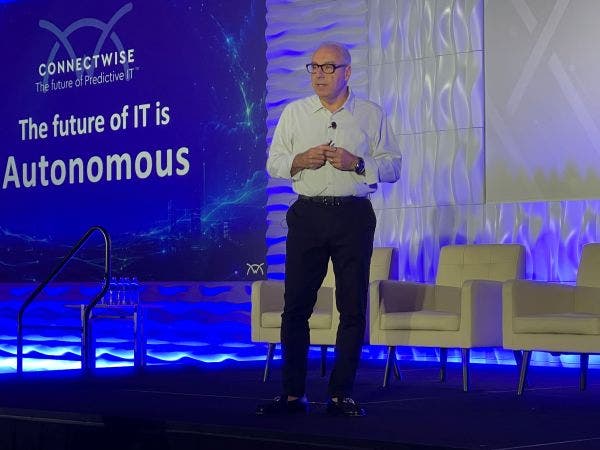
The IT industry is quickly adopting AI but needs to do so in a more careful fashion.
That’s the word from David Raissipour, chief product and technology officer at Tampa, Fla.-based MSP platform technology provider ConnectWise, who told an audience of MSP executives at last week’s XChange 2026 conference that while businesses are looking to adopt AI, they are still in reactive mode.
“For many, and this is not meant to offend anybody, please do not take offense, we’re still in reactive IT,” Raissipour said. “That does not mean we don’t use automation. We don’t use tools, but for the most part, we’re waiting for somebody to ask something for something, and we go do it for them.”
[Related: ConnectWise Dismantles Asio To Build AI-Powered MSP Platform]
XChange 2026 is owned by CRN parent company The Channel Company.
Raissipour admitted that ConnectWise itself has yet to go all-out on autonomous AI, and despite having a host of what he called “these magical agents,” his company is still “in this world of reactor. We respond to the things that come in.”
Raissipour outlined the journey that businesses, including MSPs and ConnectWise itself, can experience on the way to taking advantage of AI to add autonomous operations and predictive intelligence. That is a five-phase journey that includes:
- Operationalize AI
- Extend The Workforce With Agentic AI
- Supervise AI
- Autonomous Operations
- Predictive Intelligence
Raissipour’s outlining of the way MSPs can get to predictive intelligence is exactly what The Support Source was looking to learn at XChange, said Mary Giardina, operations director for the Toronto, Ontario-based MSP.
“We showed up to this conference with that in our heads,” Giardina told CRN. “What were we going to learn about predictive IT, and how do we consistently move away from reactive? And as an organization, we are constantly thinking about what will help our techs perform better. And that’s a multi-layered answer because they don’t just need tools. They need the right culture. They need the right expectations of themselves. They need training. They need to clear expectations from me.”
When it comes to things like providing a help desk, accountability is extremely important, Giardina said.
“Whenever we’ve seen some sort of hiccup in the help desk, it is because there was always a question around clarification, expectation, and accountability,” she said. That’s where predictive IT comes in. That’s the space where I think techs are the most stress minimalized. I don’t want to say stress-free, but I think the closer you get to the point where they can really be predictive about everything, the happier they become. They can organize themselves better. It’s easier for them. And who wouldn’t want that? Who doesn’t want to wake up in the morning and know, ‘Hey, this is what I can basically expect for my day?’”
According to ConnectWise’s Raissipour, here are the different phases of the IT journey:
Phase 1: Operationalize AI
Just like many other vendors in the industry, ConnectWise initially focused its AI journey on operationalizing IT, Raissipour said.
“We started doing things like building AI assistants,” he said. “We had this thing called Sidekick. It was an AI assistant helping you answer questions within the context of what you had. We automated certain tasks. We built RPA (robotic process automation). There’re other RPA products on the market that helped you do things like dip your toe in the water with automation. That happened over the last couple of years. For many of our partners, you’re well on your way down this journey.”
Phase 2: Extend The Workforce With Agentic AI
In the second phase, businesses move from generative AI to agentic AI, Raissipour said.
“Remember generative AI?” he said. “Lots of pictures of my English bulldog playing cards. Agentic really started to say, ‘How can I extend my workforce? How can I not hire those 170 additional people. And how can I improve my SLA for my customers that rely on me? How can I make them happier and keep that business? That is extending the workforce that’s here today.”
Nearly everyone in IT is dabbling in agentic AI, Raissipour said.
“If you have not heard of agentic, you probably should pick up your bag and move,” he said.
Phase 3: Supervise AI
Phase three is going to be a challenging one for many, because this is about where people step out of the way, supervise while AI makes decisions around what actions other agents take, Raissipour said.
“This is where having the right framework, the right permission model, right safeguards, all of those things come into play, and this is what makes the job exponentially more difficult,” he said.
Raissipour said ConnectWise expects to have completed its journey into phase three by the end of 2026.
“We built this into the platform because we want to be able to build it across everything that we have, with a common authorization model, with a common permission model, with common concept of users, all of that is built into the platform, and that’s what allows us to get into this model of being able to supervise AI, and then eventually AI monitoring AI.”
That, Raissipour said, will lead to AI being able to create new agents as needed to perform a certain task.
“Build new skills that you haven’t defined yourself, where people, instead of managing other people, become a supervisor of a virtual fleet of employees, AI agents that can go do things,” he said. “This is not a new concept. Go to an automotive plant, and what you see is people supervising robots down the assembly line to make sure that they do the right thing. It’s just something that we’ve been doing for many years that is now being extended to a new industry, and that’s what at least we should feel comfortable with. That it’s not about taking over the world; it truly is about simply redefining our part of the contribution to achieving a task. That’s what’s allowing us to advance more quickly.”
Phase 4: Autonomous Operations
Raissipour defined autonomous operations as a move toward automated IT that does not rely on AI for every task. Instead, he said, autonomous IT combines AI with deterministic automation, using the right tool for the job. The key here is that autonomous operations does not rely exclusively on AI.
“Using AI to do everything is the proverbial using a jackhammer to put up a picture,” he said. “It’s not the answer. There is lots of deterministic automation, which is a far more cost-effective, far more accurate, and far more traceable way to do things. Think of tasks like onboarding a new user. You don’t need AI. That’s deterministic automation.”
For Raissipour, autonomous operations means automating customer needs before they become requests, with the goal of improving SLAs, customer satisfaction, and gross revenue retention while shifting people toward higher-value work by using a combination of tools one has at their disposal to automate tasks.
“Moving to the world of managed intelligence provider, it is about anticipating the needs of your customers, helping them eliminate that ask in the first place, improving your SLA, improving customer satisfaction, improving your GRR (gross revenue retention), so that your business can grow, so you have happier customers. … Instead of worrying about triaging an alert that comes in about network issues, you can actually focus on hiring people that can help your customers also adapt this technology, not just about you using the technology. That’s what makes them more productive so you can upskill the people and focus on things that generate new business opportunities, new revenue streams.”
Phase 5: Predictive Intelligence
Raissipour defined the fifth phase of the AI journey, predictive intelligence, as the recognizing that most IT issues have been seen before and now looking for signals before they occur and not just predicting the future.
“We’ve all seen it,” he said. “Ninety-plus percent of everything that we ever see on a given day, we’ve seen before. It’s not new. New IT issues don’t pop up every day. Zero-day vulnerabilities don’t pop up every day, although probably more than they used to. Which means if I’ve seen it before, I can actually look for signals before it actually occurs. That’s what gets us to this world of predictive [intelligence].”
Raissipour also described predictive intelligence as using existing agents and sensors to detect those signals, analyze them in real time and make predictive resolution part of IT operations in much the same way a PC operating system can find and resolve issues.
“Predictive resolution does not mean you magically make changes to someone’s machine without their knowledge and leave no trail. … The ticket exists,” he said. “The steps are documented. Agent actions are documented. There’s an audit trail. But before you realize that your machine is running out of resources and performance is slow, and you call the help desk and say, ‘It’s taking me forever to do this,’ we can actually detect all those things and free up the resources on your machine and document it and do it in a way where the user context, user permissions, all of that is preserved and documented. We know what happens, so we don’t open back doors to nasty things happening on your machines, which is what happens sometimes when you do this without the right framework in place. That is the future of predictive IT.”