Economist: AI Should Change How Solution Providers Price, Deliver Value
AI ‘is letting us move closer to what the customer really wants,’ Shawn DuBravac, CEO, president and founder of the Avrio Institute, said.
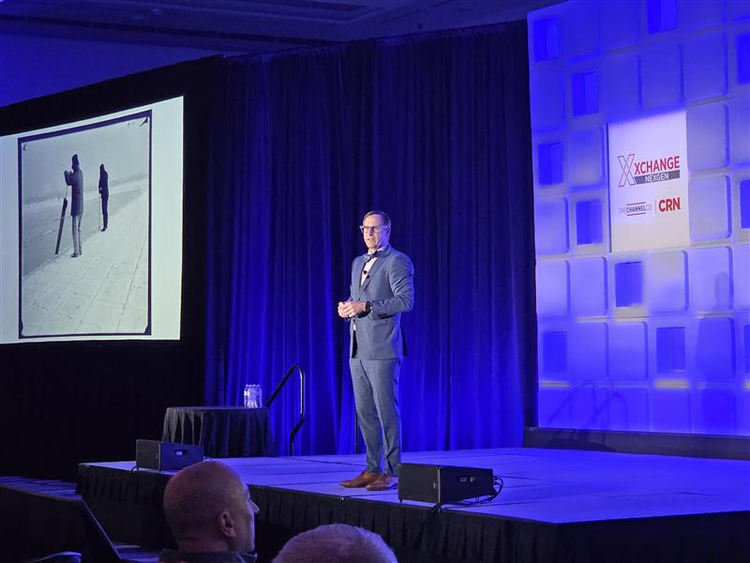
For an example of outcome-based pricing in the artificial intelligence era, look to John Deere.
The agricultural machinery manufacturer officially known as Deere & Co. moved beyond the traditional model of building a tractor and pricing it for cost plus margin with its See & Spray Ultimate product, Shawn DuBravac, CEO, president and founder of the Washington, D.C.-based Avrio Institute research and strategy consultancy, told a room of solution providers during CRN parent The Channel Company’s XChange NexGen 2026 event.
The See & Spray Ultimate, first launched in 2022, uses a 120-foot boom with 36 cameras, computer vision and machine learning to target weeds. The product charges a $5 license fee per acre, but farmers only pay on acres where See & Spray sees no weeds and where no chemicals are used.
DuBravac, who also serves as chief economist for the Bannockburn, Ill.-based Global Electronics Association, said that AI “is letting us move closer to what the customer really wants.”
“It’s letting us align with the value and the outcome that they actually want,” he said. “And that’s the appeal. That’s the attractiveness.”
[RELATED: 10 Hot Products Helping MSPs Tackle AI, Security And Automation]
Mike Goldstein, Southeast Florida market president for Entech, a Fort Myers, Fla.-based 2026 MSP 500 honoree, told CRN in an interview that DuBravac spoke to something solution providers are exploring with their clients around creating insights from unstructured data and assets that now produce data for AI agents to interpret.
Goldstein liked DuBravac’s example with Coca-Cola’s Freestyle soda-pouring machines.
The machines hit the market in 2009 but have advanced in 2026 to give the company data that supports the development of a finished, market-ready drink in as few as 90 days. The traditional process takes 18 months, according to Coca-Cola.
The company has already leveraged that live Freestyle data from roughly 11 million servings per day to develop and launch Fanta Crimson Sour Cherry and Sprite Loco Lime in under three months from concept to pouring.
“I think about it every time I use one of those machines,” Goldstein said. “I just gave them more data.”
Technology’s Incumbency Curse
Solution providers and their clients need to heed the incumbency curse that plagues companies during major technology shifts, DuBravac said. He used the example of the ice-making industry, when ice harvesters were left behind as ice manufacturing developed and then those manufacturers were left behind as Americans bought freezers for their homes.
“It wasn’t really a new industry—it was just being redefined by technology,” he said. “The companies that entered that and shifted it and changed it were entirely new to the industry. And I think that same force is upon us today. When you look at AI and you see how it’s changing not just our own businesses, but our customers and our clients and the organizations we serve.”
The problem for incumbents is focusing on their current successful businesses instead of planning to remain relevant over the next five or 10 years, which can get difficult if customers are looking to merely bolt AI onto their current processes instead of revisiting those processes entirely.
Rethinking Investment, Capabilities, Margins
The AI era requires companies to move beyond treating human capital as their primary growth lever and identify the new areas of scarcity that can deliver the highest margins and returns on investment, DuBravac (pictured) said.
“We have to shift the way we think about growing our business,” he said. “We have to move from thinking about CapEx (capital expenditure) to thinking about building capabilities.”
DuBravac’s comments echoed a philosophical question raised by Nathan Ostrowski, chief operating officer and co-founder of San Francisco-based Petra Security, during a separate NexGen 2026 session.
Ostrowski told solution providers that, to ensure he continues delivering value in the AI era, he repeatedly asks himself: What can he do so well that a model cannot?
Because AI models are “spikey” and show extraordinary capabilities in specific tasks while failing at others, MSPs have an opportunity in helping users better understand when to apply certain models.
“One cool way that I keep thinking about it is just helping clients have that ‘what excuse do you have to do anything’ feeling, sitting in it, and then showing them where the spikes are, because they don’t know,” he said. “They think it’s a uniform blob. But you know where the spikes are. You can discover where the spikes are. And they’re so applicable to every business.”