MSP Execs See AI Revenue Opportunities Grow Beyond Resale Into Consulting, Services
‘We are the guardrail in so many ways,’ says Danny Perry, managing partner of ITCubed.
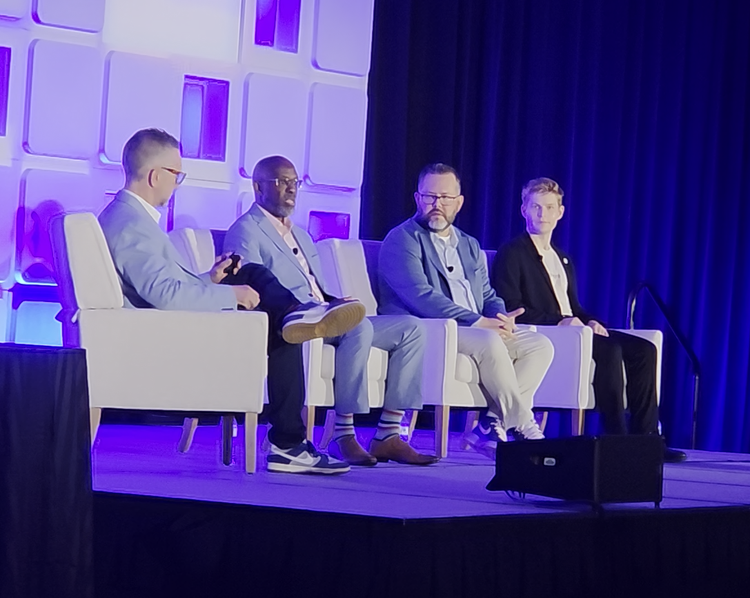
Danny Perry, managing partner of Houston-based solution provider ITCubed, is seeing MSPs’ artificial intelligence revenue opportunity increasingly shift away from resale and toward consulting and business transformation.
ITCubed—a 2026 CRN MSP 500 honoree— has seen its project work increase as the AI era develops and clients progress past initial assessments and executive projects. That project work can create opportunities for monthly recurring revenue (MRR) and ongoing agent maintenance.
“Not necessarily being just an IT provider, but how are you transforming how this business works, how it performs, how it increases its revenues, how it reduces its expenses, how it mitigates risk utilizing AI?” Perry told a room of solution providers this week. “And that’s where we all have some degree of expertise in. And we’re gaining more expertise every day.”
[RELATED: ThreatLocker Exec: Customers Are Pressuring MSPs To Let AI Agents Run]
Perry shared his view of how the money-making opportunities for solution providers are evolving in the AI era as part of a panel held during CRN parent The Channel Company’s XChange NexGen 2026 conference in Orlando, Fla.
Other CRN NexGen 2026 coverage includes articles on supporting and protecting clients and whether AI is actually allowing solution provider customers to cut workforce sizes.
Solution providers need to adopt AI internally so that they can better discuss the technology with customers, Perry said. He also recommended taking an outcome-based approach with clients, identifying specific problems and seeing if AI can help, rather than viewing AI as another product to resell from a vendor.
Perry’s fellow panelist and MSP 500 honoree, Brian Ruschman, president of Covington, Ky.-based C-Forward, said that solution providers can’t leave money on the table at a time when clients have a strong need for AI training. MSPs need to treat education as part of the project.
“We always want to say that stuff maybe is part of a sales process, and it certainly is,” Ruschman said. “But training, for sure, we need to be collecting on stuff like that. And just the ongoing—how it ties into and how it automates things for our clients, we need to be at the forefront of that. We need to get paid for it.”
When introducing new cybersecurity tools for a client, C-Forward conducts billable training every quarter for certain clients. The same goes for AI, with recorded sessions, live sessions, lunch-and-learn events all serving as revenue opportunities for MSPs, he said.
MSPs Become AI Guardrails
Solution providers will serve as the creators of the governance for the AI operating layer, helping clients connect core systems to AI with protocols, permissions, auditing and operational memory with humans in the loop, Perry said.
“We are in interesting times,” Perry said. “For a lot of us who have been in this for a long time, this is invigorating in a lot of ways. We have new things to think about, new ways to really figure out how to profit on this, to make our businesses more profitable, and to really provide a transformative role in the society that we live in. We are the guardrail in so many ways.”
Jason Myers, the panel moderator and cybersecurity strategist for MSP partnerships at Waterloo, Ontario-based OpenText Cybersecurity, said that shadow AI is a growing concern as users turn to their preferred chatbots.
“The users are finding it first, experimenting with it first, solving problems with it first. And then the business is left trying to figure out what to do about it,” Myers said. “Many of you are walking into conversations that have already started. Your customers aren’t starting at zero. They’re not waiting for a strategy document or a roadmap. And they’re definitely not waiting for the green light from you. They’re already testing tools and uploading documents. They’re already comparing platforms and building habits. And some of them are creating real value.”
Organizations are leveraging AI tools to “vibe code” their own software, but that homegrown software can lack the security and governance needed for workplaces. AI guidance, AI support and AI consulting—even as a service—are options for MSPs, he said.
“We all know the cleanup work still shows up,” he said. “But increasingly, the business opportunity shows up, too.”
OpenText has about 16,000 partners worldwide, according to CRN’s 2026 Channel Chiefs.
Nathan Ostrowski, another panelist and chief operating officer and co-founder of San Francisco-based Petra Security, said that solution providers have to show caution around how much data AI chatbots demand and the pervasiveness of the systems inside an organization they touch.
He’s seen popular chatbots import users’ browser cookies, for example. And because AI chatbots use device code flows, this has complicated stopping device code phishing attempts on items like legacy printers.
“Over an exec’s dead body are you stopping those [chatbots] from getting access to an organization,” Ostrowski said.
Guarding against malicious AI agents is hard because every AI model interacts differently, and they are hard to predict, Ostrowski said. Long-time security operations center (SOC) analysts might have trouble with the new paradigm.
C-Forward’s Ruschman said that data he’s seen points to more than half of employees leveraging six or more AI tools in their day. But solution providers have to strike “a happy balance” between shutting every AI tool down and allowing every tool.
“We know that they’re not being governed for the most part,” Ruschman said. “They’re creating processes. They’re changing what they do on a daily basis based on the tools that they have in front of them. You can’t sit back and not use it at all. That doesn’t seem right. You don’t need to put everything into it either.”
Plus, shutting down all AI in an organization will lead to employees likely prompting chatbots on their personal devices. “That’s even remarkably worse,” he said. “So it’s a stumper.”
What Happens To Tier-One Technicians?
The panelists also discussed the evolving IT workforce in the AI age. ITCubed’s Perry said solution providers will continue to need tier-one IT technicians, but the work will look very different.
Those technicians will still need certifications, but they will also need to understand new AI systems, how the solution provider organization works holistically, the agreed-upon outcomes with customers, how to prompt AI and guide AI systems to perform work, he said.
Tier-one technicians today look remarkably different than they did in 2006, C-Forward’s Ruschman said. And so he also sees technicians evolving to use more business data in their jobs and perform more double-checking of work automated through AI agents.
He still sees activities like legal decisions and permanently deleting data staying away from agents.
“There’s going to be a while here where any AI agent, any tool deserves a check in a lot of ways,” he said.
Petra’s Ostrowski said that a philosophical question he continually asks himself to ensure value in the workplace in the AI age is, what is he so good at that a model cannot do? Because AI models are “spikey” and show extraordinary capabilities in specific tasks while failing at others, MSPs have an opportunity in helping users better understand when to apply certain models.
“One cool way that I keep thinking about it is just helping clients have that ‘what excuse do you have to do anything’ feeling, sitting in it, and then showing them where the spikes are, because they don’t know,” he said. “They think it’s a uniform blob. But you know where the spikes are. You can discover where the spikes are. And they’re so applicable to every business.”
Above, left to right: Jason Myers, Danny Perry, Brian Ruschman, Nathan Ostrowski.