ThreatLocker Exec: Customers Are Pressuring MSPs To Let AI Agents Run
‘In a lot of cases, intent is all that differentiates good software from malware,’ says ThreatLocker Chief Product Officer Rob Allen.
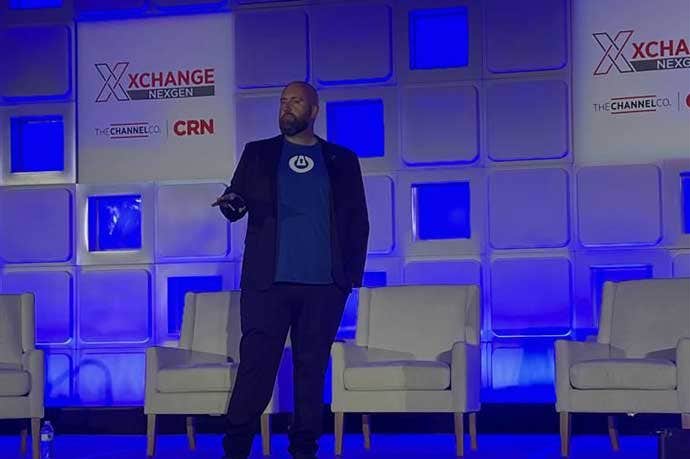
Artificial intelligence demand over the past six months has reached the point where ThreatLocker solution providers are under pressure from their customers to allow AI tools to run.
The key for solution providers is putting best practices into place, including ringfencing and a deny-by-default, permit-by-exception approach, to reduce the risk of threat actors weaponizing AI tools and AI tools ingesting sensitive data en masse, Rob Allen, chief product officer at the Orlando, Fla.-based security vendor, told a crowd of solution providers Monday.
“AI cannot determine intent,” Allen said. “And in a lot of cases, intent is all that differentiates good software from malware.”
Allen spoke at CRN parent The Channel Company’s XChange NexGen conference in Orlando, which runs through Tuesday.
[RELATED: Halo Pushes MSPs Into The Era Of Predictive IT]
ThreatLocker has about 6,000 partners worldwide, according to CRN’s 2026 Channel Chiefs.
Corey Kirkendoll, CEO of Allen, Texas-based Microsoft solution provider 5K Technical Services—a member of CRN’s MSP 500—told CRN in an interview that doubling down on zero trust is a must in the AI age.
“Shadow AI is a real threat,” Kirkendoll said. “We are being proactive by adding AI detection and response and policy enforcement as part of our offering for all clients. It is not optional since the risk will definitely come back to us in the long run.”
From Blocking AI To Allowing It Safely
Organizations can have the best policies in place, Allen said, but nothing stops an employee from ignoring those policies, which is why he advocates a deny-by-default strategy.
Ringfencing can restrict what approved tools are allowed to do while running, helping prevent misuse of legitimate applications such as PowerShell and remote monitoring and management software, Allen said.
Organizations can even block everything except their own Claude or ChatGPT tenant to ensure users are on the company account with enforced company policies and governance.
“These tools have access to everything you have access to,” he said. “They have access to everything that your users have access to, and that is why you need to keep them under control.”
Even security vendors like ThreatLocker have to watch for unsafe employee behavior. Allen said that two months after ThreatLocker started a ChatGPT company account, the user base went from a few users to more than 100. “All of those people were no doubt using ChatGPT before then,” he said. “Personal ChatGPT accounts, free ChatGPT accounts, accounts that we had no control of.”
ThreatLocker isn’t alone in ringing the alarm bell for AI’s growing presence in the cyberattack landscape. This month, Semperis reported that 87 percent of ransomware attacks see threat actors weaponizing AI. In about 70 percent of attacks, the ransomware victims were targeted multiple times. About 30 percent made multiple payments to attackers.
As of Sept. 26, OpenAI, as an example, has notified more than 100 organizations that its models may have bypassed security controls without authorization, the ChatGPT maker recently disclosed.
That OpenAI news has helped fuel merchant bank Yorkville Ives’ belief that security will move from about 5 percent of IT budgets today to 10 percent over the next three years, the company said in a report Monday.
AI Agents Create New Security Risks
Workers are leaking business secrets to chatbots, and AI tools are wiping out production databases, Allen said. In addition, organizations are adopting vibe-coded software platforms that lack enterprise-grade guardrails and governance. And AI agents can go beyond writing their own malicious software to orchestrate entire espionage campaigns, according to Allen.
Vulnerabilities, even in Linux systems, are discovered and exploited faster than ever before, he said.
The number of common vulnerabilities and exposures in 2026’s third quarter jumped about 80 percent from the second quarter, and about doubled year over year, according to data Allen showed in his presentation. By comparison, CVE growth was about flat from 2025’s second quarter to its third quarter.
Microsoft’s September Patch Tuesday fixed about 970 CVEs. October’s fixed about 1,400. By comparison, all of 2024 saw about 1,000 CVEs fixed, Allen said.
“There’s 560,000 new pieces of malware discovered every single day,” he said. “A lot of them are either made with, or augmented with, or improved with, or iterated with AI tools.”
Even AI-powered scanners and cybersecurity tools have been very exploitable, with malicious emails, for example, including prompts that tell AI scanners to ignore red flags and dangerous scripts.
“A lot of people will tell you that AI detection evens the playing field,” Allen said. “The solution to the AI challenge, the solution to the AI problem, is more AI. [But] there are very easy ways to get around AI detection.”