For MSPs, ‘AI Is The Biggest And Greatest Conversation Starter Since The Cloud—Period’
The MSPs that come out ahead won’t be the ones selling the most AI tools but those that can tie AI to real business outcomes and help customers work through the security, data and governance challenges that come with adoption, according to panelists during a discussion on AI at XChange August 2026.
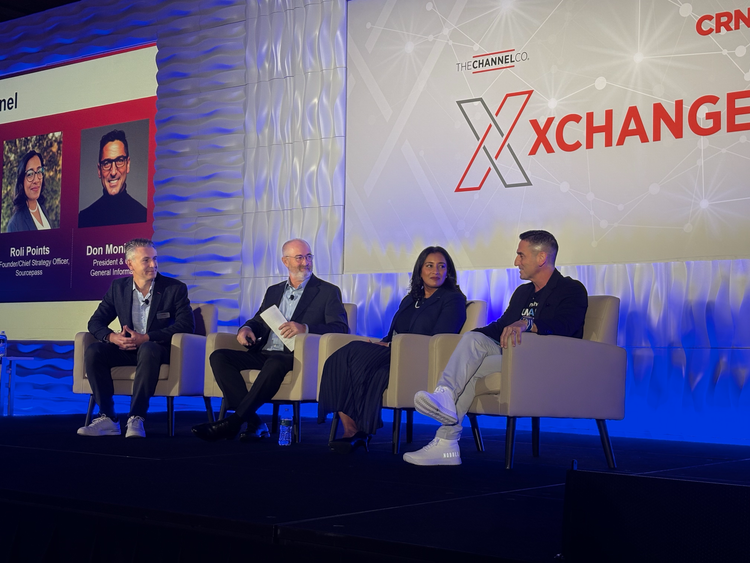
AI has become the biggest conversation starter in the IT channel since the rise of cloud computing, but the industry is still working out how to turn that enthusiasm into sustained revenue.
That was the central theme of an AI panel at CRN parent company The Channel Company’s XChange August 2026 conference in Washington, D.C., this week. The panel was moderated by Stuart Sumner, chief content officer at The Channel Company, and featured Mark Williams, senior consultant with IPED at The Channel Company; Don Monistere, president and CEO of Baton Rouge, La.-based General Informatics; and Roli Points, co-founder and chief strategy officer of New York-based Sourcepass.
Williams said research conducted by IPED over the last three years shows that MSP optimism around AI remains extremely high. The difference now, he said, is that the conversation is becoming more practical.
[Related: AI’s Workforce Shock Is Unlikely To Ease In Near Term: Circana]
“Interest is stronger than ever. It hasn’t died down,” Williams said. “We’ve moved a little bit from, ‘OK, yes, it’s going to change everything around the world today immediately,’ into more of a reality-based discussion, but the optimism hasn’t slowed down.”
The challenge, he said, is that not many channel companies are generating AI revenue yet.
“There’s a lot of optimism, but we’re still trying to figure it out,” he said. “The reality is not a lot of people are making money yet. There’s probably 10 percent of the community that’s driving a lot of it. There’s about another 30 percent that are actively involved, and there’s a whole other set that are trying to figure it out.”
For MSPs, however, he believes AI represents more than a new category of technology services. It’s becoming a way to start conversations that lead to traditional IT projects.
“AI is the biggest and greatest conversation starter since the cloud—period,” he said. “They may not buy AI, but the conversation is starting then. We have this concept called the ‘halo effect.’ A customer asks to talk about AI, but what we end up selling them is completely different, whether it’s a data project, security, modernizing their infrastructure, whatever.”
That halo effect could prove valuable for MSPs that have not yet developed a large stand-alone AI practice. But he warned that MSPs should be clear about the difference between using AI internally and creating AI-related services customers will pay for.
General Informatics’ Monistere said his company began generating AI revenue about two and a half years ago. AI advisory services and its AI platform are generating recurring revenue and project-based income. His largest professional services project for 2026 is an AI engagement. That’s because the company used AI internally before rolling it out to customers.
“When we can show use cases and show how we can utilize agentic AI to do certain things within our organization, it really piques the interest of the client,” he said. “People from all through their organization start sending you ideas of how we can then further the use of AI within their organization.”
His advice to other MSPs is to start small while keeping an eye on larger strategic opportunities.
“When we get a new client, there are two projects that we get involved in,” Monistere said. “There’s the really large project that they’ve been talking about for years and they don’t know what to do and how to get there, and then there’s more of the really small use cases that they’re trying to solve very, very quickly.”
That combination allows MSPs to demonstrate value quickly.
“If you start creating efficiencies within their organization very quickly, all of a sudden you’re the strategic partner that they’ve been looking for for some time,” he said.
AI Strategies Need Security And Governance From The Start
Monistere said customers are experimenting at vastly different speeds, with some still hesitant to adopt basic AI capabilities while others are already considering running their own models.
“There’s a data conversation obviously that you have to have, a permissions conversation, which is a little bit different than security, but the same,” he said. “And then there’s a security conversation that really needs to be had. And as much as most customers would like to tell you that all that’s ticked and tied and everything’s good, it usually isn’t.”
Sourcepass’ Points said her MSP has seen internal benefits from AI, including improved response times, lower costs and better project on-boarding. But many customers are still at the assessment and preparation stage.
“I don’t think our customers are that ready either,” she said. “Even if we could go as fast as we want, a lot of the time our customers are not ready. They still want to do the old school. They can’t even use a chatbot to put in a service ticket.”
For Points, that makes meeting customers where they are a critical part of the MSP opportunity.
Sourcepass is doing projects, assessments and reviews around AI, but Points said AI currently represents a smaller portion of the company’s overall business, although she expects that to increase. And the company’s approach starts with governance and data rather than large-scale AI transformations.
“It’s the crawl-walk-run approach,” she said. “You can’t take on that huge project; you’ve not won their trust. They don’t see you as a full-fledged AI provider.”
Instead, Sourcepass helps customers understand where their data resides, establishes policies and automates smaller tasks.
Points also believes MSPs need to think carefully about who inside their organizations is responsible for driving AI adoption.
The Channel Is Changing
The channel itself is also changing. Vendors are increasingly developing automated partner experiences, AI-assisted support and agentic systems to automate everything from deal registration and marketing to technical assistance and renewals.
But Points said the technology infrastructure connecting those systems remains a bottleneck.
“The vendors are saying the right things, but where the problem, the bottleneck, [lies] is the plumbing, which is the APIs,” she said.
For MSPs, however, the larger lesson is that they don’t need to wait for the entire AI ecosystem to mature before taking action.
The MSPs that come out ahead, the panelists said, won’t be the ones selling the most AI tools but those that can tie AI to real business outcomes and help customers work through the security, data and governance challenges that come with adoption.
Shawn Torres, co-founder and CEO of Slidell, La.-based In-Telecom Consulting, said one of his biggest takeaways from the panel was how many MSPs are experimenting with AI but still struggling to monetize it consistently.
“We’re doing some of the similar things everybody’s trying to figure out, how to monetize it more on an MRR model versus a project-based model. Everything that’s coming out of it today is more project-based,” Torres told CRN.
His company is already bringing in AI revenue through advisory, education and security-readiness services, with a focus on being a strategic adviser rather than a software developer.
“We don’t want to be a software shop,” he said. “We want to be an adviser.”