MSPs Need To Cut Out The Tech Speak To Win Over Business Leaders: Cynomi Exec
‘Technical terminology triggers resistance,’ whereas speaking in the language of business leads to investment, says Cynomi’s Tim Coach.
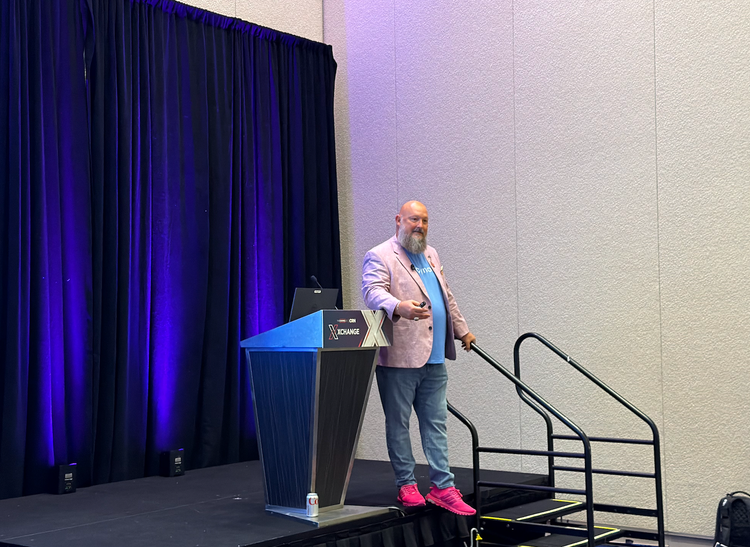
MSPs need to translate technical issues into the language of business to win over clients and grow their businesses in today’s environment, according to Cynomi’s Tim Coach.
“Technical terminology triggers resistance,” said Coach, chief evangelist of community and channels at cybersecurity vendor Cynomi, during a session Monday at XChange August 2026.
[Related: AI’s Workforce Shock Is Unlikely To Ease In Near Term: Circana]
On the other hand, speaking in the language of business more easily leads to investment, he said.
Ultimately, too often, “we speak the wrong language,” Coach said. “We’re nerds. We love zeros and ones. But what we’re not speaking is the business language.”
When an MSP relies on technical terminology and lengthy reports—or even product-focused pitches— executives can fail to understand why the issue should actually matter to them, he said.
That makes it far harder for customers to approve investments, according to Coach.
“Why would they approve a $100,000 project if they have no idea what the actual outcome of that is going to be?” he said. “It’s hard to do that.”
Without a doubt, Coach’s message speaks to a massive shift underway in the MSP sector, according to Martin Perkins, founder of Tech Cartographer, an IT and cybersecurity consulting firm based in Wabash, Indiana.
In the past, MSPs could prove their value simply through their ability to keep technology working, Perkins told CRN.
“That’s our natural habitat,” he said.
And yet, as certain services have become more commoditized—and as the MSP space has consolidated—that type of capability is no longer enough on its own, Perkins said.
Business leaders “deal in outcomes,” he said. “They don’t want to see the grinder that makes the sausage. They want to see the sausage.”
Thus, for MSPs to stand out and create long-lasting value for customers, the goal now must be to move to a deeper level of involvement and integration with customers, Perkins said.
Ultimately, the shift is about “moving from the trusted adviser to being embedded in the business—understanding the processes and being an ROI driver for their clients,” he said.
Putting Into Business Terms
During the session Monday, Coach urged MSPs to frame every technical recommendation around three key issues that business leaders already care strongly about: how much money the company can make, the associated cost and what actual risk could be prevented.
For example, it’s not sufficient just to tell a potential customer that an 18-hour outage would mean production going offline and delays for customers, he said.
Instead, if the outage was going to cost the company $150,000 in revenue, that figure should be the first point brought up in the discussion, Coach said.
“Why didn’t you lead with that?” he said.