N-able Looks To AI Agents To Help MSPs Automate More Of Their Operations
‘We’ve not yet, as an industry, moved to AI as a service. So how do you move from AI as a project-based form of monetization to AI as a recurring revenue source? There are opportunities to move from no longer just selling IT,’ says Laura Dubois, group vice president, product management at N-able.
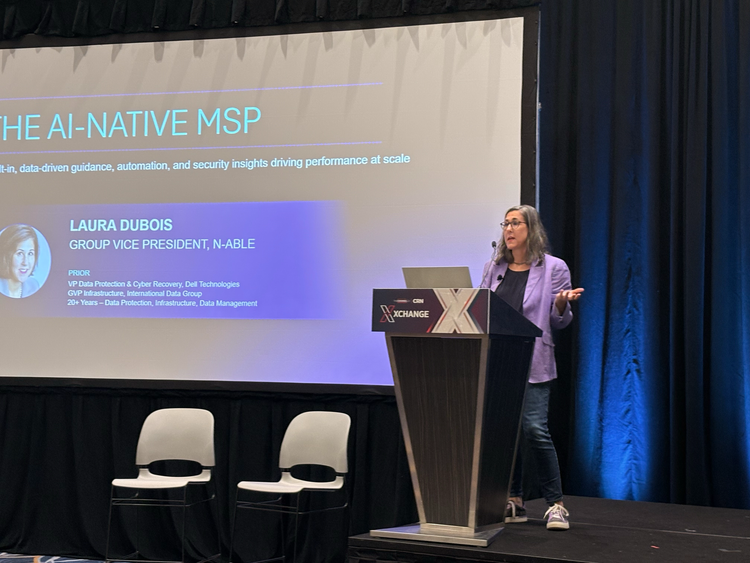
N-able is positioning AI agents as a way for MSPs to move past using AI for isolated tasks and toward more autonomous IT operations.
The Burlington, Mass-based vendor’s vision centers around helping MSPs automate work while maintaining the human oversight and controls needed for security, compliance and business-critical processes.
“We’re in the very early stages of leveraging AI for autonomous operations,” said Laura Dubois, group vice president, product management at N-able, who spoke at CRN parent company The Channel Company’s XChange August 2026 event in National Harbor, Md.
For MSPs, AI creates opportunities on both sides of the business, driving internal efficiency while opening the door to new customer-facing services, she added.
[Related: N-able Names New CRO To Drive ‘Business Resilience’ Strategy: Exclusive]
Today, many MSPs are using AI for customer education, policy development and one-off projects involving tools such as ChatGPT and Microsoft Copilot, she said. The bigger opportunity is turning those capabilities into recurring services that help MSPs move from project-based AI work to ongoing revenue streams.
“We’ve not yet, as an industry, moved to AI as a service,” she said. “So how do you move from AI as a project-based form of monetization to AI as a recurring revenue source? There are opportunities to move from no longer just selling IT. You can become a line-of-business provider, selling into HR, legal, marketing or other functions and offering value that goes beyond traditional IT services.”
In addition, N-able is developing technology to help MSPs orchestrate AI agents across different systems. Its approach centers on an “autonomous control plane” that combines AI agents with procedures, integrations and governance.
The company is also working on AI agents that can handle specific MSP workflows, Dubois said, including root-cause analysis, alert suppression, ticket triage and quarterly business review preparation. For example, an AI agent could analyze information across multiple systems and produce a QBR summary in minutes.
And N-able is incorporating AI detection into its products, giving MSPs visibility into how customers are using AI.
“If I say we’re going to standardize on Microsoft Copilot, and someone at my customer is using ChatGPT and putting sensitive data into a public instance of ChatGPT, well, that’s a problem for you and it’s a problem for the customer,” she said. “Understanding what’s visible and what’s in use, whether that’s in policy or outside of expected patterns, is really important.”
The broader goal, she said, is to give MSPs a path from AI experimentation toward controlled automation, and eventually new recurring services built around AI-driven business outcomes.
Chelsea Skinner said the growing focus on agentic AI could create new opportunities for MSPs, particularly as vendors build marketplaces where MSPs can discover and deploy agents.
“Hopefully that encourages more MSPs to start building out their agents and moving forward in agentic AI,” Skinner, president and CEO of Lewisville, Texas-based Oversee My IT, told CRN.
For Skinner, her team has already experimented internally, developing agents for operational tasks.
“We’ve been building agents internally for internal use for things like dispatch, ticket triage, email review and an executive-assistant style agent,” she said.