WOTC 2026: Why Women In The Channel May Be Best Positioned To Lead The AI Era
‘Women, from an AI perspective right now, are having a moment. We’re seeing this shift where emotional intelligence, communication, adaptability… the things that were sometimes undervalued in traditional tech leadership, suddenly matter enormously,’ says Karrie Sullivan, AI adoption coach and CEO of Culminate Strategy Group.
Women in the channel are no longer waiting for permission to lead the AI conversation — they’re building it themselves.
That was the message from Karrie Sullivan, AI adoption coach and CEO of Culminate Strategy Group, during a discussion on AI transformation, leadership and the evolving role women are playing in the channel’s next era.
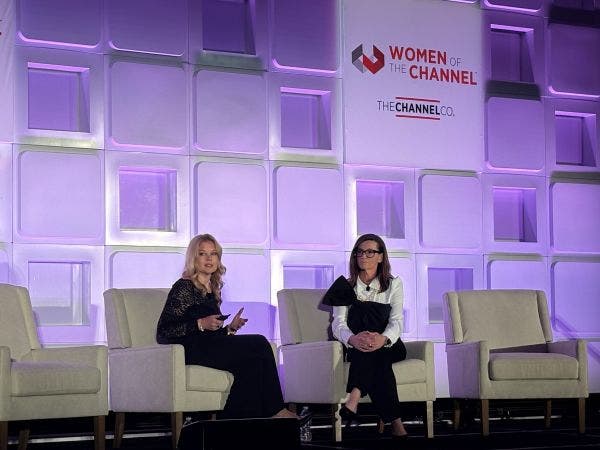
Sullivan took the stage with Kristin Malek, revenue operations leader at solution provider giant CDW, at CRN parent company The Channel Company’s Women of the Channel conference in Carlsbad, Calif., last week and opened up about her own journey into AI consulting and organizational behavior, framing AI not simply as a technology shift but as a deeply human one.
Rather than focusing solely on technical implementation, Sullivan (pictured in above photo on right) said her work focuses on understanding how people respond to uncertainty and change.
[Related: From Boomers To Gen Z, Women In IT Differ On Stress, Leadership, Success]
“I do this by using a machine learning model that reads language from LinkedIn profiles and maps it to developmental psychology,” she said. “What I figured out is that uncertainty holds people back. But what I also figured out is that those who lean into uncertainty, those are the people who thrive.”
That ability to adapt is becoming one of the defining leadership traits in the AI era.
“For the marketers in the room, you’ll get this pretty quickly. It’s basically segmentation, but on employees,” Sullivan said. “What we’re looking for is how people learn, how they adapt to ambiguity, where they are psychologically right now. Because when people feel seen, they actually change their behavior. They don’t do it because you tell them to. They do it because they want to fit in and grow.”
Sullivan’s comments come as the channel is increasingly grappling with how AI will reshape workforce structures, customer engagement and competitive positioning. But amid the uncertainty, she sees a unique opening for women leaders.
“Women, from an AI perspective right now, are having a moment,” she said. “We’re seeing this shift where emotional intelligence, communication, adaptability… the things that were sometimes undervalued in traditional tech leadership, suddenly matter enormously.”
Malek (pictured in above photo on left) agreed, arguing that the AI wave is creating an opportunity to redefine leadership in the channel rather than simply replicate older models.
“For a long time in tech, leadership was often associated with having all the answers,” Malek said. “But AI is changing that dynamic completely. Nobody has all the answers right now. The leaders who are succeeding are the ones who can navigate ambiguity, ask good questions and bring people along with them.”
She added that women in the channel are increasingly well-positioned for that kind of leadership because of the collaborative and empathetic management styles many have developed throughout their careers.
“What I’m seeing is women building influence differently,” she said. “Not by dominating the room, but by creating trust, building alignment and helping organizations move through change without panic. That’s incredibly valuable right now.”
Sullivan warned that companies focusing only on AI tools while ignoring culture and behavior change risk falling behind.
“Technology adoption fails when people don’t feel safe,” she said. “And right now, people are scared, scared of being replaced, scared of moving too slowly, scared of not understanding what’s happening. The organizations that win are going to be the ones that address the human side first.”
Brenda Hudson, SVP of corporate sales, sales enablement, learning and development at Insight, has not yet seen AI directly driving emotional intelligence, but she believes the shift is underway.
“If you want something done, you give it to a woman,” she told CRN. “AI is compressing the long tails of workflows and liberating us to focus on the things that matter most.”
She noted that women have historically carried complex, overlapping workloads both professionally and personally. Rather than replacing human connection, she said AI has the potential to liberate leaders to focus more on their people, creating more space for empathy, relationship-building and stronger emotional intelligence in leadership.
“What AI is doing for us is alleviating tremendous workflows and freeing us to focus on human connection and leadership,” she said.