For Intel, It’s All About Executing Its Goals In ‘Hyper Speed’ With Partners
‘We are rebuilding and strengthening partnerships across the ecosystem. We are doubling down on creating new business opportunities across existing and emerging domains. We are working at the full front to reimagine computing and make it highly efficient for the AI era. And this is just the beginning,’ Intel CEO Lip-Bu Tan said at Computex.
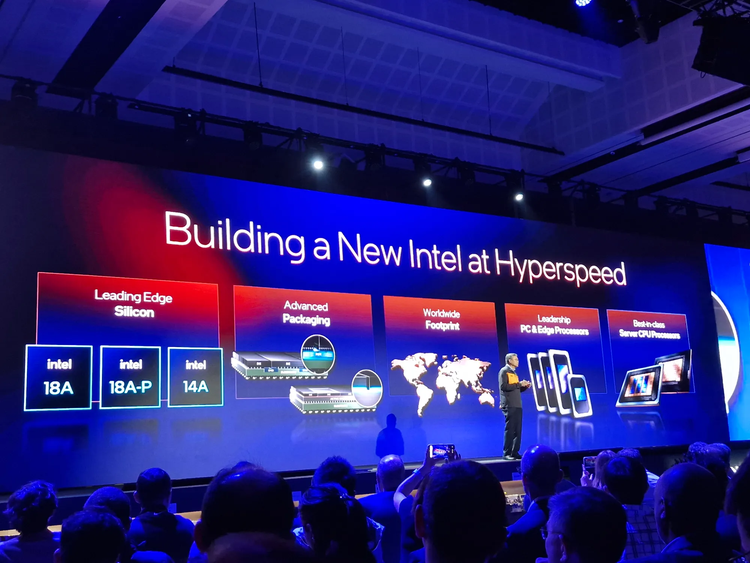
Intel CEO Lip-Bu Tan delivered an interesting keynote at Computex 2026 in Taiwan. The Malaysian-born CEO started his address by highlighting how he is the first Intel CEO who speaks Mandarin. But that’s not all that got the room excited.
“We have to bring focus back to the core. At our heart, Intel is an engineering company. And that’s what I decided from day one of becoming CEO—I have all engineering report to me to drive success in engineering performance. Our customers and partners have seen the shift in Intel, and we are just getting started,” he said.
Tan also highlighted that Intel ships millions of soc orchestrating silicon across every industry, working tightly with its partner ecosystem across each layer of the stack.
“From silicon to system and software, this generates trillions of dollars in value across four core compute ecosystems. First is personal computers. Second is edge, agentic AI and later physical AI. Third are foundational data centers and, finally, emerging intelligence centers that will power digital agents of the future. Each of these ecosystems represents generational opportunity. And increasingly each of these will need purpose-built CPU, GPU and solutions [created] for specific workloads and applications. The silicon we are building now will be for human use and the digital agent use,” Tan said.
In fact, the full house audience was thrilled to see some of the innovations Intel unveiled during the keynote. Specifically, Intel’s Arc G-Series processors, which is a new family of products designed for next-generation handheld gaming systems, and the Intel Xeon 6+ processors, which are the next-generation data center CPU built on Intel 18A and designed for high-density, scale-out workloads.
But the bigger news was actually toward the end of Tan’s keynote when he unveiled a new rack-scale AI infrastructure for customers interested in scaling their inference and agentic workloads based on Intel Xeon processors and SambaNova SN-50 Reconfigurable Dataflow Units (RDUs).
The other announcement was on purpose-built silicon, whereby Intel has strategic collaborations with industry leaders, including Foxconn, Siemens, Hitachi, Echo Neurotechnologies and Greenstone Biosciences.
“We are rebuilding and strengthening partnerships across the ecosystem. We are doubling down on creating new business opportunity across existing and emerging domains. We are working at the full front to reimagine computing and make it highly efficient for the AI era. And this is just the beginning. I’m super excited to continue executing at hyper speed,” Tan concluded.
During the press conference after the keynote, Tan reiterated that under his leadership, Intel wants to drive the leadership in the best CPU in the marketplace.
“This is a journey. And so we’re going to take one step at a time, bring in the best leaders and then the best architecture to drive the product on the PC client,” he said.
The Partner Ecosystem
For Tan, the partnership ecosystem is very important as Intel can’t do it alone. Tan explained that Intel tries to pick that partners that are particularly interested in working with the company.
“The key word is ‘open’ status. We don't want to be a customer to just partner and don’t want to be that captive. We want to be very open and have the best performance so that we can serve the customer’s purpose view. I think that’s the most important [thing] for the new Intel we’ve got,” he said.
With regard to the custom silicon business, Srinivasan Iyengar, senior vice president, fellow and general manager of Intel’s Central Engineering Group, explained that the custom silicon business is not new to Intel.
“Intel has been doing this behind the scenes for a long time, actually. It is just that scale and the focus and how do we really bring this to the rest of the world, especially when the Foundry is strengthening up. That was the whole goal here. Having said that, Google and Intel announced a major partnership where Intel is delivering the infrastructure custom unit, which is a key piece of silicon that gives the hyperscalers the performance that it needs,” he said.
Intel also unveiled a partnership with Ericsson in the telecom space on custom silicon, whereby Intel delivers the infrastructure silicon, state-of-the-art infrastructure silicon for the next generation on a global scale.
“The pipeline is very strong because custom silicon is the buzzword that the industry has been tapping into for a while. And we are very excited for two reasons. One, because of the assets that Intel has. And the next is the fact that we are an ITM, and the wafer shortage is such a big thing, it’s a lot easier for me to work around this. For me also, the ecosystem is very important. In my business, I probably need more ecosystem partners than internal help because there are technology nodes that I might not have. So it’s very, very important that we figure out how to leverage the ecosystem,” he concluded.
This article originally appeared on CRN sister website CRN Asia.