Nvidia CEO Sees ‘Significant Growth Opportunities Ahead’ Despite China-Related Hurdles
‘Over the next five years, we’re going to scale into—with Blackwell, with Rubin and follow-ons—effectively a $3 trillion to $4 trillion AI infrastructure opportunity,’ Nvidia CEO Jensen Huang says as the company reported double-digit growth across all of its businesses in the second quarter.
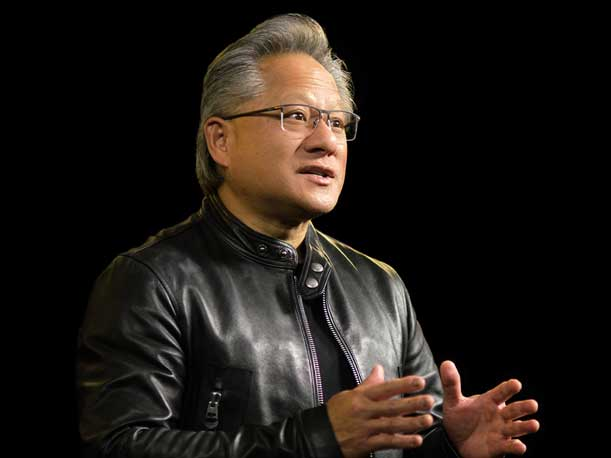
Nvidia CEO Jensen Huang said that he sees “significant growth opportunities ahead” that could allow the company to seize a “large part” of an AI infrastructure market it forecasts to reach up to $4 trillion by the end of the decade.
The Nvidia founder made the comments Wednesday after the Santa Clara, Calif.-based company reported second-quarter revenue of $46.7 billion, up 6 percent sequentially and up 56 percent from the same period last year. This was in line with Wall Street’s expectations and about $1.5 billion higher than Nvidia’s forecast.
[Related: 5 Things Intel’s CFO Said About US Equity Deal, CPU Road Map, Foundry Warning And Other Topics]
“Large [cloud service providers] are coming out, renting capacity from other CSPs. And so the AI-native startups [are] really scrambling to get capacity so that they could train their reasoning models. And so the demand is really, really high,” Huang said on the second-quarter earnings call.
With the top hyperscalers alone representing about $600 billion of capital expenditures in AI data centers every year, Huang said, it isn’t “unreasonable” to imagine Nvidia growing to represent a “significant part” of that spending as it ramps up over the years.
“Over the next five years, we’re going to scale into—with Blackwell, with Rubin and follow-ons—effectively a $3 trillion to $4 trillion AI infrastructure opportunity,” the CEO said, referencing its currently available Blackwell GPU computing platforms as well the Rubin GPU platform it plans to launch next year.
Nvidia Continues To Deal With US Export Control Fallout
Huang offered this bullish stance despite the company saying that it did not sell any H20 GPUs to Chinese customers in the second quarter as it continued to deal with the fallout of the Trump administration’s export controls that restricted sales of the product into China.
Nvidia did, however, manage to sell roughly $650 million in H20s to an unrestricted customer outside China, which resulted in a $180 million release of previously reserved inventory for the second quarter.
Back in May, the company incurred a $4.5 billion charge in the first quarter related to export controls against the H20 and said that the restrictions resulted in the loss of $8 billion in H20 sales for the second quarter.
Colette Kress, Nvidia’s CFO, said on the Wednesday earnings call that the U.S. government began reviewing licenses for the sale of H20 GPUs to Chinese customers.
“While a select number of our China-based customers have received licenses over the past few weeks, we have not shipped any H20 based on those licenses,” she said.
Kress also referenced the Trump administration’s “expectation” that the U.S. government “will receive 15 percent of the revenue generated from licensed H20 sales.”
However, the CFO added, the federal government “has not published a regulation codifying such requirement.”
While Nvidia decided to not include H20 sales in its third-quarter revenue forecast as it continues “to work through geopolitical issues,” Kress said, the company expects $5 billion in H20 revenue for the period if those issues get resolved.
In the meantime, the company is continuing to “advocate for the U.S. government to approve” a version of its Blackwell GPU for China.
“Our products are designed and sold for beneficial commercial use, and every license sale we make will benefit the U.S. economy, the U.S. leadership in highly competitive markets,” Kress said. “We want to win the support of every developer. America’s AI technology stack can be the world’s standard if we race and compete globally.”
All Nvidia Businesses Grow By Double Digits
While Nvidia’s data center business continued to drive the most revenue thanks to ongoing demand for Hopper- and Blackwell-based platforms, the company saw double-digit percentage growth across all of its businesses, including gaming.
Data center revenue came in at $41 billion, which made up nearly 88 percent of total revenue, representing a 5 percent sequential increase and a 56 percent year-over-year increase. Within the segment, compute revenue represented about 82 percent of data center sales, declining by 1 percent sequentially but growing 50 percent year over year.
Networking revenue within the data center segment, however, increased by 46 percent sequentially and by 98 percent year over year.
Nvidia said that Blackwell platform revenue in the data center segment grew by 16 percent sequentially, with broader platform growth driven by large language models, recommendation engines as well as generative and agentic AI applications.
Data center networking sales growth, on the other hand, was driven by the NVLink compute fabric connecting its Blackwell-based GB200 and GB300 systems as well as its XDR InfiniBand and Ethernet platforms.
Gaming revenue increased by 14 percent sequentially and by 49 percent year over year to $4.2 billion, driven by “strong sales and increased supply” of its Blackwell-based GeForce RTX graphics cards that launched at the beginning of the year.
Professional visualization revenue came in at $601 million, up 18 percent sequentially and up 31 percent year over year, thanks to a ramp-up in sales of Blackwell GPUs for laptops that are used for “AI workflows, real-time graphics rendering and data simulation.”
Automotive revenue increased 3 percent sequentially and 69 percent year over year to $586 million due to “strong adoption” of Nvidia’s self-driving platforms.
Lastly, the “OEM and other” segment grew by 56 percent sequentially and by 97 percent year over year to $173 million. The company did not elaborate on what drove sales.
Nvidia estimates that it will make $54 billion in revenue for the third quarter, plus or minus 2 percent. At the midpoint, this would represent a 15.6 percent sequential increase and a 53.8 percent increase from the same period last year.