Oracle Q2 Earnings Preview: 5 Things To Know
Oracle leadership will likely field plenty of questions on not just AI, data center revenue, but also on the quality of that revenue, profit margins and customer diversity.
Analysts on Oracle’s quarterly earnings call this week will likely want to hear more than just new revenue milestones from the vendor’s artificial intelligence products and data center buildouts.
Instead, it’s likely that leadership of the Austin, Texas-based company will field plenty of questions on the quality of that revenue–what margins is the vendor seeing, is it getting business from companies not named OpenAI and what tools are in place should OpenAI face struggles in the years ahead.
These are some of the biggest topics to come up Wednesday when Oracle reports results for its second fiscal quarter, ended Nov. 30. And answers from the vendor’s C-suite could provide important information for solution providers also investing in meeting AI demand–or wondering about the quality of that revenue in the short term.
[RELATED: Salesforce Q3 Earnings: CEO Benioff Calls SaaS Industry’s Death By AI A ‘False Narrative’]
Oracle Q2 Earnings
Oracle could report revenue growth of 16 percent year over year for the quarter, Bernstein said in a note Monday. The investment firm assumes revenue growth of about 75 percent from Oracle Cloud Infrastructure, a significant acceleration from the 55 percent growth reported the prior quarter.
KeyBanc, on the other hand, put OCI growth at 67 percent in the quarter, coming in at $3.88 billion and total revenue growth of about 13 percent to $16.14 billion. In a report Friday, the investment firm said to expect capital expenditures to more than double to about $8 billion in the quarter, with fiscal year CapEx going above Wall Street expectations and reaching $36.57 billion.
Oracle could also report another bump in its pipeline, according to a KeyBanc report Friday. The investment firm does think that bump won’t be as earthshattering as the nearly $500 billion remaining performance obligation amount that sent Oracle’s stock roaring last quarter. KeyBanc estimated RPO coming in at $523.3 billion for the quarter.
Read on for what you need to know ahead of Oracle’s latest quarterly earnings call.
Spotlight On Co-CEOs
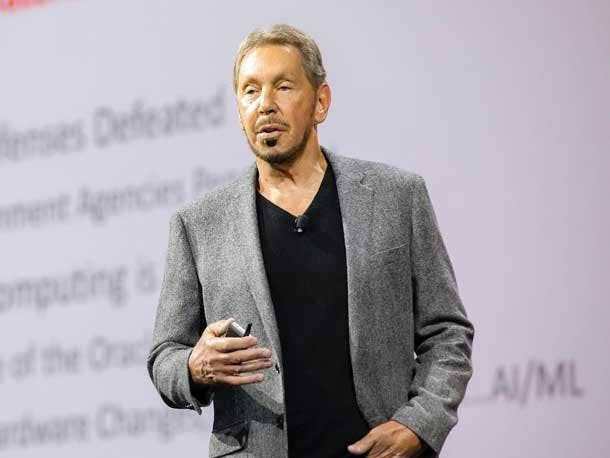
Wednesday will mark the first chance for Oracle’s new co-CEOs to share quarterly earnings call airtime with co-founder and Chief Technology Officer Larry Ellison. It is also the first call without Safra Catz in the top role, having moved to the position of executive vice chair. She had served as CEO since 2014.
Assuming both CEOs speak on the call, they may have offered a previewof what they hope to get across during the vendor’s AI World conference in October.
Infrastructure-focused CEO Clay Magouyrk said in his AI World keynote that Oracle’s focus on hardware flexibility is now paying off in the AI era when OCI is optimized for a variety of hardware accelerators, investing in disintermediation to drive down network fees for customers and working with Microsoft and Google to charge zero egress fees for multicloud customers–among other differentiators.
“We’re constantly focused on living up to our commitment to be the highest performance, lowest cost and most secure infrastructure possible,” he said. “And we get closer to that ideal every single day.”
Oracle’s other co-CEO, Mike Sicilia, who leads the applications side of the business, said in his keynote that Oracle is helping customers unlock AI use cases with the structured and unstructured data they’ve long stored in the vendor’s database products.
He said customers are using AI to decrease hiring time, resolve service tickets, more accurately predict cash flow, flag supply chain risks and more. Employees gain more time for more strategic and creative work with once-manual tasks now automated. “You’re getting real results with no extra cost and no waiting,” he said.

The Cost Of AI
Oracle dazzled investors during the previous quarterly earnings call with a massive pipeline of contracted work to fulfill–a pipeline (or remaining performance obligation, in cloud vendor speak) that crossed the $500 billion mark, as revealed during AI World 2025.
However, investors appear ready to hear more about how much AI buildout will cost the vendor, with its stock price down almost 10 percent since the September earnings call, according to a Monday report by Bernstein. Oracle’s stock traded at about $221 a share at market close Tuesday.
Bernstein remained optimistic on Oracle’s business for the long haul, saying that Oracle is on its way to becoming the No. 3 hyperscaler by revenue and largest AI training vendor in the Monday report. The firm said that Oracle needs to update the world with more clarity on capital spending and free cash flow as it builds data centers to meet AI demand.
It’s a possibility that Oracle’s free cash flow (FCF) remains negative going into fiscal year 2029 due to capital expenditure spending, KeyBanc said in a Friday report.
As with other AI and cloud giants such as Microsoft, timing of revenue recognition is fluid and could shift between quarters, Bernstein said. Microsoft earlier this year contended with constraints in compute and then data centers.
Oracle still needs to answer how it underwrites customers’ ability to pay for data center capacity contracts, the size of cash and lease investments Oracle needs to take on over the next five years and the size of cash and lease CapEx over the next year or two, according to the investment firm.
The vendor should also clarify exits it has in data center leasing should a customer defaults or ways it can repurpose or sublease data center capacity, according to Bernstein. The firm also wants more information on whether training or inference workloads are more valuable to Oracle.

Takeaways From Latest Snowflake, Salesforce Quarters
Quarterly earning results from AI and data products vendors Snowflake and Salesforce last week bolster Oracle’s arguments for growing its spending on data centers to meet AI demand.
Both companies showed signs of growth in their AI revenue–Snowflake saw $100 million in AI annual recurring revenue (ARR), one quarter earlier than anticipated, according to a Bernstein report. Because Snowflake’s business is consumption based, not license based, the milestone reflects real-world enterprise usage, not testing and demonstrations. The vendor also reported more than 7,300 accounts now using Snowflake AI capabilities every week.
Although Salesforce’s business comes from licensing more so than consumption, the $1.4 billion ARR it reported from Data Cloud and AI–more than double year on year and with AI agents building platform Agentforce individually surpassing $500 million, quadruple growth year on year–shows the growth of AI. Agentforce accounts in production grew 70 percent quarter on quarter, according to a Wedbush report.
Salesforce has also closed 18,500 Agentforce deals, up from 12,500 its prior fiscal quarter. About 9,500 of those are paid deals, up from 6,000 the prior quarter, according to a Morgan Stanley report.
Salesforce’s Data 360 product ingested 32 trillion records, more than double year on year, also reflecting greater demand, according to a William Blair report. The firm estimated that Data 360 ARR is around $900 million and grew 60 percent year on year.

Turning Pipeline Into Revenue
The vendor said during AI World it has a $225 billion consolidated revenue goal and unveiled a series of increased expectations for Oracle Cloud Infrastructure (OCI) revenue going into the 2030 fiscal year–although Oracle maintained its $18 billion expectation for the 2026 fiscal year.
Oracle’s path to $104 billion in revenue by fiscal year 2029 is less fraught with than initially believed when the vendor revealed that much of its AI contracts come from a handful of companies, Bernstein said in its Monday report.
For Wednesday, Oracle’s own forecast suggests 4 points of total revenue growth acceleration and at least 15 points of acceleration to OCI revenue growth, Bernstein said.
Oracle (and likely its solution provider partners) continue to collect revenue from enterprise resource planning (ERP) products moving to the cloud, though that growth is decelerating over time. OCI growth is driven by capturing more of the sovereign cloud market, although it's a relatively small portion at less than 15 percent. And Oracle’s partnering with Microsoft, Amazon Web Services and Google is moving more database revenue to the cloud, according to Bernstein.
The AI contracts that pumped up Oracle’s RPO come with multiple tranches, each around five years long, according to the firm. RPO is also partly defined as non-cancelable agreements, and the AI data center agreements don’t allow for mid-term hardware changes. Oracle has also put gross margins for AI revenue at around 35 percent, higher than Wall Street expectations but still lower than Oracle’s traditional business.
The Oracle method of data center build out is also different from other AI vendors that actually build and own the data center. Instead, Oracle is leasing data centers, which shows up in the company’s cost of goods sold (COGS) and not its CapEx.
As for Oracle servers, the vendor assembles its own and likely doesn’t take ownership of parts until six months or less time before the data center goes live, according to the investment firm. This also limits CapEx exposure from data center delays or client problems.
Bernstein also dismissed concerns around one of Oracle’s biggest customers, ChatGPT maker OpenAI, being unable to generate enough cash for its non-cancelable contracts. The investment firm called OpenAI “too big to fail” at this point, with other companies likely stepping in should OpenAI experience cash problems. OpenAI has a data center capacity contract worth about $300 billion with Oracle.
It’s possible that Oracle’s leadership is ready to assuage concerns with details on a diversity of cloud commitments by model providers beside OpenAI, KeyBanc said in its Friday report. Meta is another of the AI giants doing business with Oracle.

Competition From NeoClouds?
A topic that could come up during Wednesday’s earnings call is whether Oracle sees a competitive threat from so-called neoClouds–specialized cloud providers built for intensive artificial intelligence (AI) and high-performance computing (HPC) workloads.
A number of startups that could be considered neoClouds have also popped up in recent years and raised big money in 2025, with names including Armada and Fireworks AI even offering partner programs. More established players in the space with partner programs include Vultr and Lambda.
Investment firm Bernstein said in its Monday report that it wants to hear more about potential competition from neoClouds–but it also acknowledged the possibility that neoClouds could become profitable customers for Oracle should it end up with unused data center capacity that can be subleased or repurposed.