Salesforce Q3 Earnings Preview: 5 Things To Know
Informatica, a potential AI bubble and Salesforce’s M&A strategy are expected subjects for the third-quarter earnings call Wednesday.

Integrating Informatica. Artificial intelligence bubble concerns. And Salesforce’s merger and acquisition strategy.
These are among the biggest items expected to come up during the San Francisco-based enterprise software vendor’s earnings call Wednesday for the third quarter of its 2026 fiscal year. The quarter ended Oct. 31.
Salesforce subscription revenue should come in at 8.7 percent growth year on year ignoring foreign exchange rates, coming in at $9.7 billion, according to a KeyBanc report from November. Expected Sales Cloud growth of 8.8 percent year on year and Service Cloud’s 8.1 percent expected growth year on year should drive that.
[RELATED: Informatica CEO Walia Sees Consumer AI, Enterprise AI On Separate Journeys]
Salesforce Q3 Earnings
Amit Walia, CEO of newly acquired Salesforce subsidiary Informatica, told CRN ahead of the sale closure that AI watchers should not equate the consumer AI adoption cycle with the enterprise AI cycle.
Adoption by enterprises has come slower than everyday consumers, but that isn’t bad news for solution providers partnered with Informatica. The company and its ecosystem continued to see investment in data infrastructure not just for AI, but for digital transformation and data governance projects not necessarily using AI as well in Informatica’s latest fiscal quarter, Walia said.
Informatica solution providers should still see plenty of opportunity working with customers on proofs of concept, moving AI projects into production and shaping a budget for AI projects, Walia said. He sees economic upside from the AI wave playing out at least another five to 10 years.
Here’s more of what to expect on Wednesday when Salesforce co-founder and CEO Marc Benioff and his team discuss third fiscal quarter results.
Partner Opportunities
Although Salesforce executives don’t always discuss business opportunities with the vendor’s 16,000-plus partner ecosystem on earnings calls, Benioff’s thoughts on global systems integrators on the previous call could signal more insight to come for the community on Wednesday.
In September, Benioff said on the earnings call that he’d like to see larger Salesforce systems integrator partners “move their business downstream to serve these companies that have single-digit-thousand” employees.
The vendor’s channel chief, Phil Samenuk—who became Salesforce’s senior vice president of global alliances and channel revenue in February—told CRN in a recent interview that partners can expect more resources and more enablement to pursue growing business opportunities in the agentic AI era.
Post-implementation work helping the vendor’s customers with consumption pricing—Salesforce is better known for seat-based pricing—is one of the biggest opportunities for Salesforce solution providers, Samenuk said.
“We will not be a successful consumption company without our ecosystem and partners,” Samenuk said. “The focus and expectations on the ecosystem have never been greater. … It just shows that Salesforce is really evolving its thinking and not just relying on what got us here.”
Most partners surveyed by investment firm KeyBanc ahead of Wednesday said they saw positive results in the ancillary clouds and Agentform, with more enterprise pilots, each pilot usually costing around $50,000.
The surveyed partners saw positive conversations around Agentforce Vibes and Voice and positive momentum in Life Sciences Cloud, according to KeyBanc. Some partners reported longer sales cycles than normal amid a global economy facing changing tariff policies and other economic headwinds.
In perhaps another sign of Salesforce investing in its partner ecosystem, the vendor recruited Andrew Kisslo in November as senior vice president of partner programs and strategy, according to Kisslo’s LinkedIn account. He will work with Brian Landsman, CEO of Salesforce’s AppExchange marketplace.
Kisslo came to Salesforce from SAP, where he worked for almost three years as senior vice president of global partner marketing, according to his LinkedIn account. He also worked as a director at SAP in the 2000s.
His resume includes about 16 years on and off with Microsoft, most recently serving as senior director of Microsoft 365 product marketing with a focus on direct and assisted sales channels for small and midsize companies until 2023.

Informatica Integration
Salesforce executives will likely want to talk about the integration of newly acquired Informatica into the CRM giant and the ways Informatica’s data catalog, governance, privacy, master data management and other capabilities improve Salesforce’s offerings.
Salesforce completed its Informatica purchase on Nov. 18. Informatica’s platform will help fragmented enterprise data become context for AI agents to improve reasoning, acting and outcome delivery for users and should offer advancements across the Salesforce portfolio, from the MuleSoft integration platform to the Tableau data visualization tool.
Informatica should help unify Salesforce’s fragmented datasets and allow customers to bring larger volumes of external data into Salesforce, William Blair said in a November report. The investment firm added that Informatica should be accretive to Salesforce operating margin within 12 months, a year ahead of the timeline originally shared when Salesforce disclosed the deal.
In November, ahead of Informatica’s official sale closure, the company reported a 29.5 percent year-over-year increase in cloud subscription annual recurring revenue, with its AI-powered Intelligent Data Management Cloud fueling demand. That marks an acceleration over the prior quarter’s 28 percent increase.
Informatica’s Walia told CRN that solution providers should still expect “tremendous innovation” from Informatica to meet customer demand for artificial intelligence and digital transformation capabilities.

Details On New Revenue Targets
Analysts on Wednesday’s call might seek more details around Salesforce’s new revenue goals revealed back in October.
In October, Salesforce said it now projects more than $60 billion in revenue by fiscal year 2030. That amount doesn’t include Informatica and implies 10-plus percent organic compound annual growth rate from fiscal year 2026 to fiscal year 2030, according to the vendor.
The company also unveiled a net-new annual order value metric to measure its success, with the metric forecast to keep accelerating.
Analysts on Wednesday’s call are looking for reacceleration signals in the core cloud products, with confidence in double-digit growth for subscription and support revenue in fiscal year 2027, KeyBanc said in a November report.
Sales and Service Cloud revenue should grow in the high single digits, according to the investment firm. Platform revenue should grow double digits.
The investment firm said it expects an update on Salesforce’s Data Cloud and AI annual recurring revenue and ARR growth, which was last revealed to be more than double year on year at $1.2 billion-plus.
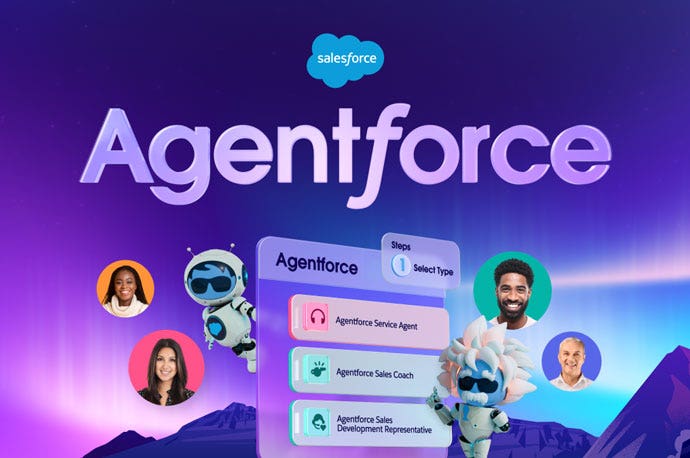
The firm thinks a dedicated ARR number for the Agentforce AI agent building platform, however, isn’t likely. Last quarter, Salesforce saw 6,000 paying Agentforce customers, up from 4,000 the prior quarter.
An AI Bubble?
Analysts will likely seek Benioff’s thoughts on the AI market and his company’s place in it, particularly as concerns about an AI bubble popping emerge.
Salesforce was among a group of companies removed from Wedbush’s AI 30 winner list, with the investment firm citing slower-than-expected monetization of Salesforce’s Agentforce strategy across its enterprise installed base.
The investment firm said in a Monday report, however, that it still feels “very positive” about Salesforce’s performance overall, with more enterprises slowly building agents within Agentforce. Wedbush also dropped SoundHound and ServiceNow from its AI 30 list while adding CoreWeave, Iren Limited and Shopify.
Wedbush also called AI bubble fears “overblown” because of room to grow in consumer AI, AI-driven autonomous systems, AI-driven robotics and less than 5 percent of U.S. enterprises “truly” going down AI strategic paths, according to the firm. The firm has seen about 20 percent of the AI-driven deal flow at hyperscalers accelerate over the last month, growing focus by end-user enterprise customers on fast-tracking AI use cases and $550 billion to $600 billion in capital expenditures set for AI in 2026, keeping the market humming for at least “the next few years.”
Wedbush also estimated that more than 20 percent of cloud services include some form of AI and about 20 percent of IT budgets now have an AI influence and AI focus. It expects the global AI market to hit $407 billion by 2027 and $1.81 trillion by 2030, a 36 percent CAGR.
Salesforce M&A Strategy
The vendor closed on the purchase of process intelligence software company Apromore while working on the Informatica acquisition and closed on the purchase of agentic analytics platform Spindle AI on Nov. 21.
On Monday, Salesforce revealed that it completed the acquisition of agentic enterprise search company Doti.
This year, Salesforce also bought AI agent company Convergence, prospecting platform Bluebirds, natural language-to-SQL platform provider Waii and AI-powered business process automation technology provider Regrello.
Analysts may look to ask Benioff and his team about Salesforce’s M&A strategy in 2026, especially analysts that have criticized Salesforce’s acquisitions sprees in the past and their eating into margins.
Salesforce solution providers have told CRN that the vendor can take a long time integrating newly acquired companies into the rest of the portfolio to enable partners looking for new revenue opportunities.