Salesforce’s Dreamforce 2025: Channel Takeaways Involving Agentic AI, SaaS
‘I really think this is the next revolution,’ Salesforce co-founder and CEO Marc Benioff says.
General availability for Salesforce Agentforce 360. A new goal of $60 billion in revenue by the 2030 fiscal year. And more ways to pay for artificial intelligence.
San Francisco-based customer relationship management (CRM) software giant Salesforce made plenty of announcements this week as part of its annual Dreamforce conference, with some of the news shedding more light for solution providers not only on how the vendor’s own AI products are growing, but on the trends Salesforce sees in customer demand for AI and how the technology is evolving software-as-a-services (SaaS).
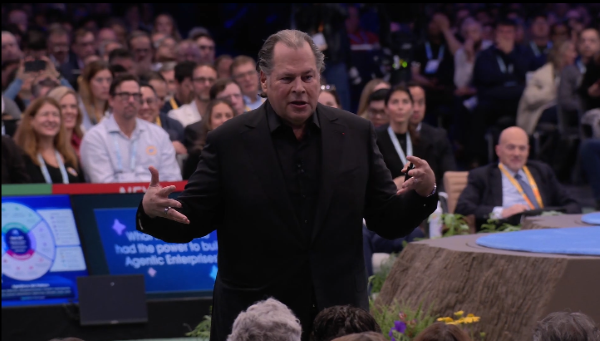
Salesforce co-founder and CEO Marc Benioff said in his keynote address at the conference that his company will play a major role in turning companies into agentic enterprises, bridging an agentic divide where consumer AI is bringing everyday people more power than enterprises.
“I really think this is the next revolution–we’ve gone through cloud, we’ve gone through mobile, we’ve gone through social, we’ve gone through predictive AI,” Benioff said. “Now we’re entering this new agentic AI revolution.”
[RELATED: Salesforce Launches Agentforce IT Service, Opening New Doors For Partners]
Salesforce Agentforce 360
Michael Utell, chief commercial officer for the Salesforce practice at Jacksonville, Fla.-based Bridgenext–No. 213 on CRN’s 2025 Solution Provider 500–told CRN in an interview that much of his team’s work has been helping clients understand Agentforce and all it can bring by putting clients on the path to becoming agentic enterprises.
The solution provider has been building a unique practice that is a mix of managing Salesforce for enterprises and its product development side, Utell said. Many clients still need traditional data cleanup work to get the most out of the vendor’s AI wares.
Bridgenext “is trying to help our clients not just implement Salesforce–there’s a lot of fish in the sea that go and implement Salesforce–but truly understand why they are implementing and what return they’re getting,” Utell said.
The many Agentforce capabilities still in development and the transparency on Salesforce’s growth plans over the next year-and-a-half reflect some near-term challenges for the vendor, William Blair said in a report Thursday. However, the investment firm still saw Salesforce as well-positioned in the medium and long term for bringing generative AI to enterprises.
As a holder of much of enterprise data, Salesforce tools present a strong case for being the leaders in delivering AI agents, Bernstein said in a Thursday report. That evolution is important with AI threatening the traditional per-seat pricing model of Salesforce’s biggest product, Service Cloud, and as the largest technology vendors and smallest startups threaten Salesforce in not only AI, but its traditional customer relationship management (CRM) market.
Salesforce is also trying to break into new markets, most notably the IT service space dominated by players such as ServiceNow. Bernstein predicted more difficulty for Salesforce becoming an AI force in newer markets where it has less data, context and expertise, instead using its existing data and context to drive AI adoption in its core markets.
Here’s more of what the channel can take away from Salesforce’s news around Agentforce 360 and monetizing agentic AI.
Agentforce 360 Goes GA, Some Capabilities Still In Development
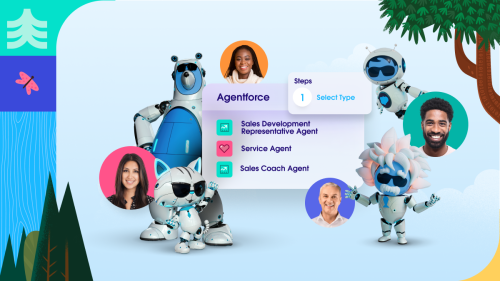
Salesforce made its Agentforce 360 platform generally available during the conference, giving users new capabilities with a conversational artificial intelligence agent builder, agent scripting and hybrid reasoning for greater control and accuracy, voice and a trusted, unified data layer for agent context.
The Agent Script and hybrid reasoning capabilities could prove especially helpful for knocking down barriers to agentic AI adoption, adding if-then business logic for agents instead of trying to limit them with just prompts, William Blair said in a Thursday report. Enterprises fear losing control of AI models and agents once unleashed and suffering material adverse consequences.
Agent Script is in pilot, with public beta expected in November, according to Salesforce.
As AI vendors fight for the dominant user interface for the AI era–with potential contenders being chatbots like Microsoft Copilot and OpenAI’s ChatGPT, operating systems like Microsoft Windows and collaboration applications such as Microsoft Teams–Salesforce is putting its own Teams rival Slack forward as a way to put AI agents to work.
Slack serves as the real-time interface for humans and agents, with Agentforce 360 also bringing “vibe coding” capabilities for enterprise developers who want to work with customer data and embedded governance capabilities.
Slack users can leverage Agentforce 360 and other Salesforce products without leaving the app, getting answers in natural language based on data from Google Drive, GitHub, Atlassian Jira and other sources.
Along with an IT service-focused version of Agentforce, Salesforce also unveiled ones for human resources (HR) service, field services and supply chain. Salesforce has rolled out industry-focused Agentforce 360 offers for life sciences, public sector and manufacturing.
Alongside all the news around Agentforce, Salesforce showed its continued acquisition strategy for inorganic innovation, revealing in the lead up to Dreamforce that it expects to close the acquisition of Melbourne, Australia-based Apromore in the fourth quarter of its fiscal year 2026. Apromore should add to Salesforce’s capabilities in business process discovery, simulation and optimization, Salesforce said in a statement.
So far, Agentforce customers are still largely in the pilot phase, William Blair said in a note Thursday. The investment firm hopes to see more scaled Agentforce deployments and large Agentforce deal sizes in the future.
Salesforce now has about 10,000 paid Agentforce customers leveraging it to deflect support cases, cut down incident resolution times, handle job candidate conversations outside of work hours and other use cases. That number is up from 6,000 in the second quarter, according to William Blair. The vendor is targeting 20,000 paid customers by the end of the year.
The innovations unveiled by Salesforce during Dreamforce 2025 reflect lessons from the past year of trying to grow enterprise AI adoption, Morgan Stanley said in its Thursday report. A lack of reasoning depth limited the consistency in agent performance from natural language instructions. And AI answers were inaccurate or incomplete due to challenges from digesting complex, unstructured data.
Third-Party Partnerships Reflect Changes In SaaS
Perhaps the most exciting partnership news to come out of Dreamforce was a bi-directional expansion in how Salesforce is working with ChatGPT maker OpenAI and Claude maker Anthropic.
Salesforce and OpenAI are now at work making Salesforce’s Agentforce 360 applications and Agentforce Commerce available in OpenAI’s ChatGPT chatbot and AI assistant, with details promised “in the coming months,” according to Salesforce.
From ChatGPT, users will have the ability to query Agentforce sales records and customer conversations and even build Tableau visualizations, according to Salesforce. The companies will give users a new commerce experience for selling to hundreds of millions of potential U.S. users in ChatGPT.
As part of the partnership, Salesforce Agentforce Commerce will integrate with the Agentic Commerce Protocol, the standard that powers ChatGPT’s instant checkout capability. Slack also gained a ChatGPT application option for bringing OpenAI’s tool into Slack.
The collaboration could be a testament to both companies’ AI leadership–and the evolution of applications in the AI era.
“The SaaS landscape is changing — with dedicated point-and-click applications evolving to include multi-surface, agent-driven conversations,” Salesforce said in its statement on the partnership. “This partnership advances that shift by combining OpenAI’s frontier models and capabilities and Salesforce’s data-grounded enterprise workflows across ChatGPT and Slack, which together support over 800 million weekly users and 5.2 billion weekly messages, respectively.”
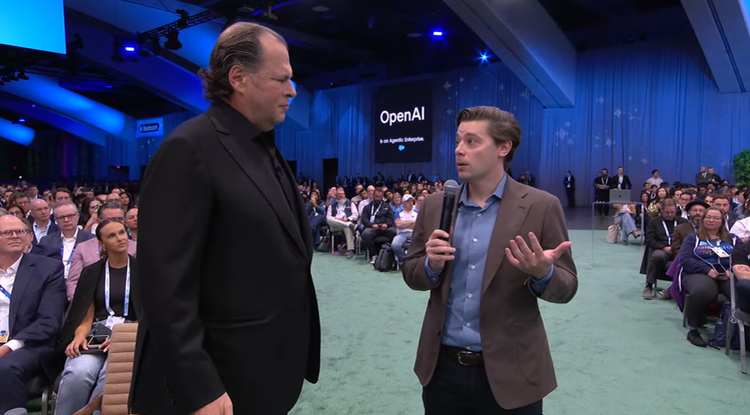
During Salesforce co-founder and CEO Marc Benioff’s keynote address, he spoke with OpenAI Chief Operating Officer Brad Lightcap (pictured above, right, with Benioff, left), who said “we’ve got to integrate with the systems and tools that people use” and “it’s all got to be trust-based” — good signs that, at least for now, ChatGPT isn’t a replacement for Salesforce.
Salesforce’s expanded Anthropic partnership will allow Salesforce regulated industry users to leverage the Claude family of AI models while keeping sensitive data and workloads secure in a trusted Salesforce environment. Anthropic becomes the first large language model (LLM) provider fully integrated within the Salesforce trust boundary. The companies also plan to bring Agentforce 360 into the Anthropic Claude chatbot.
The vendor also revealed during Dreamforce 2025 that the Slack-native AgentExchange marketplace allows for agents and applications from Anthropic, Cursor, Google Cloud, OpenAI, Perplexity, Vercel and Writer. Agentforce 360’s low-latency transcription, realistic speech synthesis and other voice capabilities work with contact-center-as-a-service (CCaaS) vendors Amazon Connect, Five9, Nice and Vonage.
And the new Tableau Semantics capability in the platform translates data into business language and ensures consistent metrics across clouds, even working with third-party data vendors Databricks, dbt Labs and Snowflake.
The focus this year on partnerships goes with an overall more measured message by Salesforce executives in how soon AI drives a meaningful amount of its own revenue after touting at last year’s Dreamforce the ease of making Agentforce agents and how Agentforce will dominate enterprise AI, Bernstein said in a Thursday report.

$60 Billion In Revenue By 2030
With plenty of industry handwringing over how AI agents will change how people interact with enterprise applications made by the likes of Salesforce, the company’s executives shared with analysts this week longer-term revenue projections to show continued growth by the vendor.
Salesforce executives have introduced a $60 billion revenue target by its 2030 fiscal year with a 10-plus percent compound annual growth rate (CAGR) and marking an end to a period of decelerating growth. That dollar amount excludes any revenue Informatica brings in after Salesforce closes on that acquisition, according to the vendor.
Salesforce’s goals imply a 40 percent operating margin target, according to a Thursday report by William Blair. The math also suggests about $24 billion in annual operating income in fiscal 2030, above investor expectations.
Its executives also maintained previously announced goals for the current fiscal year–$41.1 billion to $41.3 billion in total revenue, up about 8 percent year on year ignoring foreign exchange, up about 9 percent in subscription revenue growth and 34.1 percent operating margins, Morgan Stanley said in its Thursday report.
The vendor said to expect a gradual revenue inflection in 12 to 18 months–around the second half of its 2027 fiscal year–and told analysts to watch net new annual order value as a key metric for revenue acceleration. Salesforce defined NNAOV as annual contract value (ACV) minus lost annual order value.
Salesforce attributed continued deceleration in subscription revenue growth to negative NNAOV growth dating back to fiscal 2023, William Blair said in a Thursday report. NNAOV growth has been accelerating recently, however, with bookings acceleration and improved attrition. Now, Salesforce executives need NNAOV to exceed total AOV, which executives expressed confidence in achieving.
The vendor reported its latest quarterly earnings in September, marking $10.2 billion in revenue for its second fiscal quarter, up 9 percent year on year ignoring foreign exchange. It ended the 2025 fiscal year Jan. 31 with $37.9 billion in total revenue, up 9 percent year on year.
Salesforce also revealed to investors that its total agentic AI annual recurring revenue (ARR)–which includes Agentforce–in the second fiscal quarter was about $440 million, up fivefold year on year. Data Cloud brought in about $800 million in ARR.
Although Salesforce didn’t explain what all is included in agentic AI ARR, the number is higher than the $100 million Agentforce AOV Salesforce disclosed during the first quarter, according to William Blair.
The vendor predicts a potential triple or quadruple annual recurring revenue (ARR) uplift for customers expanding agentic AI across their businesses, according to a Salesforce statement. The vendor’s Data and AI offering reached $1.2 billion in the second quarter, more than double year on year.
Although generative AI has likely proved disruptive to Salesforce’s business, more competition in the vendor’s traditional customer relationship management (CRM) business and a saturating cloud market may have contributed to revenue deceleration in recent years, Bernstein said in a report Thursday.
The investment firm said that it wants to know how much Salesforce growth will come from subscription and AI usage compared to services, with a large amount of services needed to implement generative AI and build agents–perhaps good news to Salesforce solution providers and other channel partner businesses.
Salesforce has been growing its seller ranks, KeyBanc said in a report Wednesday. Sales capacity has grown 20 percent year on year and should continue to expand. The sellers are focused on life sciences, international public sector, field service and other high-growth segments. Salesforce also expects to grow technical sales representatives from the mid hundreds to 1,000 by year’s end.

The Price Of Agentic AI
The Agentic Enterprise License Agreement that Salesforce introduced during Dreamforce represents yet another way for customers to pay for AI, this time with unlimited consumption and unlimited licenses at a fixed cost.
That means unlimited consumption in Data Cloud, Agentforce and MuleSoft and unlimited licenses for Slack and Tableau Next.
The AELA joins seat-based offers launched in the second quarter, giving paid users unlimited access to Agentforce for a significantly higher price on their seat stock-keeping unit (SKU), pay-as-you-go pricing for getting started quickly without usage commitments, and a pre-commit model for discounted consumption pricing for agreeing to higher levels of Agentforce usage, according to William Blair’s Thursday report. AELAs will go to about 150 accounts in the second half of the year.
Salesforce also has flex agreements for users to switch between per-seat licenses and Agentforce credits depending on headcount changes. The new Agentforce Voice low-latency interactive voice response (IVR) feature costs 15 cents per voice action.
The vendor will likely consolidate some of its payment models based on customer feedback, but for now the many options reflect meeting customers where they are and lowering barriers to adoption, William Blair said in its Thursday report.
Consumption-based pricing can prove too uncertain for some enterprises, Bank of America noted in its Thursday report. Salesforce can also use the AELA to foster more comprehensive AI deployments in its customers.
The vendor appears to have scrapped a previous offer for $2 per conversation, Bernstein said in its Thursday report. Salesforce executives are hopeful for AI consumption growing enough to offset reduced spending on per-human seats in the AI era along with AI-embedded products having a multiplier effect on contract value.
While the death of SaaS in the AI era is “overblown,” according to Bernstein, AI could enable more competition and put pressure on pricing if more technology vendors start offering the same products with less differentiation. It’s not clear yet whether agentic AI is monetizable and profitable or more so a cost of doing business.
Salesforce is hardly the only vendor to experiment with different payment models for AI, with Microsoft also rolling out consumption-based pricing for some offers, subscriptions and other payment models.

Salesforce Partner Feedback
Salesforce partners have been seeing gradual pipeline build for Agentforce, Bank of America said in a report Thursday. They also saw demand for Sales Cloud and Service Cloud staying stable or even improving.
Partners have also seen in-line performance in the latest quarter, with growth in the high single digits, Morgan Stanley said in its Thursday report. The investment firm found Salesforce executives and customers at the conference more excited and confident in the product portfolio than channel partners. Partners said customers continue to scrutinize deals amid uncertainty around global tariffs and other macroeconomic factors, plus they have trouble proving the return on AI investment.
However, partners did see high activity around Data Cloud and Agentforce, perhaps an indication of projects moving from proof of concept to production, according to the investment firm. Customers moving into piloting can increase spend by as much as eightfold. Going into full deployment can lift spend as much as 25 times.
Partners have told KeyBanc that the difficulty in predicting the total cost of ownership (TCO) for Agentforce has proven a hurdle. Partners also now feel the responsibility of helping customers figure out pricing, optimizing how agents use credits and finding the lowest usage cost, according to the investment firm’s Tuesday report.
Salesforce co-founder CEO Marc Benioff even spent time on the company’s pricing strategy toward the end of his Dreamforce keynote address.
“We had one pricing model a year ago,” he said. “It’s clear, one pricing model is not right for every company in the era of the agentic enterprise. So we’ve had to radically shift our pricing, and we want to thank you for the advice that you’ve given us.”