IBM CEO Touts Partner Opportunities In Power, Storage, Quantum
“That middle bucket of, ‘How do I help a client exploit quantum?’ is going to be the massive unlock and where I want to urge people to start thinking,” says IBM CEO Arvind Krishna.
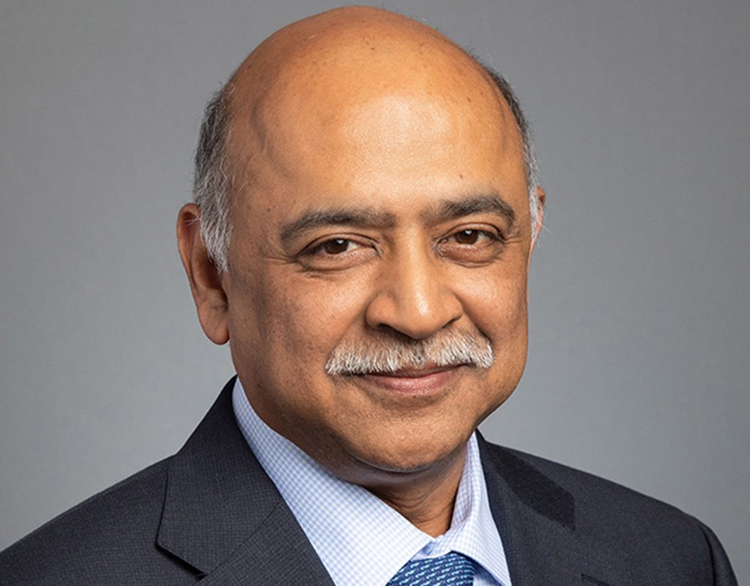
As IBM Chairman, President and CEO Arvind Krishna leads the technology giant through the artificial intelligence era, he’s encouraging the vendor’s solution providers to explore a hardware sales opportunity resonating with customers today—the data center component crisis—and to start laying the tracks for the next technological paradigm shift of quantum computing.
Solution providers that have faced shrinking price quote windows and inability to get certain data center components should look to the Armonk, N.Y.-based vendor—including its Power high-performance enterprise server suite and Storage data storage systems and management software, Krishna told CRN in an interview.
“Because we are good about trying to manage our supply chain, so all of those costs, and we’re good about maintaining pricing for at least a month at a time—right now, I think that that’s remarkably better than most of the competition because some of them are only good to hold prices for a week as opposed to a month,” the CEO said.
[RELATED: IBM CEO Krishna: In The Age Of AI, ‘Who Do You Want To Trust?’]
IBM CEO On IBM Power, Storage, Quantum
On quantum, multiple solution providers that partner with IBM and its enterprise-grade open-source technology division Red Hat told CRN that they are notching early wins in quantum through readying clients for post-quantum cryptography (PQC).
“Going in [to client environments] to say which parts of the infrastructure need to be getting their cryptography to evolve is an opportunity that’s measured probably in the tens of billions [of dollars], if not even bigger,” Krishna said.
Wes Brown, CTO of Brentwood, Tenn.-based solution provider Arctiq, told CRN in an interview that his company has been among the solution providers educating customers on migrating to quantum-safe ciphers and workflows to protect their data.
“The best that we can do here is we’re talking to our customers as early as we can, helping them understand what that looks like,” Brown said.
IBM Distributed Infrastructure Presents Partner Opportunity
The increased cost and decreased supply of various data center components have put pressure on not just IBM, but the entire IT channel.
Customers pulling funds from other projects to secure data center components in the near term to avoid future price increases and shortages had enough impact on IBM’s latest quarterly earnings to receive a call-out by Krishna in a letter eight days before IBM’s official earnings call.
IBM customers shifted CapEx to servers, storage and memory, which hit IBM’s Z mainframe business and associated software sales, primarily in transaction processing. Krishna also acknowledged that IBM didn’t adapt to the new infrastructure spending environment quickly enough, with some large deals moving to close later than expected.
However, the quarter also presented potential opportunity in the IBM portfolio due to the component crisis. IBM’s distributed infrastructure business grew 37 percent year on year in the latest quarter, its best quarter of revenue growth on record. IBM entered its current quarter with $500 million in backlog for the business and now expects the Power, Storage and overall infrastructure portfolio to grow in the low single digits in 2026.
“Given that we have supply—not necessarily of everything, but of a lot of the parts and systems that we can sell in Power and Storage—I would strongly urge our partners to, say, leverage the fact that we have supply to go sell,” Krishna said. “Remember, if you take an order from one or some our competitors or people in the ecosystem, but if they can’t fulfill the supply, you actually don’t make any money. And we can [fulfill supply].”
Alex Talmor, president of Toronto-based solution provider GlassHouse Systems, told CRN in an interview that some customers have accelerated component purchases to get ahead of cost increases. Others have sought ways to get more life out of their existing infrastructure. And then others have looked to the cloud.
Customers have taken budget away from projects to cover component costs, Talmor said. “It’s times three, times four the initial cost,” Talmor said. “We’re left with no ability to execute on things that we had lined up.”
Krishna said that procurement alone won’t help in the component crisis. Instead, he suggested solution providers explore ways to increase clients’ token efficiency, noting that even a tenfold increase in efficiency is an effective counter against growing prices.
IBM engineers, with about a week’s work, recently found a way to get 80 times the tokens per minute out of a leading-edge open-weight AI model, going from about 10,000 tokens per minute to 800,000, Krishna said. Even achieving one-tenth of that efficiency is an opportunity for solution providers working with clients on right-sizing their new infrastructure.
Soaring Memory Costs Reshape Infrastructure Spending
Data center component cost increases show no signs of halting. Memory could become a $1.5 trillion market opportunity in 2030, and DRAM prices are up threefold since the start of the year, with NAND prices up almost the same, according to an August report by investment firm William Blair.
The memory crisis points to a shift in the industry from compute-centric AI to a memory-centric model for storing growing parameter footprints, according to an August report by Bernstein. Memory capacity and bandwidth are becoming more critical determinants of AI system performance and scalability. The adoption of mixture of experts architectures for models helps improve compute efficiency.
The Quantum Computing Era Looms
Meanwhile, Krishna puts quantum among the four biggest platform plays for the vendor. He likened quantum’s potential to the decades of business brought to IBM by mainframes and creating a technological wave akin to semiconductors.
Krishna expects the first examples of quantum advantage on IBM hardware to emerge this year, with the vendor on track for large-scale fault tolerance by 2029. The CEO also believes that critical industries should look to be quantum-ready by 2029—the same year he predicts that IBM launches a large-scale, fault-tolerant quantum computer, a significant milestone.
One sign of the growing post-quantum cryptography opportunity is President Donald Trump’s June executive order, “Securing the Nation Against Advanced Cryptographic Attacks,” which establishes upcoming federal deadlines around PQC.
Krishna recommends solution providers not only look into the IBM-developed, open-source, Python-based Qiskit quantum computing software stack released in 2017 but also start to imagine the algorithms possible on quantum. He sees a few dozen vendors benefiting from the pending quantum infrastructure gold rush, which could see winners in fabrication, control electronics, cryogenics and networking.
“That middle bucket of, ‘How do I help a client exploit quantum?’ is going to be the massive unlock and where I want to urge people to start thinking,” Krishna said.
Lisa Dyer, senior vice president of mainframe at Downers Grove, Ill.-based Ensono—No. 73 on CRN’s 2026 Solution Provider 500 and an honoree on CRN’s 2026 MSP 500—told CRN in an interview that her company has explored quantum-safe computing to prepare customers for the future.
“You can do something about protecting what you have already today so that you are ready for when quantum actually enters mainstream and bad actors can start doing crazy stuff with it,” Dyer said.