Microsoft Partner Chief Nicole Dezen: Partners Deliver End-To-End AI Value
Customers ‘look to Microsoft channel partners as their managed services providers to deliver that end-to-end value,’ says Microsoft Chief Partner Officer Nicole Dezen.

Microsoft’s artificial intelligence technology combined with the services and domain expertise provided by members of its 500,000-member partner ecosystem serve as powerful forces democratizing AI—especially for smaller businesses, Nicole Dezen, Microsoft’s chief partner officer and corporate vice president of global channel partner sales, told CRN in an interview.
“I really do see this as a phenomenal democratizer for customers that don’t have their own IT,” Dezen said. “They look to Microsoft channel partners as their managed services providers to deliver that end-to-end value.”
As the calendar turns to May and the Redmond, Wash.-based technology giant enters the final weeks of its 2026 fiscal year, Microsoft is unveiling and rolling out changes to training and discounts designed to help solution providers with the AI opportunity ahead. Microsoft’s new 2027 fiscal year starts July 1. Microsoft discloses its next quarterly earnings report on Wednesday.
[RELATED: Microsoft Unveils E7 Suite, Copilot Cowork In Enterprise AI Push]
What’s New For Microsoft Partners: E7, Agent 365, Training, Discounts
Dezen spoke with CRN ahead of Microsoft’s new E7 license plan becoming generally available Friday alongside the Agent 365 (A365) agent control plane. For partners selling Microsoft’s Windows 365 Business cloud PC offer, the vendor plans to reduce list prices by 20 percent starting Friday to better appeal to small and midsize businesses.
In the coming months, Microsoft plans to evolve its “frontier badge” into a “frontier partner specialization,” update its “frontier distributor designation” to better signify distributors that can help solution providers scale agentic AI and improve benefits in the App Accelerate program for software companies building AI applications and agents. Dezen revealed the updates in her annual “State of the Partner Ecosystem” blog post, published last week.
The frontier partner specialization should help differentiate services partners, channel partners and other partner business models that demonstrate they can build or deliver agents across the Microsoft product stack, according to the vendor. Customers and Microsoft field sales teams will use the specialization to identify solution providers validated for agentic AI scenarios.
Asked why partners should bet on Microsoft instead of AI upstarts like Claude maker Anthropic and ChatGPT maker OpenAI, Dezen pointed to Microsoft’s platform strategy enabling solution providers to deliver value based on their own intellectual property plus Microsoft’s storied research and development prowess.
“The partner has the capability of pairing Microsoft innovation plus the partner’s own innovation,” she said. “That’s a very powerful formula for customers. Customers count on partners to understand what they need and help them achieve their goals.”
Here’s more of what Dezen had to say on Microsoft solution providers capturing the AI opportunity.
What’s your message to Microsoft solution providers on this phase of the AI era?
We’re seeing AI and agentic move so quickly into production. Customers have incredibly high expectations for what that experience looks like for them in their business.
This is how we think about frontier transformation. This is all about how AI is core to how businesses operate. It’s embedded in their flow work, their business processes, the way they engage customers.
Partners are instrumental in delivering this frontier transformation for customers in every segment, every industry and every geography.
Our focus is really about how we enable and empower customers to meet customers’ needs.
Any themes that are emerging from customer AI adoption that you want solution providers to think about?
Customers need a secure estate from which to then build and deliver AI. There’s no such thing as AI without security, nor security with AI. They really, really go hand in hand.
That’s a lot of what you see in our product announcements this year. Earlier this fiscal year, we announced the Business Premium security suites [Microsoft Defender Suite for Microsoft 365 Business Premium and Microsoft Purview Suite for Microsoft 365 Business Premium made available in September].
We announced Copilot Business [which became available in December and is aimed at organizations with fewer than 300 users]. These are offerings that map to Business Premium right in the heart of SMB customers.
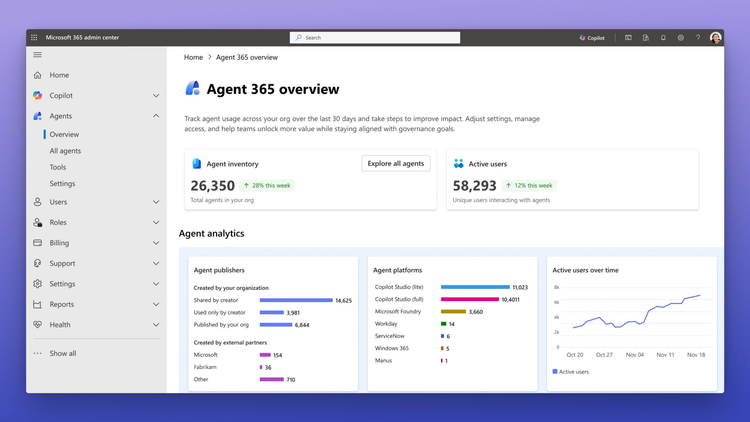
On May 1, we’ll have general availability for M365 E7 [Microsoft’s first new enterprise license plan in about 10 years] and Agent 365 [a control plane for observability and governance for AI agents].
This is really our frontier suite. I’m truly excited about what this means for partner capability and the way that partners can deliver the full suite, secure productivity, identity and access control. Copilot as the UI for AI.
What do you want solution providers to know about Agent 365?
I see this as an absolute game-changer for customers and for partners. The way that I think about this is: The control plane that businesses are very familiar with, the tools they have to govern and manage employee permissions, access and control—now they can apply this to their next-generation workforce, their agents.
And so this is where partner capability really comes into play. Understanding the customer needs, their full estate, all of the capability—and then building and delivering agents that are adding value to customers, businesses.
Why should partners continue to bet on Microsoft instead of some of these new AI upstarts making waves in enterprise technology?
We have a platform strategy. So when partners bet on Microsoft, they’re betting on the fact that Microsoft invests our R&D on innovation, on capability in the platform.
It’s enterprise-grade security, enterprisewide capability. And then partners can deliver value based on their own IP, their services and solutions, their customer depth, their geographic knowledge, any dimension of understanding the customer’s business.
The partner has the capability of pairing Microsoft innovation plus the partner’s own innovation. That’s a very powerful formula for customers. Customers count on partners to understand what they need and help them achieve their goals.

With rising costs, pricing changes and nonstop product updates, what’s your advice to Microsoft partners navigating all this uncertainty?
This is a partner superpower. When I look at the channel, our channel partners are masterful at thinking end to end holistically about what customers need. This is the promise of CSP [Microsoft’s Cloud Solution Provider program].
It’s a really important time for partners to speak to customers about their security posture, about their data estate and, frankly, about migrating to the cloud. There’s a powerful set of solutions. We have very, very healthy incentives in the market right now for partners to move customers to the cloud and set them up for their journey to AI transformation.
For customers that haven’t started yet, there’s still time. And we always suggest to partners to start with Copilot. That is the logical point of entry for customers.
SMB customers—my guidance to partners there is deploy Copilot Business. Pair [with] a strong foundation of our security suites with identity, data protection, compliance. And then help these customers by building and delivering agents that extend that Copilot capability in the customer environment.
This is such an empowering democratizer for SMB customers in particular. And these are customers that count on Microsoft partners to deliver value, understand their business needs and support their growth objectives.
Sounds like partners can use the cost environment to encourage more cloud and AI adoption?
Oh, absolutely. The time is now. We’re seeing more and more customers move to widespread implementation.
This is what frontier is all about. It’s how AI is operationalized across the business. And this is where partners add tremendous value in that they understand the customer’s business goals, thinking about how they want to approach changing the way that they engage their own employees, the way that they engage customers, reimagining business processes.
And then AI is an enhancement and capability accelerator for all of that.
Several Microsoft changes over the years—from the new commerce experience to faster product innovation—have pushed some solution providers more toward distributors. What do partners need to know about the role distributors play in Microsoft’s channel today?
I always start with customers. Where is their customer need? Where is their customer opportunity?
I touched a little bit on the opportunity for SMB customers with AI and agents, and I really do see this as a phenomenal democratizer for customers that don’t have their own IT. They look to Microsoft channel partners as their managed services providers to deliver that end-to-end value. And this is one of the reasons that we’re betting so heavily on distribution.
Last year, [we raised] the bar for distribution authorization. And we’re continuing to focus very deeply on the value that we deliver both to distributors and ultimately to the SMB customers they serve.
The Copilot Business Premium suites that we introduced earlier in our fiscal year, this is really about adding comprehensive capability to Business Premium. These are solutions designed for SMB customers.
We’re updating the “frontier distributor” designation [distribution giants including TD Synnex and Ingram Micro have the designation] to really reflect what it takes to scale agentic AI across the channel.
And this is about helping resellers identify those distributors that are best equipped to deliver repeatable skilling, agent enablement and marketplace-backed motions so that they can transact and grow their sales.
Any updates for Microsoft solution providers on getting the most out of Marketplace?
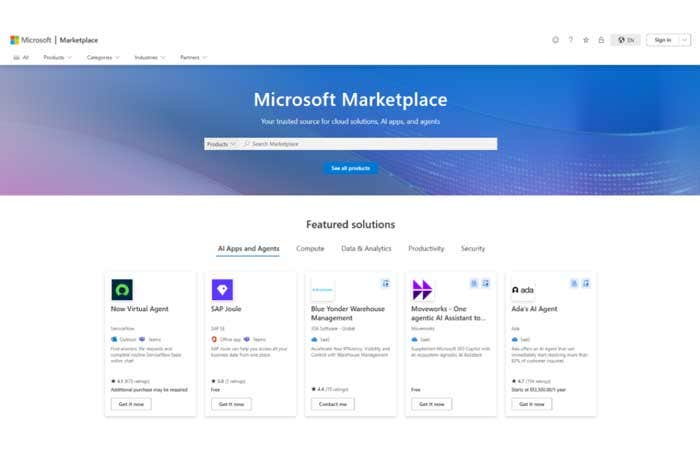
Microsoft Marketplace is the premier destination for customers to find, try, use and buy agents, partner solutions.
We now have more than 5,000 AI solutions available in the marketplace, and that’s growing every day.
This is all about increasing discoverability for all of these AI solutions and certainly agents so that customers have a trusted source to purchase and deploy from.

How is Microsoft looking at investments in training and skilling for solution providers?
We continue to invest all of the capability through the Microsoft AI Cloud Partner Program. This is the home for everything we do to enable partners to build, co-sell and go to market with Microsoft.
We continue to invest in skilling at record levels of investment. This year, we’ve got project-ready workshops. This is about translating skills into repeatable delivery practices for partners. This capability is so critical for partners in an agentic world—for partners to be able to not only build agents, but to be able to deliver them and deliver the security capability that customers need and count on.
We deliver all of this through our Partner Skilling Hub [which became generally available in November].
The Frontier Engineer Badge—this is a new learning path that we’re delivering through our Titan Academy [which was launched in June]. Think of this as readying solution engineers in the partner—as well as their solution architects—so that those individuals in the partner are certified to design, build and operate production-ready agentic solutions for customers.
And this spans our frontier transformation stack. So it includes Copilot, Copilot Studio [Microsoft’s platform for creating, managing and deploying custom AI agents], Foundry [Microsoft’s platform for building, fine-tuning and deploying AI applications and multi-agent systems], GitHub Copilot [Microsoft's AI-powered code generator], Microsoft Fabric [for data engineering and warehousing] and Agent 365.
So this is a huge investment we’re making in partner capability. And we have significant incentives in the market.
With the introduction of ME7 and Agent 365, those incentives are there as well, all part of the solution area capability, where we invest in presales, CSP transaction and, of course, post-sales investments for partners to deliver value.

Is the Microsoft channel partner program keeping up with new economic models emerging from the AI era?
CSP is absolutely the hero motion. And the reason this is so crucial is it brings everything together from a partner to deliver that end-to-end customer life-cycle experience.
In a recent Omdia study where [267] CSP partners from around the world were surveyed, 79 percent rated it good, very good or excellent, 88 percent would recommend it, and 60 percent of CSP partner revenue is now tied to value-added services.
This is the strong indication that partners are delivering that important transaction moment and building services capability on top of it.
These are the partners that are delivering new outcomes to customers, building and delivering agents on top of a secure estate. These are partners that are benefiting from our financial incentives that reward outcomes and growth. We see this as a very repeatable motion.
Are Microsoft partners rewarded enough for growth within an existing customer as much as they are rewarded for new net logos?
Our partner incentive model is grounded in rewarding partners for delivering growth. And growth can look like many things.
That can be a new logo. It can be upsell. It can be enhanced capability.
Think about attaching Copilot to an ME5 customer or to a Business Premium customer. There are many, many ways that we reward growth.