Pax8 Channel Chief On AI: ‘Adoption Alone Doesn’t Create Value, Integration Does’
‘The first step is changing the conversation. Businesses need to start thinking about AI as a new way of operating rather than simply another tool. Instead of asking how to optimize existing processes, they should ask how they would design the business from scratch if AI existed from day one,’ says Ryan Walsh, chief strategy officer at Pax8.
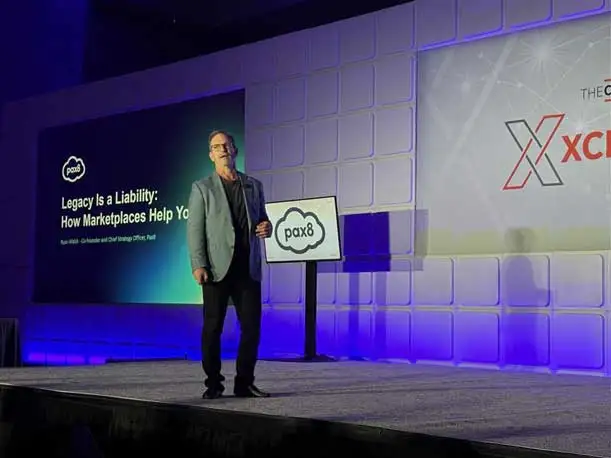
AI adoption is taking off among SMBs, but a new Pax8 study revealed that many customers still need MSPs to help turn experimentation into real business impact.
The Denver-based cloud marketplace’s study, “The Agentic Workforce Economy,” revealed that AI has moved from experimentation to expectation, yet most SMBs remain stuck in what Pax8 calls the “messy middle”–deploying AI tools without integrating them into core operations.
“Adoption alone doesn't create value, integration does,” Ryan Walsh, channel chief and chief strategy officer at Pax8, told CRN. “Small businesses understand that AI matters and they're beginning to adopt it, but most have not yet integrated it into the way they actually operate.”
That disconnect, he said, is preventing many businesses from capitalizing on their AI investments. The study also revealed that SMBs more and more view AI as a competitive advantage but lack the expertise, governance frameworks and operational changes.
Walsh argued that MSPs are the trusted advisors to guide their clients through this next phase of AI maturity.
“We saw this huge gap between adoption and integration,” he said. “And moving from experimentation to integration creates a completely different level of business impact. That's why we believe organizations need a new operating model, not just new tools.”
CRN spoke further with Walsh about the report, SMB AI adoption and how MSPs can further help their clients integrate the technology to enhance their businesses.
Why did Pax8 conduct this report? What were you hoping to learn?
We’ve always believed it’s important to validate our own assumptions against what’s happening externally in the market. We may have a vision for where things are going, but if the market is moving in a different direction, we have to recognize that and respond to it. So we’ve always valued external signals because if we’re trying to help our partner community take advantage of what’s happening right now and what’s coming next, we need those signals informing our decisions. We intentionally combined feedback from our own partners with outside research because we wanted to understand how this new technology is impacting the SMB market.
Ultimately, we wanted to answer a few important questions: What’s actually happening with AI adoption? What does it mean for our partners? And what should they do about it? The report helps answer those questions, but it also informs the programs we’re building. A lot of the things we’ve announced are directly tied to what this research is telling us our partners and their customers need.
What convinced you that AI adoption has become an immediate business shift for SMBs?
We track where money is being spent and how many SMBs are adopting the technology. A few years ago, adoption rates were around 25 percent. Then it moved toward 50 percent. We were watching that trend, but recently we noticed something more significant happening. Small businesses increasingly view AI as a way to compete with larger organizations. In our own SMB Pulse research, three-quarters of respondents said they believed AI could help them compete more effectively…that belief drove adoption, but then we found a problem. Businesses were adopting AI, yet very few were fully integrating it. One of the statistics in the report is that 92 percent have started adopting AI, but only 10 percent have integrated it. We started calling this the ‘messy middle.’
Companies were getting stuck and moved beyond experimentation and pilots, but they didn’t know how to optimize the technology or generate real business outcomes. Even when they were saving time, that value wasn’t necessarily showing up in revenue or profitability. The MIT research we referenced was really interesting. It showed that 95 percent weren’t seeing meaningful returns, but the five percent that were succeeding were generating millions of dollars. So that led us to ask, ‘What’s the difference between those two groups?’
Another statistic that stood out was trust. Only six percent of SMBs said they trusted agents today, yet 88 percent said they were willing to spend more money on the technology. That told us something important. They know they need AI, but they don’t fully trust it yet. That’s where MSPs have a tremendous opportunity because they already occupy a position of trust with those customers.
So what are the top-performing five percent doing differently?
The biggest difference is full integration. They’re not just using AI tools here and there. They’ve incorporated AI into the way they run their businesses. They’ve redesigned processes, re-engineered workflows and fundamentally changed operating models. That integration is paired with governance, security and oversight.
Meanwhile, many organizations are hesitant because they don’t have governance in place. They don’t fully understand the security implications and they’re not integrated deeply enough to realize meaningful returns.
We also found a growing security challenge. AI-related breaches are becoming more expensive for SMBs. Fewer than half of SMBs have acceptable AI-use policies in place today. Those findings reinforced our belief that MSPs have a critical role to play. So if businesses want to be in that successful five percent, they need to move with confidence but they also need to move securely.
What surprised you most in the report?
The biggest surprise was how little organizations were doing with the time they were saving. We saw evidence that functional leaders were using AI and immediately realizing productivity gains. Depending on the study, people were saving anywhere from one hour to three hours per day. For a small business, that’s meaningful.
But what surprised me was how few organizations were actually redeploying that time into new growth opportunities. You would think that if you’re resource constrained and constantly short on time, you’d immediately put those hours to work elsewhere. We think part of what’s happening is a confidence problem. Leaders worry about security, about sensitive information getting exposed and about risks they don’t fully understand. What we’ve consistently heard from early-adopter partners is that this isn’t primarily a technology conversation. It’s a change-management conversation. It’s governance. It’s security. It’s policy. It’s organizational transformation. Customers often think they’re buying a button, but what they’re really doing is redesigning how their businesses operate.
So if mindset is the biggest obstacle, how do MSPs help customers overcome it?
The first step is changing the conversation. Businesses need to start thinking about AI as a new way of operating rather than simply another tool. Instead of asking how to optimize existing processes, they should ask how they would design the business from scratch if AI existed from day one.
One partner told me they start every conversation by asking customers how they think about AI and what concerns them most. That’s a great place to begin because it immediately turns the discussion into a change-management conversation.
What practical actions should MSPs take right now?
The first thing is commitment…you can’t treat AI as a side project. The report makes this very clear, being AI-first is fundamentally different from being AI-adjacent. Second, dedicate someone within the organization to focus on AI full time. This can’t simply be another responsibility added to somebody’s existing workload, there needs to be ownership.
Third, assess where you are today. Even if you’re confident, evaluate your readiness and understand your strengths and weaknesses before you start building customer offerings. And then start having customer conversations immediately. Don’t wait until you’ve mastered everything. The most important thing is understanding what business problems customers are trying to solve and where they’re struggling.
Why does Pax8 believe it should play a central role in helping MSPs navigate AI?
MSPs need infrastructure that helps them move with confidence. That’s why we’re investing in things like the Agent Store and broader AI enablement capabilities. If a partner can deliver that first AI agent to a customer in a secure, governed and supported way, that’s incredibly powerful.
So what’s the one thing every MSP should do right now?
Dedicate resources and make AI somebody’s full-time focus. Then educate yourself. Understand what’s happening in the market, understand what your customers are struggling with and assess your own readiness. And finally, start delivering AI outcomes for customers. Don’t wait. The organizations that move now and establish that trusted position will have a tremendous advantage as AI adoption continues to accelerate.