Salesforce Channel Chief Samenuk: Partner Trust Needed Because ‘The Stakes Are So High’
‘It’s never been more important for us to very acutely communicate this to our partners because the stakes are so high,’ says Phil Samenuk, Salesforce senior vice president of alliances and channels for the Americas.

Part of a series of updates to Salesforce’s partner program planned for early fiscal year 2027 is an annual review process around solution provider certifications and customer outcomes, a necessity in the era of artificial intelligence when “the stakes are so high” channel chief Phil Samenuk told CRN.
The San Francisco-based agentic AI and enterprise applications vendor promises communication with partners on how to stay compliant with program changes and direction on the basics on how Salesforce defines a good partner.
“It’s never been more important for us to very acutely communicate this to our partners because the stakes are so high,” said Samenuk, whose official title is senior vice president of alliances and channels for the Americas. “The opportunity for these partners is so great. … Our No. 1 value is trust. So if we’re going to go take this journey, and we need our ecosystem like we never have before, we need everyone oriented around that No. 1 value of trust.”
[RELATED: ServiceNow Beefs Up Channel Program With AI Emphasis]
Salesforce Partner Program Changes
Salesforce joins a host of other technology vendors rolling out changes for their programs in the first weeks of 2026, with January seeing program updates announced by Google Cloud, Extreme Networks, Cisco and ServiceNow.
The company is now at more than 165,000 AI-certified experts and 9,000 pre-built applications available for customers. Samenuk expects the new program to launch early in the next fiscal year, which starts Feb. 1.
The vendor has seen partners take on an important role in driving customer consumption of Salesforce products and bringing the agentic AI era to life, he said. Partners are leading more than 50 percent of Agentforce client engagements, and 72 percent of customers continue to actively use agents following a partner-led implementation.
In December, Salesforce revealed that Agentforce annual recurring revenue (ARR) alone passed $500 million in the most recent fiscal quarter, quadrupling the amount a year prior. Agentforce accounts in production rose 70 percent quarter on quarter. Half of the bookings for Agentforce and Data 360 came from existing customer expansion.
Read on for more of what Samenuk had to say about upcoming changes to the Salesforce partner program.

How are things going in the partner program as 2026 gets rolling and as you approach the one-year mark in your current role?
We’ve never seen such a dynamic ecosystem. The opportunity is wide open for new entrants, but also really exciting for traditional partners.
We continue to see a lot of M&A activity, which is such a sign of a healthy ecosystem. We continue to see so much success with our joint end clients led by our partners. I’m just really fired up about where we’re going.
What I’m really trying to do is build an agentic ecosystem. We’ve had this great ecosystem of partners for, now, essentially 26 years as a company. But we haven’t really made overhauling changes to the program in maybe 10 or so years.
As the company is moving to the agentic era, my team and my challenge and what we’re doing and executing on is building this agentic ecosystem.
We launched Agentforce in October of last year. We now have 18,000-plus clients using Agentforce.
Partners are leading over 50 percent of these. We’ve just never had this much excitement and, really, expectations on the ecosystem to deliver success.
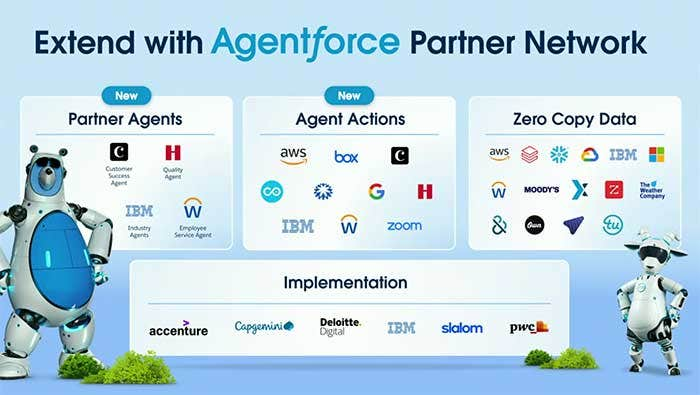
I’m in daily discussions with … top partners, but think like Accenture, Deloitte, PwC, Slalom.
And then our smaller, but fast-growing partners like a Perficient (and) Rosetree.
We’re not just engaging them to discuss deals and sales–that’s really important, and our sales organization is very in tune and close with our partners.
But it’s also our product organization that is pushing our ecosystem and has expectations on them.
Our customer success group, which is super focused on–once you buy Salesforce, how do we make you successful. But tactically, how do we start driving consumption and make you a really happy client that you want to continue with us.
And then even our professional services organization, there’s great collaboration there. So I share that all to say we’ve never had these many expectations, which is a great thing, across all of Salesforce on our ecosystem, specifically our partners.
Any changes coming for the Salesforce partner program?
It will be launched very early next fiscal year … and with that, we have these annual reviews. It’s essentially, how do we ensure every partner in the ecosystem is current on their certs? Is up to speed on Agentforce expertise and knowledge? How do we know what type of results and outcomes they’re driving with our clients?
What are just the basics and the baseline of how we deem what a good partner looks like?
It’s never been more important for us to very acutely communicate this to our partners because the stakes are so high. The opportunity for these partners is so great.
We need these partners to continue to be hand in hand with us.
We’ll be informing our partners on what they need to do to be compliant with this program change and remain in the partner ecosystem formally. This is a net good thing.
It’s what our customers require and ask for, for us to ensure that we have the right partners in the ecosystem, that when we recommend a partner, we’re confident that they have that product expertise, they understand what makes a successful Salesforce transformation or agentic enterprise journey.
This is also what our partners are asking for. They’re simply just asking for communication on what makes a good partner. What do you want to see from us?
Amount of certifications? What type of certifications? Are we working with you on any leads? Do we have qualified projects submitted? It’ll be requirements around those kinds of categories. It is pretty standard, but we’re just trying to be very transparent and intentional.
Our No. 1 value is trust. So if we’re going to go take this journey, and we need our ecosystem like we never have before, we need everyone oriented around that No. 1 value of trust.
Any changes coming with partner enablement?
We’re–I wouldn’t even call it doubling down. I call it tripling down.
Agentforce is changing so quickly. And we need to interlock with our partners, with our product group, with our marketing teams on what the messaging is, what the use cases are, where is there success, what are the best practices? You’re going to see a lot of intentionality around enablement around our partners having deep industry knowledge, which has always been such a great, accretive thing for us.
Why are some of these partners so successful in Agentforce? A lot of them are because of their deep architectural and integration knowledge of the Salesforce platform.
PwC (as an example of an effective partner) right now is in a multi-year journey with PepsiCo on defining their AI strategy. Pepsi is a great, longtime client of Salesforce, but leveraging Agentforce in a big way and hand in hand with PwC.
Are you seeing any changes to Salesforce customer behavior in this AI era?
Time-to-value–if you think about traditional delivery models that might have been people heavy and time-to-value was OK, but maybe not what the expectation is these days, clients want time-to-value quickly.
They’re OK with proofs of concept. They want them quickly, and they want to iterate even quicker.
Talking about a healthy ecosystem, Rosetree (is one of our smaller partners and is) led by two brothers who are driving the agentic transformation at OpenTable. At times, it’s been one of our largest consuming Agentforce clients.
I’m so happy when I see these examples, when they come to life, because we are driving agentic success with partners, big, small, regional, product focused, industry focused. Everyone has the opportunity to win right now.
Clients want real ROI (return on investment). And clients one are requiring the stakeholders and decision makers to go sign up for whatever that ROI is that Salesforce and the partner are discussing.
We have a great example with Pandora. … We have Publicis Sapient, who’s driving that Agentforce implementation, which is a service use case, which has been great.
And Publicis is great because they’re a traditional (partner) and one of the world’s largest agencies. Also one of our top Salesforce partners who really found their way with driving Agentforce success.
Are some of these program changes meant to add value into what it means to be a Salesforce partner?
This isn’t an exercise of, let’s just focus further on specific partners. This is, partners that meet these requirements–which, by the way, there’ll be lots of notice and lots of opportunity to meet those requirements as well as reenter should they not meet the requirement but meet them in the future.
They’re going to get big accretive value and benefit (around things like) enablement.
Incentives–(I’m) not ready to share all the details around that, but our incentive model is evolving very quickly. This is something that we are quickly going to catch up with how our peers think about it. In fact, we’re thinking about this in a really innovative way that our partners are going to be so fired up to see how they can access new incentives from us.
Product access as well. We have provided product access in the past, but we’re doing it in a much more efficient way here.
Also just general access to Salesforce, whether it’s discussions with product (teams), understanding roadmap. It’s discussions with sales and doing account planning, where appropriate, that’s also going to be amplified.
How about smaller Salesforce partners, how do they fit into this revamped program?
Smaller partners, not a traditional GSI (global system integrator), these have been some of the lifeblood of our Agentforce success.
Rosetree is a relatively small firm by people but big on impact as it relates to Agentforce. So I’m very confident that these smaller partners are going to meet a bunch of these requirements, too, should they want to.
NeuraFlash was one of our top Agentforce partners (and was acquired by Accenture in the summer). They would have fit right into this program. Our focus on these smaller partners isn’t going anywhere.
Big, small, regional, product, geography focused, there’s going to be room for all of those in the in the program.
Are Salesforce internal sellers well-aligned with your solution providers?
Whether it’s me, whether it’s my leadership team, we look at the ecosystem as a growth lever.
We are very much on our front feet on the ecosystem–and specifically for my business, our consulting partners.
Everything I think about with our consulting partners is a growth mindset. It’s driving deals. It’s driving consumption. It’s driving success. It’s driving renewals. And so we are pushing that narrative internally. And it’s blossomed to the extent that there are lots of expectations on us, which is a great thing. We have our work cut out for us, but I think we’re ready.
Is reaching a certain number of partners part of your goals?
I don’t think we’re focused on, ‘We need to get to X amount of partners’--whether it’s higher, whether it’s lower.
We’re focused on quality of partners. And then those who are demonstrating the intent around some of these requirements–I want to go meet them where they are putting the investment.
It’s my job to go meet them and advocate for them. There’s no finish line on what a goal looks like here. It’s just to drive better communication and accountability with one another, which, by the way, our partners have been looking for.
They’re like, ‘tell us what to focus on. Tell us how to be successful in your ecosystem. Don’t be everything to everyone at all times.’
This is going to be really positive coming out of it. It’s really been 10 years since we’ve been relaunched and reimagined what a program looks like for the agentic era.
What are some of the big opportunities ahead for Salesforce partners?
It is still a very good business to be in the partner ecosystem. We have multiple partners that are doing billions (of dollars) in revenue in their Salesforce practices and launching their data and AI practices and touching practices and disciplines (where they) probably hadn’t thought about Salesforce before.
And that’s because Salesforce is so wide ranging–you know our applications around sales, service, marketing. But what’s really exciting, besides this agentic era, is also our data portfolio.
We’ve closed on our acquisition of Informatica, which our partners are so fired up about.
The technology is brilliant, but their distribution and relationship with the ecosystem of partners is very strong. I feel like we’ve hit the ground running on the Informatica discussion. And with Informatica, think MuleSoft on integrations and APIs (application programming interfaces).
The opportunity for the partners is–how do we go together to help our clients get their data strategy correct so that they can, in fact, go enable, use, drive value from Agentforce.
Agentic (AI) works to the extent that you have the right data. So we’re excited about that because partners are really leading the way on helping us with our clients’ data.
We always care deeply about customer success. I mentioned trust is our No. 1 value. Customer success is also one of our five values here at Salesforce.
We just didn’t have the way to go monitor or keep the level of intimacy on some of the customer success post sale. Now, when we sell to a client, we are highly motivated for that client to be successful because of our subscription model. We need them to be successful so they renew. And that’s always worked well for us. That’s not going to go away.
But that is going to get very much amplified, because it will become very stark and binary on if these clients are successful or not with Agentforce because they’ll be consuming or they won’t be consuming.
We’re seeing consumption absolutely take off. … But we require partners in a big way to really help drive that consumption. Partners love it because it gives them great insight into are we doing what we told the client we were going to go do.
They’re going to be really excited about this as a new piece to the puzzle and another place to go add value and grow their share of wallet with our clients.