Cisco 360: A 180 For The Tech World’s Iconic Partner Program
Cisco’s channel leaders are ‘putting their foot on the gas’ to drive the complete revamp of the company’s nearly 25-year-old partner program, Cisco CEO Chuck Robbins tells CRN. At the heart of the changes: profitability, predictability and the push to help partners capture the massive opportunities created by AI.

It is those looming opportunities that have the tech giant’s C-suite and channel leaders “putting their foot on the gas” in the form of Cisco’s fully remodeled partner program, set to launch Jan. 25. The new program has been designed to help the company and its channel partners capture more business in the AI era, Robbins said.
But first, Cisco must stick the landing on the new program, which is still actively being co-developed with the help of the channel.
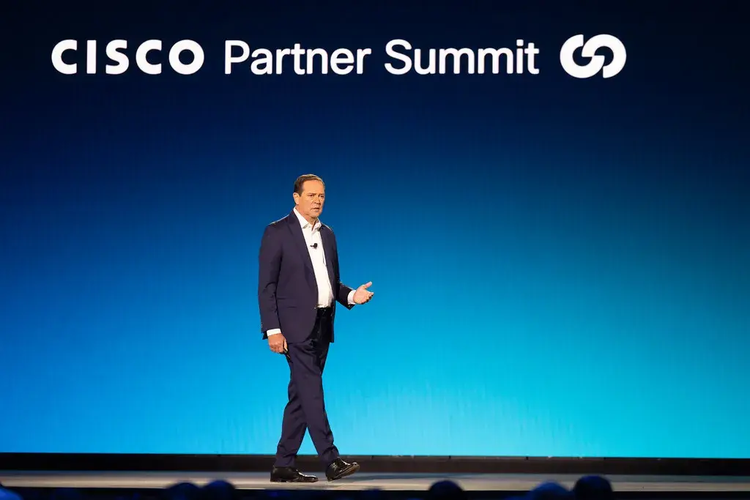
“We just have to get it right,” Robbins told CRN in a November interview at the 2025 Cisco Partner Summit.
Cisco 360 is a complete overhaul of the company’s iconic, nearly 25-year-old partner program on which many other OEM partner programs are modeled. The idea behind the refresh is to simplify the previously complex program structure with a focus on profitability and predictability, especially for emerging areas of opportunity. New features, such as the Partner Value Index (PVI) and the Cisco Partner Incentive (CPI), will measure and reward the investments that partners are making in Cisco’s broad portfolio, according to Tim Coogan, senior vice president of global partner sales, who took over for Rodney Clark as Cisco’s channel chief in August as the massive partner program refresh was still being developed.
Adding pressure to the need to get it right is the fact that the program redesign comes approximately seven months after Cisco’s closest networking competitor, HPE, closed its $14 billion acquisition of fellow networking mainstay Juniper Networks. The megamerger is being seen as a strategic move to strengthen Spring, Texas-based HPE’s competitive stance against networking giant Cisco, particularly as HPE incorporates Juniper’s AI-native Mist management platform into its portfolio.
With the new program, Cisco aims to strike a balance between rewarding partners that want to build businesses across the company’s entire portfolio and “boutique” partners that specialize in one specific area, Robbins said.
“You’ve got partners who are going to roll across the portfolio, [and] you have partners who are going to go deep with [something like] security, for example, and the program has to recognize both of those are valuable without creating conflict,” he said. “That’s part of the magic of what [Cisco’s channel leadership team is] trying to accomplish.”
AI, said Robbins, is the biggest IT opportunity in his career and possibly of his lifetime. His wish is for partners to understand the monumental opportunity—and responsibility—in front of them to create a new vision for their customers, all with the help of San Jose, Calif.-based Cisco and its freshly revamped partner program.

‘Our traditional way of enabling and communicating with partners is not going to be enough. It’s got to have more frequency. It’s got to have more depth. It’s going to have to have more technical detail.’
—Chuck Robbins, Chair, CEO, Cisco
“We have to communicate more with our partners, probably than we ever have on this because it’s moving fast, and this is super complicated. But I think right now we’re in the midst of it,” he said. “Our traditional way of enabling and communicating with partners is not going to be enough. It’s got to have more frequency. It’s got to have more depth. It’s going to have to have more technical detail.”
The Nuts And Bolts Of Cisco 360
The “why now?” behind Cisco 360 is twofold, said Elisabeth De Dobbeleer, senior vice president of the Cisco Partner Program. One, the program was very complex, and partners had long been asking for simplicity. Two, the pace of change in the technology market and the impact of AI also required a reimagined partner program.

Cisco first unveiled the new program in October 2024, a full 15 months ahead of Cisco 360 going into effect. That was a “deliberate” choice to have the time to co-design the program alongside partners. Cisco’s channel executives, for their part, have spent “thousands” of hours collecting feedback from partners on the new program, channel executives said.
“We said we were going to take time, and we did in the last 12 months. … Some partners are feeling a little bit anxious because they say things keep changing, [but] we deliberately took that risk because we wanted to get it right. I personally did not want [us] to say three months from now: ‘Ta da! We’re changing the program,’ and then we have all this partner feedback, and we realize that half of it may be wrong,” De Dobbeleer said.
The Cisco 360 program will eliminate separate partner programs and incentives such as VIP—the company’s flagship rebate incentive program—Perform Plus and the Cisco Services Partner Program, or CSPP. These will instead be folded into a single structure, the CPI, which will mirror the overall value index that will measure partners across four areas: foundational, capabilities, performance and engagement. The CPI will include an Eligible Offers list and rebate rates designed to incentivize adoption in several innovation areas—campus refresh, AI, security and premium services, and adopt and renew.
While the VIP incentive itself might be going away, “VIP logic” on which behaviors are rewarded, is continuing in the form of the program’s new incentives, meaning if a partner lands, adopts, expands or renews, they’ll get paid, De Dobbeleer said.
Also revealed in November was the long-awaited Cisco Partner Incentive Estimator, which offers a way for partners to model out their earnings. Cisco said that partners can use the Estimator to unlock two additional bonuses—the Cross Sell Bonus, which rewards portfolio breadth, and a Next Generation Specialization Bonus, which rewards deep expertise or greater value and predictable growth.

‘Partner confidence in the new program is very much hinging on how confident they are about being able to monetize the relationship with Cisco. Predictability, of course, is very important as well, and then finally, it’s all about growth.’
—Elisabeth De Dobbeleer, SVP, Partner Program, Cisco
“Partner confidence in the new program is very much hinging on how confident they are about being able to monetize the relationship with Cisco,” she said. “Predictability, of course, is very important as well, and then finally, it’s all about growth.”
Splunk partners, meanwhile, are part of the Cisco 360 Partner Program through the Cisco 360 Splunk Index. It’s where they can also earn program benefits and Cisco Partner incentives. Splunk Partnerverse will be integrated into Cisco 360 during Cisco’s 2027 fiscal year, which begins in August.
Cisco acquired Splunk in 2024 for $28 billion.
Goodbye, Gold
Perhaps the most controversial element of the new program for partners is that Cisco’s traditional metal-based partner levels, including the illustrious Cisco Gold partner designation, are going away. In their place will be two new designations: Cisco Partner and Cisco Preferred Partner. Cisco partners will be able to earn these designations for each technology portfolio, such as security or networking. Cisco Preferred partners will be eligible to earn two new specializations, Secure AI Infrastructure and Secure Networking, beginning in February 2026, according to Cisco.
“We feel we’re in a better place than ever before,” said De Dobbeleer. “We are still as partner-centric as before, maybe more than ever, and we are absolutely convinced that we cannot do it without the ecosystem.”
When Cisco 360 was first unveiled to partners, it was met with uncertainty, especially around some of the changes to program elements many Cisco partners have made significant investments in, such as the Cisco Gold partner designation.
“There was a big fear around the prestige that was associated with the Gold partner badge. If you think about it, a lot of us have invested so much in multiple CCIE [Cisco Certified Internetwork Expert] badges to earn that Gold, and there was a fear that that prestige will just get diluted,” said Faisal Bhutto, president and CEO of Houston-based MSP and Cisco partner Alykas.
To Cisco’s credit, it has worked hard to empower partners to be ready for the changes since they were announced 15 months ago through “no shortage” of webinars and training, Bhutto said. The next obstacle, he added, will be marketing the new “Preferred” partner label to end customers, which are still familiar with the outgoing Gold partner moniker.

“Customers knew if [a partner] is Gold, you have X amount of CCIEs. The next hurdle is how quickly can you put out a marketing campaign to say, ‘Look, these are the same partners, but here’s what we’re making them focus on.’”
—Faisal Bhutto, President, CEO, Alykas
“Customers knew if [a partner] is Gold, you have X amount of CCIEs,” he said. “The next hurdle is how quickly can you put out a marketing campaign to say, ‘Look, these are the same partners, but here’s what we’re making them focus on.’ The messaging to the customer should be: What’s in it for them? We already see what’s in it for [partners] and what’s in it for Cisco.”
Under the guidance of 25-year Cisco veteran Coogan, it’s becoming clear that a great deal of the early feedback on Cisco 360 from partners was well-received by Cisco, Bhutto said.
“It’s a big sigh of relief … but change is hard and it takes a little bit of time. You want the people who tell you about that change [to be] people you have trusted in the past that can say, ‘Hey, listen, we’re not going to leave you hanging,’” he said.
The New Frontier Of Customer Experience
According to Cisco’s 2025 AI Readiness study, which surveyed more than 8,000 senior IT and business leaders across 30 markets and 26 industries, only 34 percent of companies rated themselves as having “high” or “full” readiness to adopt and scale their IT infrastructure to accommodate the needs of AI projects. Meanwhile, 83 percent of organizations plan to deploy AI agents, and nearly 40 percent expect them to work alongside employees within a year, but few have the secure infrastructure to sustain it, the survey found.
The IT industry has seen many technology transitions, but perhaps none so consequential as AI, especially with the onset of agentic and generative AI. It’s part of the reason why Cisco partners need more—and very specific kinds of—resources to help them go after these opportunities, said Liz Centoni, Cisco’s executive vice president and chief customer experience officer.

‘Our customers are demanding a very different experience. So we have to change the enablement and incentive program with our partners to come along with us.’
—Liz Centoni, EVP, Chief Customer Experience Officer, Cisco
“Our customers are demanding a very different experience,” she said. “So we have to change the enablement and incentive program with our partners to come along with us.”
From a customer experience (CX) perspective, Cisco’s strategy has “completely changed” as the vendor doubles down on enablement and incentivizing premium services, Centoni said.
As an example of the change happening within the industry, Cisco’s original partner program didn’t include much automation to speak of. Today, however, 90 percent of the company’s support cases are enabled by AI-driven automation, which is helping the company and its partners move from reactive support to predictive, proactive and personalized support, she said.
“Customers want more premium capabilities, and so that’s why I think the shift in the program was absolutely needed,” she said. “When what we’re building for customers, like products and services, is changing, how we’re going to deliver the services [and] the program needs to adapt for that as well.”
Cisco IQ, revealed at Partner Summit 2025, is a brand-new digital interface for customers and partners that offers real-time insight, on-demand assessments, troubleshooting and personalized learning, as well as automation and agents from across professional services and support together in a single interface. It’s one way that Cisco’s CX team is prioritizing enablement for the channel, Centoni said.
Partners can use Cisco IQ’s assessments to offer higher-value services to their end customers to boost efficiency and reduce manual work, she said. The offering is expected to be available in the second half of Cisco’s fiscal 2026, which means sometime in February or later. Early field trials with about 100 customers are currently underway, according to the company.
Irvine, Calif.-based Cisco partner Trace3 in 2022 created a new business unit within the company focused on life-cycle management through the acquisition of Lasalle Solutions, which got its start in 2000 as a provider of an infrastructure life-cycle asset management platform that helped businesses manage their IT environments.

‘We’ve got a number of engagements going on the collaboration side that are AI-focused. You look at all these companies that are deploying AI, like agentic AI, and it’s a real thing that also plays into network, storage [and] compute, so [Cisco’s] new channel strategy makes sense.’
—Steve Wylie, VP, GM, Northeast, Trace3
Cisco IQ is an extension of that idea, according to Steve Wylie, vice president and general manager, Northeast, for Trace3.
“The life-cycle tools that we were providing were doing a good job with inventory and refresh dates, but I think the Cisco IQ tool will help us package more of these, like CX and EA [enterprise agreement]-type solutions, and it also gives [customers] visibility into what’s accurately plugged into their networks. It’s just a better view into what customers have deployed.”
Cisco IQ will help partners like Trace3 continue the life-cycle conversation with end customers, Wylie said.
“We already have lots of life-cycle conversations. And so, it’s just a natural capability that will help,” he said.
As well as a focus on life-cycle services, Trace3 specializes in operationalizing trustworthy AI and bridging the gap between principles and practical application for its end customers, according to the company.
Cisco 360, meanwhile, was designed through the lens of helping partners go after the AI opportunity, a cross-platform opportunity by its nature, Wylie said.
“You can’t just be good at network. You need to understand network and storage and compute, at a minimum,” he said. “We’ve got a number of engagements going on the collaboration side that are AI-focused. You look at all these companies that are deploying AI, like agentic AI, and it’s a real thing that also plays into network, storage [and] compute, so [Cisco’s] new channel strategy makes sense.”
Attacking The AI Opportunity
In the age of AI, Cisco wants to incentivize partners to adapt their businesses and build practices around AI, observability and services using the new Cisco 360 partner program as a vehicle for change, according to channel chief Coogan.

‘We’ve talked about Cisco 360 as respecting the partners that got us here [and] rewarding the partners that are with us today, but very importantly, rewarding and fueling the partners that are prepared to take us into the future.’
—Tim Coogan, SVP, Global Partner Sales, Cisco
“There’s an argument that if I make it too easy to stay the same, I’ll stay the same forever,” he said. “We must encourage and incent change because true growth requires us to have deeper architectural expertise [and] a services portfolio, and that will require hard work in some places. … We’ve talked about Cisco 360 as respecting the partners that got us here [and] rewarding the partners that are with us today, but very importantly, rewarding and fueling the partners that are prepared to take us into the future,” Coogan said.
Tempe, Ariz.-based solution provider and Cisco partner iT1 has a budding AI practice that’s centered on compliance, education and helping customers figure out where to start with AI, said David Harper, iT1’s CRO. He’s also the head of its AI practice, which has been a big priority for the company.
“It’s about talking about the art of possibility as it pertains to AI because it’s kind of like security: It’s a very broad topic. We have to really help educate our customers and narrow the focus on solving a specific business problem and building a plan,” he said.
From there, it’s about building the right solution stack, which is where iT1’s vendor partners, such as Cisco, come in, Harper said.
“AI is really redefining the value we create with our OEM partners, whether it is Cisco or others. It’s not about just new technology. It enables us to really go back and co-invent intelligent solutions with these OEM partners [that are] really focused on accelerating outcomes for our customers to unlock growth opportunities,” he said.

‘What you realize is that when you get deeper and deeper into the 360 program, Cisco is offering additional specializations or certifications, and then an incentive to grow your practice, a lot of it around AI.’
—Shelliy Cymbalski, CMO, iT1
IT1 has spent the last year digging into the emerging details and nuances of Cisco 360 to figure out where it will stand within the new rankings and incentives that will be available around emerging technology opportunities such as AI, said Shelliy Cymbalski, iT1’s CMO.
“What you realize is that when you get deeper and deeper into the 360 program, Cisco is offering additional specializations or certifications, and then an incentive to grow your practice, a lot of it around AI,” she said.
Within Cisco 360, partners that reach a value index of 5.0 in a given portfolio will be able to add the portfolio name to their designation, i.e., Cisco Security Partner, for example. Partners that reach a value index of 7.5 in a given portfolio can use the new Cisco Preferred Partner designation, i.e., Cisco Preferred Security Partner, according to Cisco.
“Cisco is doing what any other OEM or organization in this industry has been doing, which is really trying to shift from transactional to outcome-based sales,” Harper said. “As it pertains to AI, the 360 program really is helping accelerate how partners like iT1 bring AI-ready infrastructure to our customers and solve for real business outcomes.”
Cisco certainly isn’t the only large OEM going through a change to their partner incentive structure right now, Cisco’s Coogan agreed. But what he does know for sure, he added, is what Cisco is not trying to do with Cisco 360.
“We are not doing it with the intent to cut partners or take accounts direct. In fact, our ELT [executive leadership team] has been crystal clear. The goal here is not to spend less on our partners. It’s, quite frankly, to spend as much or more based on mutual co-investment in our success moving forward,” he said. “The message here is: Don’t just look at the fact that we are changing. Look at how we are changing.”
Maintaining The Channel Momentum
Cisco’s Robbins likes to say that the company was working hand in hand with the channel before its competitors realized it was “cool” to do so. He would know, having spent over five years leading the company’s U.S. channel earlier in his career. That long history together matters, he said, especially at a time in which customers need to trust that their vendors and partners will be there to help them modernize their infrastructure for the next big technology transition.
Robbins’ message for partners to take into 2026?
“We will probably not get it perfect, but we will listen and we’ll adapt, and we’ll modify [the program] to the extent we need to,” he told CRN. “But we do believe that it lines up against this AI opportunity, which is the biggest opportunity we’ve seen in our life. It’s incredible. And that’s coming from the guy who lived through the internet buildout."