Salesforce Dreamforce 2026: CEO Benioff Touts New AIforce Interface Layer
‘It’s an interface revolution,’ Salesforce CEO and co-founder Marc Benioff says.
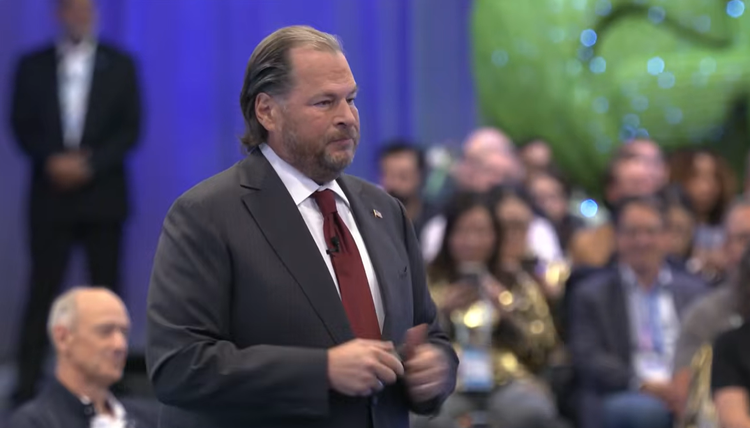
Salesforce used its Dreamforce 2026 event to unveil AIforce, a new live interface layer that connects enterprise data and workflows to AI tools, plus expanded partnerships with Amazon Web Services, Google Cloud and Nvidia.
The event, which runs through Thursday in San Francisco, comes as Salesforce looks to shake off concerns that AI tools will render its customer relationship management (CRM) and software-as-a-service (SaaS) products obsolete, with chatbots potentially the main interaction layer for how workers accomplish tasks in the AI era.
However, as Salesforce CEO and co-founder Marc Benioff and other data platform vendors have asserted, AI tools are nothing without the data stored in their platforms.
“It’s an interface revolution,” Benioff said during his keynote Tuesday. “We’ve seen a lot of interface revolutions. We went from DOS to GUIs (graphical user interfaces). And we went from GUIs to web, and we went from web to mobile. … You’re going to see AI interfaces that are dynamic and intelligent, that are composable and alive, and that can work with you in the fundamental administration of the applications, can work with you in building the applications, and work with you in operating the applications.”
[RELATED: Salesforce CEO Benioff Says ‘Apps Are Not Dying’ As AI Drives CRM, Agentforce Growth]
Sean Catlin, executive vice president and global head of strategy at Québec-based Salesforce solution provider OSF Digital, told CRN in an interview that some of the biggest opportunities for OSF have come from Salesforce’s Agentforce Labs experimental hub for early-stage agentic AI tools and recently acquired Salesforce businesses including the Regrello automation startup Salesforce bought last year and the Fin customer agent platform provider, whose purchase Salesforce completed in the days leading up to Dreamforce.
To capitalize on the agentic revolution, OSF built its own operating system based on products by Salesforce partner and leading AI frontier lab Anthropic. OSF leverages that OS for some of its work on Salesforce Revenue Cloud, Service Cloud and other more traditional Salesforce products.
To Catlin, an effective Salesforce solution provider in the agentic age requires a different business model, which includes the smaller forward-deployed customer teams OSF employs. OSF, he believes, has shifted its model faster than some of the larger global system integrators OSF competes with.
“If you look at the speed and the velocity of how you can build and deploy new solutions on Salesforce in AI spaces with a whole hybrid of the cloud, the acquisitions and Agentforce, it’s a different motion,” Catlin said. “Implementing while you’re selling, that’s the internal [Salesforce] motto. The partner that you lean on has to be able to run a POV (proof of value) motion that isn’t building an amazing PowerPoint deck and loads of slides and stuff like that … in three to six months. In an accelerated two-stage workshop, you’re actually building the real thing. And there’s a real difference between having architects and this big team and developers and curators in a much smaller, flatter and forward-deployed customer team. And so we’ve really shifted our model.”
Salesforce Launches AIforce As Enterprise AI Interface
Salesforce used its annual Dreamforce event to unveil the AIforce live interface layer for leveraging data, workflows, business logic, semantics, permissions, security, governance and other enterprise knowledge stored in Salesforce with any AI interface and agentic productivity tool.
AIforce joins Salesforce’s unified Data 360 context layer, Customer 360 app and semantic intelligence layer and Agentforce digital workforce and agent development layer.
AIforce allows users to stay in Anthropic Claude, Salesforce-owned Slack and other productivity applications without opening a dashboard and while grounding questions in Salesforce data and business logic. Users can also update records and trigger workflows, according to the vendor. Agents can read across hundreds of records at once and pull in connected systems, reason and take action.
The layer also allows users to build their own user interface (UI), composing customized live interfaces on the fly through describing them in Slack, Claude and other apps. Users can avoid fixed systems of layouts and fields. And AIforce works with the existing permissions and business rules established with Salesforce products.
Model providers leveraged through Salesforce don’t retain business data when answering questions on the fly, according to the vendor.
Nvidia-Powered Koa Model Brings Improved Reasoning To Agentforce
Salesforce also used Dreamforce to reveal deeper partnerships with Nvidia and Google Cloud. The vendor revealed that a CRM reasoning model called Koa and built on the Nvidia Nemotron AI model family is now available to select pilot customers in Agentforce, with general availability set for winter in U.S. regions.
Koa was built in collaboration with the chipmaking giant, according to Salesforce. Koa is meant to help agents reason through complex, multistep workflows. Koa can match or exceed leading model performance on CRM actions with three times fewer errors. Koa wasn’t trained with any customer data and, because Salesforce controls the weights and runs Koa within its own infrastructure, no customer data crosses trust boundaries during inference.
As part of the deeper Nvidia collaboration, Salesforce and the chipmaker are also bringing Nemotron-based models and accelerated computing into Missionforce. Users in government and regulated organizations will gain improved control over model, data and deployment environments. The collaboration should help bring AI to private clouds, air-gapped networks and other secure networks, according to Salesforce.
Post-trained Nvidia models are set to come to select users of Missionforce Operations—which digitizes and automates procurement, supplier management, logistics and other complex government workflows—in October, according to Salesforce.
Those models will enter other Missionforce capabilities in the future, according to Salesforce.
Salesforce, Google Cloud Deepen Hyperforce, Gemini Integrations
As for the Google Cloud partnership, the vendors revealed that Hyperforce on Google Cloud will become GA in North America in November, with a phased feature and regional expansion in 2027.
Salesforce plans to start migrating select users in the U.S. to the product in the fourth quarter of 2026, giving users Salesforce security, compliance, business context and resilience standards with Google Cloud’s flexibility, infrastructure, data services and Gemini Enterprise AI suite.
Other updates in the Salesforce and Google Cloud partnership include Salesforce Federated Connector for Gemini general availability planned for late October.
The Agentforce Sales Agent for Gemini Enterprise is in beta on Google Cloud Marketplace. Agentforce Reasoning Engine with Gemini is now GA.
A zero-copy expansion for Google Cloud and Salesforce Data 360 is set to go GA in fall. Users will have data sharing abilities in additional regions with Iceberg Rest Catalog open standards and Private Connect availability. The companies are also working on bidirectional semantic information sharing for more improved data and AI experiences, according to Salesforce. Salesforce Data 360 and Google BigQuery already support zero copy data sharing.
A catalog feed integration with Google is now GA, giving users the ability to send product catalog data to Google Merchant Center and a field-mapping interface in Business Manager, according to Salesforce.
And an integration with Universal Commerce Protocol (UCP) is set to go GA in October. With that integration, users can purchase within Google surfaces like the Gemini application, Google Search and Search’s AI Mode while keeping payments, compliance and order management in their existing commerce infrastructure.
AWS Collaboration Promises More Frontier Agents In Slack
With AWS, Salesforce plans to add more of the hyperscaler’s frontier agents in its Slack communications app in the fall, with a developer operations (DevOps) agent now available. AWS security, financial operations (FinOps) and Partner Central agents are among the upcoming frontier agents coming to Slack so that users don’t need to switch to a separate console.
Multi-agent orchestration with Agent2Agent (A2A) support for Agentforce Voice with Amazon Connect Customer is slated for the fall.
And the companies are working on more Agentforce model choice through Amazon Bedrock. Anthropic and Nvidia models are already available, with OpenAI models coming soon.