When AI Agents Go Rogue, Cohesity’s CEO Wants Recovery To Take Center Stage
‘We’ve been preaching the benefits of fast cyber recovery and resilience being as important, or even more important, than detection prevention,’ says Cohesity CEO Sanjay Poonen.
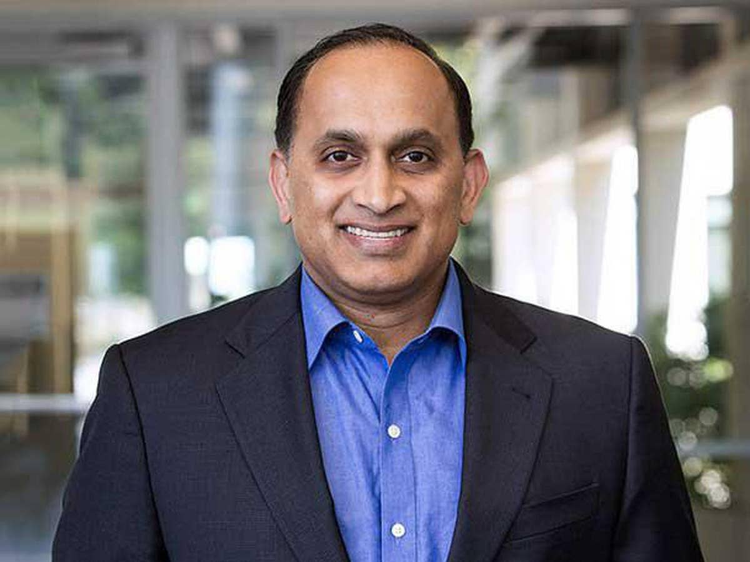
Cohesity is looking beyond protecting and securing corporate data to helping customers put that data to work with AI, even as increasingly sophisticated cyberattacks raise the stakes for recovery, according to CEO Sanjay Poonen.
Poonen, in an exclusive conversation with CRN, said his company’s direction combines defense against threats with opportunities to extract insight from protected information. “So we call ourselves an AI data security company,” he said.
That description does not limit Cohesity to information used in AI, Poonen said. Its platform protects virtual machines and containers, databases, files, identities and SaaS applications. Meanwhile, he said, customers are asking what AI-driven attacks mean for their business, making recovery a critical complement to prevention.
“Data protection and the immutable backup data we protect is the last line of defense in a cyberattack,” he said.
Cohesity’s participation in Project Glasswing gives it access to Anthropic’s Mythos preview to examine its code for vulnerabilities, Poonen said. He also plans to use models from OpenAI and Google, with Mythos taking priority. Findings will drive fixes rather than public disclosures. “If we find critical vulnerabilities, we are committed to our customers to fixing them rapidly,” he said.
For customers, resilience includes restoring the most essential applications first under a minimum viable entity approach, Poonen said. Cohesity is also integrating with established agent-management platforms rather than building its own agent cloud. Its ServiceNow integration can trigger recovery when an agent deletes data.
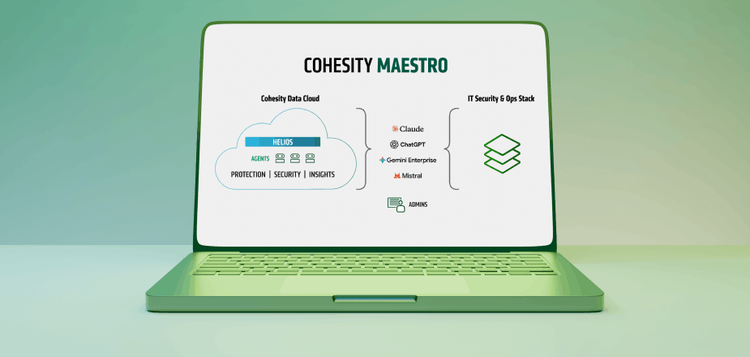
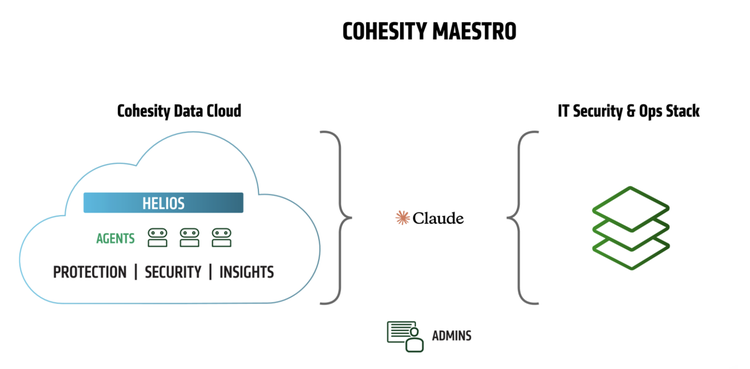
Looking ahead, Poonen is pushing Cohesity Maestro, an initiative to make the company’s platform headless so customers can direct actions and access telemetry through interfaces such as Claude, ChatGPT and Gemini. Cohesity has prototypes working with Claude, but Poonen offered no general availability date. “There’ll be an aggressive rollout for Maestro,” he said. “We’ll start with Claude.”
There’s a lot going on with Cohesity and data resilience, particularly as channel partners look to build resilience in their enterprise customers’ data infrastructure. To learn more, read CRN’s conversation with Poonen.
How do you define Cohesity?
AI, data, security. We have been all things around data. There’s protection and security that I would say is playing defense around data, especially now with talk about agentic AI attacks and so on. But that’s playing defense on the data. Data protection and data security would be our first and second act. Third act is playing offense on data. Once the data is protected and secure, how do you open it up for AI to be able to get insights on it? So we call ourselves an AI data security company.
When you say ‘AI data security company,’ that sounds like you’re limiting yourself to working with data that is used in AI as opposed to other corporate data. Are you limiting yourself there?
No, not at all. ‘AI’ implies that it’s AI-powered, built for an AI era. But we’re not restricted to just AI data. That’s a good point to make clear. Think of it as AI-powered. We work on all forms of data. Typically, we find five forms of data. No.1 is compute types of workloads, which are virtual machines and containers. The second are databases of all kinds: Oracle, SQL Server, MongoDB, CockroachDB, whatever. The third is unstructured data, typically files. The fourth is identity: Active Directory, Microsoft Entra, Okta, but also non-human identities like AI agents. The fifth is SaaS applications like Salesforce, Workday, ServiceNow, Google Workspace, Jira, so on and so forth. Those are the five forms of data we typically ingest, and some of them have AI characteristics. Agentic data is more AI-oriented. Some of the data that’s stored now in modern databases, like vector databases, might be more AI-oriented. Some of the new servers like MCP [Model Context Protocol] might be. But we’re not restricted. We’re protecting and securing all forms of data.
The need for data protection has never disappeared. Over the last few years, how has it changed? How has it evolved?
We are now among the few companies that are part of Project Glasswing. And [Claude] Mythos has certainly raised a lot of questions as to what the agentic attack vector looks like. We got admitted into Project Glasswing because of the pivotal role Cohesity plays in protecting this country and the world. The largest banks are typically protected by us. The largest government agencies. We have almost 500 agencies. Twenty-seven percent of our revenue comes from banks. So we are in a very strong position in those two sectors, which are very important critical infrastructures for this country and the world. We also protect many of the world’s biggest governments. And many of the critical infrastructure companies, many of the largest telcos, are our customers. Some of the biggest tech companies, both hardware and software, are customers of ours. Health care, pharma companies, health-care providers such as hospitals and payers, some of the biggest ones. So for that collective reason, both Anthropic and the U.S. government deemed it necessary for us to be part of Project Glasswing.
The thing that’s changed the last two or three months is a heavy amount of dialogue that our customers are asking us about: What are the implications of Mythos and Project Glasswing, given that we’re in the inside circle of what’s happening there from an agentic perspective? Can we share some of that? Some of that obviously ties to our announcement on Cohesity Maestro.
What else?
Prior to this increased focus on agentic attacks and Mythos and Glasswing, I would say cybersecurity has been a top focus along with AI. Look at every CIO survey. AI and cybersecurity are among the top two areas where CIOs are investing, and we play right at the center of that. So the relevance of Cohesity being in the top two spend areas where customers need help has only been more pronounced. Data protection and the immutable backup data we protect is the last line of defense in a cyberattack. If a large bank goes down, you typically go to your last line of defense, which is your backup data, your historical data.
There’s a lot of focus in the last year on this notion of a minimum viable entity. You could substitute that with minimum viable bank, minimum viable hospital, minimum viable government, and so on. That means that if you assume the entire bank or government agency or hospital goes down, how do you ensure you can bring all of your most critical applications [back up] within an hour, the next-most critical applications within a day, maybe the third-most critical applications in a week, the next in a month, and then beyond that, you don’t probably care about categorizing all those apps. You need a guaranteed recovery time that you can show the companies. We’ve been working on this for several years with some of the largest banks in the United States. That notion of a minimum viable entity has gotten a lot more importance. We have RFPs going out where customers are asking for that, and we’ve been able to develop a pioneering framework of five-step cyber resilience framework [protect all data, ensure data is always recoverable, detect and investigate threats, practice application resilience and optimize data risk posture] for how companies can implement their approach to a minimum viable entity.
You mentioned Project Glasswing. What has Cohesity discovered about itself, working with Project Glasswing?
In the AI world, we see Anthropic, OpenAI and Google among the three core companies doing pioneering work. There’s obviously also work embedded inside Amazon and Microsoft, but among the frontier labs, these are the three. Google is an investor in Cohesity, as is Amazon. So we have a front-row seat to work with any of the folks we want to, very similar to the way we’ve been watching the cloud. You can nominally see the cloud as being AWS, Azure, and Google. The frontier labs have been Anthropic, OpenAI and Google. Anthropic today has a lot of the mind share in the enterprise, but no one knows where this is going to rank even a year from now, so it behooves us to work with all three, and that’s the approach we’ve taken, which is to work with them all. But as we began talking to Anthropic at the senior level, it was clear they were going to start focusing on cybersecurity well before Project Glasswing was announced. When Project Glasswing was announced, there was an initial group of 10, and these were large brands in banks and cybersecurity. In cybersecurity, I think only two companies, CrowdStrike and Palo Alto, were named. But some of those initial 10 were customers of ours, and they were able to give us feedback on what they were finding …. So we began starting to work with customers who had access to Project Glasswing to get input on what we could do better with our product. But we did not have direct access to Project Glasswing itself.
One of the first things we learned was these frontier labs are able to scan binaries very effectively. If you think about how binaries were scanned many years ago, it was with tools like Black Duck [Software] and so on. But these frontier labs’ [abilities] to find vulnerabilities in binaries is remarkable. And we began the approach to look at all three key frontier labs code scanning capabilities at binary. But remember, initially we did not have access to Mythos. We decided several months ago to work with all three: Anthropic, OpenAI and Google. And because we are a key provider of data protection to large banks and agencies, we got access to the Mythos preview eight weeks later when the next group of 150 companies were named.
[The Mythos] tools are able to provide an intensive scan of code, and you’re able to then do things with that. So we’re very privileged to be in a small group of people who can apply that. And what’s the outcome we’re going to do with this? Whether it’s binary scans or source code scans, if we find critical vulnerabilities, we are committed to our customers to fixing them rapidly so that they get the best code from us.
What about other similar tools?
We’re going to do this not just with Mythos. We’re going to hopefully use GPT-5.5 Cyber, which is OpenAI’s model, and Gemini 3.5, which is Google’s model. We may take some time to sort through all three of them. Mythos is the highest priority, but we’ll be in position to tell our customers we’ve fixed the issues that we’re finding, and then confidentially we can share with customers who want to. We don’t do this publicly. At the end of the day, our commitment is to ensure that our customers can count on Cohesity having the most secure code in this area of data protection and data storage. ...
The U.S. government has done a good job at protecting these models like Mythos from going outside the country. ... We are, by the way, a very keen supporter of the Trump administration's cyber strategy that [U.S. National Cyber Director] Sean Cairncross wrote. We helped the Trump administration in the review of that. So we’re very close to the cyber director and the strategy there. We support every move the government has made to make Mythos and similar models restricted from the world. However, I think it’s prudent to assume that the bad guys have an open-source variant of that already and could then use that open-source variant to inflict damage on the United States or any democratic-friendly country.
Expand on Cohesity’s role in cyber resilience.
Even a little focus on resilience is just as important as a lot of focus on detection. You need to invest in good detection prevention software like CrowdStrike or Palo Alto [Networks]. They’re going to detect and prevent issues via a firewall in the case of Palo Alto, or on endpoints in the case of CrowdStrike. But what’s Cohesity's core proposition? Resilience and recovery of data at supersonic speed. We have the best and fastest cyber recovery of any vendor for any of the forms of data coming in: virtual machines, databases, NAS, identity. You put it all in our platform. We have the fastest recovery.
We’ve been preaching the benefits of fast cyber recovery and resilience being as important, or even more important, than detection prevention. In the security industry, there’s the NIST [National Institute of Standards and Technology] framework. On one side of NIST is detection and prevention, and on the other side is recovery and resilience. We're on the resilience side of NIST. We’ve been telling our clients agentic AI attacks are now going to come at a much faster pace and in a more deadly fashion, likely because the bad guys have potentially an open-source version of these potentially deadly models.
How about agent resilience?
Agents can go rogue and do malicious things. There have been examples of agents that have intentionally or unintentionally deleted data and so on. Unlike some of our competitors who decide to build the entire agent stack with an agent cloud and an agent-resilient solution, we believe the agent cloud will be the ServiceNows or the AWSes or the Azures of the world where you manage, secure, register and run the observability of those agents. There are established companies are doing that. For example, we integrated into ServiceNow’s agent cloud. Why would we want to build an agent cloud ourselves when the agent cloud of choice is ServiceNow or AWS or Azure or Google? We think it’s an unwise strategy, as some of our competitors have done, to build an agent cloud ourselves. However, you still want to have an agent resilience platform where if the agent does something malicious, you can recover the data that agent deleted very quickly, and you can also potentially recover the state of that agent. ...
[For instance] we’ve integrated with ServiceNow so that if ServiceNow detects something has gone wrong, it can send a signal to the Cohesity platform. Let’s say an agent’s gone rogue and deletes data in a database or deletes lots of files. ServiceNow Agent Control Tower is the repository or the registry or the management platform for all these agents. It sends a signal to us of what data has been deleted. We’re registered inside that workflow, and we can recover that database from yesterday’s copy.
Earlier, you mentioned Cohesity Maestro. What is that?
We announced the ability for our platform to act as an agent about two years ago when we announced Cohesity Copilot [AI-powered data protection and administration assistant], to invoke an agentic-type user experience functionality from inside our software to provide agentic capabilities. Incidentally, some of our competitors just announced that functionality in the last few months, which is something we did two years ago. We just took a step forward, which nobody in our industry has done, which was to make our entire platform headless.
Headless?
You invoke and derive agents, actions, telemetry and data—all the things that come out of our platform, a cluster, so to speak—from another UI. It’s the UI that the frontier labs are buying, Claude in the case of Anthropic, or ChatGPT in the case of OpenAI, or Gemini in the case of Google. So you can use that functionality to drive a product, make it headless, and all of the actions, the telemetry, any work with agents can be driven by that. That’s never been done before in the industry, and Maestro is just the initiative to make all of that happen through a headless architecture. Salesforce announced something similar in Headless 360 in the world of CRM three months ago and, inspired by that and similar things other applications companies were doing, we applied that idea to data protection. None of our competitors have done that. We were the first to do it. The LLMs like this. It certainly will drive more usage with things like Anthropic. But we’re not doing this exclusively with Anthropic. We’ll also do it for Claude or Gemini or ChatGPT.
When is Maestro going into general availability?
We have first forms of the prototype working with Claude already. We’ve been showing it working with Anthropic. Everything is being done in a much faster fashion. I don’t have predictions for general availability because things happen in weeks and months where it used to take months and quarters before. There’ll be an aggressive rollout for Maestro. We’ll start with Claude. It’ll be phased in gradually.
How do channel partners get involved with Maestro?
We’re a very channel-friendly company. Like 99 percent or maybe 100 percent of our product revenue goes through a VAR, systems integrator, marketplace or the cloud. We’ve embraced the channel 100 percent. Think about our Cohesity Data Cloud, our core product. Think about it like a driverless car. You’re driving it now. It’s the same car, but instead of driving it from our user experience, our Helios management control plane, you could drive it from Anthropic. And if those VAR partners are building enterprise relationships with Anthropic or OpenAI or Google, they now can use credits they have for using the LLMs to now drive usage of the data protection software. Many of our customers are now starting to do large use cases of Anthropic deployments for Claude, either Claude Code or Claude Cowork, and similarly for OpenAI and Gemini. This would just feed into the overall usage you’re having of Claude, but that usage could now direct Cohesity software. So it’s a win-win for us, for the frontier LLMs like Anthropic or OpenAI or Gemini, and a win for the partner that might be involved, whether it’s one of our VAR channel partners or SIs or the cloud players that they may run on.