IBM’s New ‘AI Operating Model’ And Agent Tech Offerings Create Partner Opportunities
At its Think 2026 conference this week IBM not only debuted its blueprint for how AI can become the core of a business’s operations and transformation efforts, the company also detailed the critical role its legions of sell, build and service partners will play in this vision.
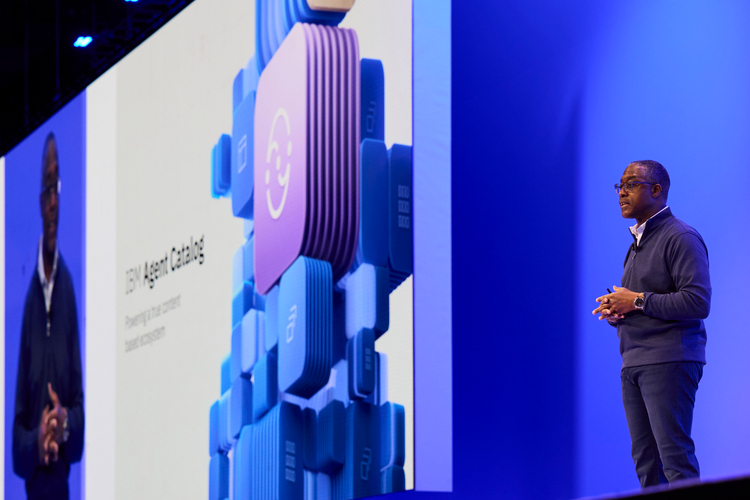
IBM’s “AI Operating Model” blueprint, including new agentic and orchestration tools and Sovereign Core cloud technology introduced at this week’s IBM Think 2026 event, provide opportunities for the company’s sell, build and service channel partners, channel chief Kareem Yusuf told conference attendees.
“AI underpins everything we’re doing,” Yusuf, IBM senior vice president, ecosystem, strategic partners and initiatives (pictured), told the hundreds of solution provider and service provider executives during the Partner Day portion of the Think 2026 event in Boston this week.
A common theme running throughout the Think 2026 conference was that while many businesses and organizations are implementing AI to augment and automate specific tasks, few are successfully adopting it as the core of their business operations and transformation initiatives—and so are not realizing its full benefits.
[Related: IBM Think 2026 Showcases Agentic AI And Sovereign Cloud Strategy]
And that creates opportunities for IBM’s legions of channel partners.
The AI Operating Model, which incorporates the new products and capabilities unveiled at Think 2026, integrates data, agents, automation and hybrid infrastructure to create a scalable framework to help enterprises shift from fragmented AI experimentation to running AI at the core of their business and transform their business operations.
IBM executives made it clear at Think 2026 that channel partners—including resellers and co-sellers (sell), ISVs and development partners (build), and systems integration and strategic service providers (service)—are a key part of that.
“Our goal is to produce the technologies, to [enact] the strategies, where we see lots of demand and then work with you to get it out there,” IBM Chairman, President and CEO Arvind Krishna said addressing partners during the Partner Day keynote.
“We want to help our clients take advantage of artificial intelligence, hybrid cloud, emerging quantum [computing],” Krishna said. “We want to help them make use of all these to help improve their business. These clients are counting on us. They’re counting on us to help them as they transform into becoming AI-first.”
Krishna said 60 percent of IBM customers, within this decade, intend to move beyond using AI “from being just a source of cost and productivity gains to a place where they are going to fundamentally change their business.”
“This is a pivotal moment for clients and, as a consequence, for all of us together—it’s why we invest in our [partner] ecosystem,” the CEO said. “And it’s our commitment to work with you to make our clients successful.”
“It’s been very clear from the get-go that to have a vibrant ecosystem, you need to have an aligned community of partners focused on driving towards a common goal,” channel chief Yusuf said. “The goal, as I continue to stress, [is to] extend our reach, scale our revenue, and do that in a way where you focus on all the needs associated with the different personas and types that partners embody, whether you’re operating as a sell partner, a build partner, a service partner, or all in combination.”
During his keynote, Yusuf touched on steps IBM has taken over the last year to assist each partner type. For resellers, for example, he touted partners’ ability to sell through the Amazon Marketplace, a move he described as key to “removing friction and increasing velocity” in sales processes.
He also cited the Watsonx Workshop, currently in beta for partners and slated for general availability later this year, that provides hands-on technical training for developers, data scientists and IT professionals who build, train and deploy AI models using the Watsonx.ai platform.
IBM Agent Development Offerings
For build partners, the channel chief emphasized the competitive advantages offered by the new IBM Bob agentic development platform, the new IBM Watsonx Orchestrate agent control plane, the Watsonx Orchestrate Agent Catalog, and the new IBM Sovereign Core (for embedding AI governance policies at the infrastructure runtime level).
“We have technology that you can embed in your solution to speed your time to value,” Yusuf said.
That resonates with Nexar, an IBM development and technology partner based in Tel Aviv-Yafo, Israel, which manufactures dashboard cameras and collects anonymized data from its network of 350,000 devices. That data is used for AI-powered applications including city development planning, auto insurance and training autonomous vehicles.
Nexar CEO Zach Greenberger, in an interview with CRN at Think 2026, said his company is using IBM technology, including early editions of IBM Bob and Watsonx Orchestrate, to develop AI-powered road management solutions. The system collects, manages and distributes data from the device network. IBM, in turn, sells the packaged data to its customers including insurance companies and the public sector.
“Our relationship with IBM is very new today,” Greenberger said, noting the development work began just four months ago. “The technology they brought to bear was just very easy to use. They’ve been great collaboration partners.”
Fiducia AI, an IBM ISV and development partner, offers an AI-powered “visual engagement” system, based on IBM technology, for the retail industry and fan engagement. The system is deployed on the IBM Cloud and leverages IBM Cloud Object Store and the IBM Watsonx AI and data platform.
Fiducia, based in San Ramon, Calif., has been working with IBM for about a year and founder and CEO Ganesh Harinath, speaking in an interview with CRN at Think 2026, said the main attraction was the ability to scale the business through IBM: Fiducia is featured in the IBM Partner Plus Directory and is sold by IBM’s own sales force to joint customers.
“The time to build a new solution for retail is shrinking,” Harinath said. “This will be the new paradigm as we go forward.”
Partner Service Opportunities
IBM and its service partners have opportunities to work with customers as they try to integrate new AI agents and applications with existing hybrid cloud infrastructure, said Nick Holda, IBM vice president of AI partnerships, in an interview with CRN at Think 2026. And ISV build partners can bring their domain expertise to AI workloads.
Opportunities also include developing prevalidated integrations with “technical predictability” and built-in governance for faster time-to-value for clients, Holda said. And partner-developed agents can be sold through the IBM agent marketplace and managed using the new IBM Watsonx Orchestrate.
Krishna, during his keynote, said IBM’s goal is to increase “the long tail” of revenue—now about $7 billion—that the company generates through the channel from smaller customers that IBM does not sell to directly.
“We are not going to go there directly. We are going to go there with partners. So our vision for this is how we work together. And that is why you heard Kareem [Yusuf] talk about, ‘Is it a services partner? Is it a skills partner? Is it a build partner? Is it a resell partner?’ Because we need all of those, depending on who [the customer] is in that long tail.”
Another piece of IBM’s vision for its channel ecosystem was highlighted during an “Ask Me Anything” session at Think 2026 when Rob Thomas, IBM senior vice president, software and chief commercial officer, noted that 70 percent of IBM’s revenue today comes from product sales, in contrast to several years ago when 70 percent of revenue was generated by services.
“We’ve made it clear to every SI that we are not an SI,” Thomas said, noting the deep relationships IBM has established with global systems integrators such as EY and Deloitte. “We have a consulting business, but we don’t want to compete with other SIs. And that’s been a dramatic shift.” But he also said IBM has “more work to do” in helping tradition reseller partners build skills around services and product integration.