Google Cloud CEO On $106B Backlog, Gemini AI ‘Large-Scale Adoption’ And BigQuery Momentum
‘Why we’re winning is because we see this deep product differentiation now being adopted by customers. That’s leading us to win new customers, deepen our relationship with existing customers and broaden our addressable market,’ says Google Cloud CEO Thomas Kurian during his keynote at a recent Goldman Sachs conference.
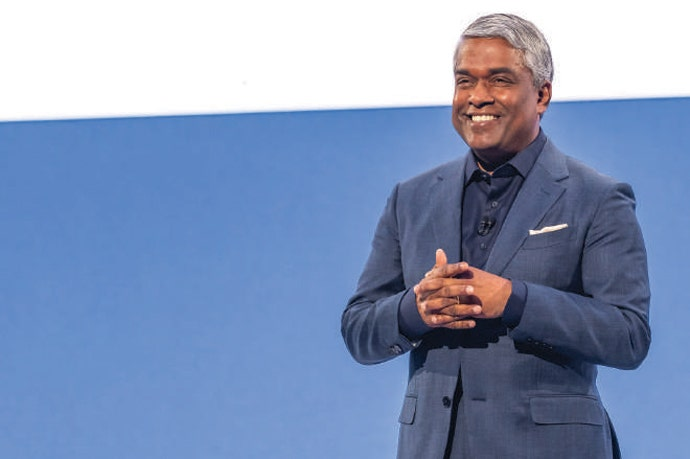
Google Cloud CEO Thomas Kurian says his cloud company is already generating billions in AI with a massive $106 billion backlog and “large-scale adoption” of Gemini by its growing customer base.
“We’ve made billions using AI already,” said Kurian during his recent keynote at the Goldman Sachs Communacopia and Technology Conference.
“Our remaining performance obligation, or backlog, is now at $106 billion. It is growing faster than our revenue,” Kurian said. “More than 50 percent of it will convert to revenue over the next two years.”
[Related: Google Cloud President On Topping Microsoft In AI And Channel GTM]
CRN breaks down the six most important remarks Kurian made in his keynote around a 27-times increase in the volume of data processed in BigQuery with Gemini, over 9 million developers building applications on Gemini, agentic AI innovation and how 65 percent of Google Cloud customers are using “our AI tools in a meaningful way.”
Google Cloud Earnings And Cloud Market Share
Before jumping into Kurian’s most important remarks at the Goldman Sachs conference, here is a quick look at Google Cloud’s current global market share and recent financial earnings.
The $54 billion Mountain View, Calif.-based company currently ranks as the third largest cloud computing company, according to data from market research firm Synergy Research Group.
Google Cloud won 13 percent share of the global enterprise cloud infrastructure services market in the second quarter of 2025, followed by Microsoft at 20 percent share, then Amazon Web Services at 30 percent share.
In second-quarter 2025, Google Cloud’s total sales reached $13.6 billion, representing a 32 precent growth rate year over year.
Click through to read CEO Thomas Kurian’s most important remarks.

$106 Billion In Backlog, Over 50 Percent ‘Will Convert To Revenue Over The Next Two Years’
Our revenue does not come from a single product line. We have many different product lines, all of them growing.
We’ve made billions using AI already. We’re growing revenue while bringing operating discipline and efficiency.
Our remaining performance obligation, or backlog, is now at $106 billion. It is growing faster than our revenue. More than 50 percent of it will convert to revenue over the next two years.
Not only are we growing revenue, but we’re also growing our remaining performance obligation. We’re also very focused on operating discipline to improve operating margins.
‘Large-Scale Adoption Of Gemini,’ Agent AI Kit ‘By Far’ The Market Leader
We offer leading models for large-scale generative AI applications, Gemini. Gemini leads in many dimensions: performance, cost, quality, factuality, the ability to do very sophisticated kinds of reasoning.
It’s used by 9 million developers to build applications. Just to give you a sense, compared to [Gemini version] 1.5, which we launched in January of this year, our latest model [Gemini] 2.5 reached a trillion tokens 20X as fast.
We’re seeing large-scale adoption of Gemini by the developer community.
In addition to that, we offer a leading suite of what’s called ‘diffusion models’ that create images, video, audio, speech, etc. We’ve added a third set of models around scientific computation. For example, our time series model is used by many firms in financial services to do numerical prediction of sequences. Molecular design, we offer a model to help people design molecules, which is getting a lot of interest in the pharmaceutical industry. There’s a whole range of models.
As people switch from just using a raw model to building an agent, we’ve introduced Agent Development Kit, which is a platform to help people build agents. It is by far the leading agent development platform in the industry, supported by over 120 companies.
To give you a sense of the scale, if you compare us to other hyperscalers, we are the only hyperscaler that offers our own systems and our own models. We’re not just reselling other people’s stuff.
The volume of tokens we process is twice [as large compared with] other providers in half the time—so roughly four times the volume. We have a lot of different companies using these AI models, from companies creating digital products to using AI within their organization.
27X Increase In Data Volume Processed In BigQuery
AI is driving growth in our data platforms. To give you a sense, we’ve seen a 27-times increase in the volume of data processed in our data cloud, BigQuery, with Gemini.
We’ve seen that BigQuery—which normally, when people think of data warehouses, they think of things that handle numbers and tables—now is also being used to store and process unstructured data.
We have many more customers than some of the pure-play providers.
Our strength in security is now applied to AI models. We protect your data. We have new solutions to protect AI models themselves so that when you load your data into a model, you do not get compromised by the model. We also protect organizations with new advances that we’ve introduced from threats introduced using AI models to attack systems. All that has driven growth with a lot of different customers, from regulated industries to commercial enterprises to small businesses.

65 Percent Of Google Customers ‘Using Our AI Tools In A Meaningful Way’
We also upsell people as they use more of [AI] from one version to another because we have higher-quality models, more quota, and other things in higher-priced tiers. Because of this, we’re capturing new customers faster.
We’ve seen 28 percent sequential quarter-over-quarter growth in new customer wins in the first half of this year.
Nine of the top 10 [largest] AI labs, and nearly all the AI unicorns, are our customers. We’re deepening our relationship with existing customers.
Sixty-five percent of our customers are already using our AI tools in a meaningful way.
Those customers that use our AI tools typically end up using more of our products. For example, they use our data platform or our security tools. On average, those that use our AI products use 1.5 times as many products than those that are not yet using our AI tools.
That leads customers who sign a commitment or a contract to overattain it, meaning they spend more than they contracted for, which drives more revenue growth.

5 Billion Commerce Transactions Via Google Cloud’s Commerce AI Agent
We’ve seen strong growth in our customer service technology, with 10-times growth in chat and voice interactions.
We’re also building domain-specific agents for specific industries, for example, to help people do shopping and commerce.
Today, we handle roughly 5 billion commerce transactions through our commerce agent.
We make all of these agents, as well as any bespoke ones that people want to build, available on a single platform we call Agentspace. [Agentspace] provides a single panel for a company to access and use all of the AI technology within their organizations.
We’re seeing growth and broadening of our addressable market by applying AI now in domains that IT departments historically didn’t serve: marketing, customer service, commerce, etc.

‘Why Are We Winning?’
Why are we winning? Three things: [First], we provide deep product differentiation in performance, cost, reliability and efficiency in AI infrastructure.
Second, we provide deep differentiation by offering a leading suite of best-in-class generative AI models. In order to feed these models, we use our strengths and historical strengths in data processing, analytics and security to feed models with high-quality data and keep them safe.
Finally, for many years now, we’ve been building domain-specific AI applications and agents, and that work is now seeing a lot of interest from customers. Starting with AI infrastructure, we’ve introduced chips for many years. We’re in the 11th year now [of] building AI systems and chips. Our AI systems are optimized for high performance, highly reliable and scalable training, as well as for inference.
We’ve spent years building advanced AI technology of our own: chips, systems, tools, agents. We made those bets very early. We’re not just reselling third-party technology.
Why we’re winning is because we see this deep product differentiation now being adopted by customers. That’s leading us to win new customers, deepen our relationship with existing customers and broaden our addressable market.