Exclusive: AMD Makes Big Channel Funding Boost As It Builds ‘True’ Partner Program
AMD says it has boosted partner funding by more than 40 percent this year as it works to nearly double its channel staff and grow its global partner coverage by roughly 20 percent. ‘We have to turn this channel on in a major way, in a much more improved way,’ AMD Global Commercial Channel Chief Jason Mooneyham says in an exclusive interview with CRN.
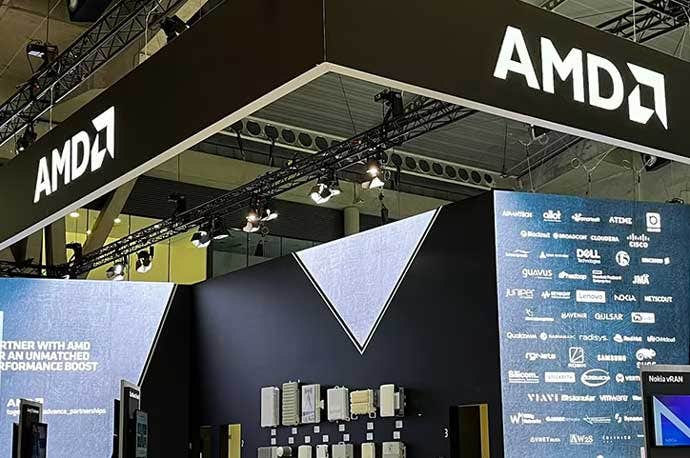
AMD said it has boosted partner funding by more than 40 percent this year as it works to nearly double its channel staff and grow its global partner coverage by roughly 20 percent in its move to build a “true channel program” that is competitive on many fronts.
“This is a gigantic movement for the entire company,” said Jason Mooneyham, who became AMD’s global commercial channel chief in January after previously serving as head of Americas sales for several years, in an exclusive interview with CRN in mid-June.
[Related: The Biggest AMD Advancing AI News: From MI500 GPU TO ROCm Enterprise AI]
Mooneyham, who also holds the title of AMD’s North America channel chief, said his team has spent this year expanding its commercial partner program to better compete with Intel in the CPU arena for data centers and commercial PCs, particularly in the midmarket and SMG segments after years of gains with enterprise customers.
“Our growth in large enterprise has been fantastic, but in order to get to that customer below large enterprise […] we have to turn this channel on in a major way, in a much more improved way. It couldn’t just be status quo,” he said.
Santa Clara, Calif.-based AMD is amping up its channel resources as the semiconductor industry gets increasingly competitive, with Qualcomm doubling its channel funding and quadrupling its commercial channel team this year to grow its small slice of CPU market share. Even Intel has vowed to deliver “more value” and “more benefits” to partners as part of a simplified partner program it plans to launch this October in the face of mass layoffs and other sweeping changes.
Richard Rudometkin, an 11-year AMD veteran who is now vice president of strategy at Northbrook, Ill.-based systems integrator International Computing Concepts, told CRN that the chip designer has come a long way in developing a proper partner program.
“The partner program went from zero 10 years ago, where we had no partner program, to something of substance that I think is excellent today,” said Rudometkin, whose company was named No. 1 in CRN’s Fast Growth 150 this year.
The systems integrator executive said AMD Chair and CEO Lisa Su made clear that she is committed to the channel at the AMD Partner Advantage event he attended in July.
“The Lisa Su keynote was spectacular. She really did double down on her commitment and AMD’s commitment to the channel and to its partners,” he said.
A senior executive at a solution provider, who asked not to be named in order to speak candidly, said he has witnessed AMD’s increased investments in the channel firsthand.
He contrasted this with the lower engagement he’s been getting from Intel since the chipmaker changed his sales representative roughly a year ago. This makes it harder for him to get interested in any changes Intel is making to its partner program.
“It’s real clear to me what I get from AMD because they’re here telling us about it all the time and want to engage with customers in the field, and so that’d be the difference,” said the unnamed solution provider executive.
AMD: Instinct GPUs Aren’t Ready Yet For Channel Prime Time
The one area AMD isn’t ready to address with the expanded partner program is the company’s Instinct data center GPUs, which are key in the chip designer’s fight to challenge Nvidia’s dominance of the AI computing space.
The reason Instinct isn’t ready for channel prime time yet is because the company is focused on “high-touch” engagements with its biggest customers—which include Meta, OpenAI, Microsoft and xAI—to ensure they have an optimal experience, according to Kevin Lensing, who runs Americas and hyperscaler sales for AMD.
The chip designer is also refining the software stack, including the recently launched ROCm Enterprise AI, to ensure channel partners can make repeatable sales and integration motions with Instinct-based systems, Lensing added.
“The challenge with doing a channel enablement on Instinct is we can’t enable a model where we have to go one-to-many if we can’t touch them all and deliver a great experience,” he said.
While Lensing couldn’t commit to a timeline for when Instinct GPUs will become a broad channel play, he said AMD’s new partner program is set up to support the product line and expansions into other product categories in the future.
“With this new overall structure that we’ve rolled out, it lends itself to extensibility, to other product lines and to new ways to incentivize on top of the base. That’s the whole concept,” he said.
Rudometkin, the executive at International Computing Concepts, said that while Intel’s partner program had served as the “guiding light” for AMD’s channel aspirations, the chip designer needs to aim for a program that is on the same level of the Nvidia Partner Network.
The solution provider executive credited Nvidia and his company’s strong partnership with the AI infrastructure giant as a major driver for the 376.5 percent revenue growth the systems integrator experienced over the past two years.
“[AMD] really has to look in the mirror and then look at what Nvidia is doing for their partners and say, ‘This has to be where we need to be,’ and it’s a leap,” said Rudometkin, whose company debuted on CRN’s Solution Provider 500 list this year at No. 108.
Big Channel Expansion Has Buy-In From Top Leaders
While AMD launched a commercial partner program in 2022 to increase its cachet with solution providers, Mooneyham said that program mainly revolved around a volume incentive rebate in addition to some MDF and training elements.
He and his sales team eventually realized that the chip designer should do more to enable partners to sell AMD’s products, particularly because of how often the company wins deals when it runs proofs-of-concept for customers.
“When we get an at-bat, our success rate is extremely high,” Lensing said. “[If] we can get to the level where we get a POC on the EPYC side of the business, we convert it like 80 [percent to] 90-plus percent of the time.”
This led Mooneyham to go to the company’s leadership team—including CEO Su—to make the case for bigger channel investments.
“I went to our leadership and said, ‘Hey, we believe that in order to get the most discerning buyers, the highest-performing buyers on the planet, we can either hire another 250 people in the Americas and try to get to that next layer, or we can really start to empower this channel model.’ So that was well received,” he said.
As a result, AMD made a more than 40 percent increase to its overall 2025 channel investment budget, which includes funding for sales incentives, new strategic programs and marketing funds. This boost in channel spending is part of the increased investment AMD announced for go-to-market initiatives in early May, according to Mooneyham.
“We know we can’t scale organically fast enough to touch every customer. This is the next step in our evolution, and I think it’s widely agreed upon now at the highest levels of the company,” Lensing said.
Chris Bogan, vice president of sales at Houston-based systems integrator Mark III Systems, said AMD has “definitely” been expanding its channel investments as his company is “seeing them in more places” and having “much more interaction with them.”
“I think [AMD and Intel are] doing a really good job of realizing, ‘Hey, the channel is important. We need to make sure that we’re communicating clearly with the channel’ because that is how you interact with customers. And a lot of our customers turn to us for recommendations,” he said.
Mooneyham: New Program Is ‘Best-Of-Breed In A Lot Of Areas’
New AMD sales incentives for partners include special rebates for things like AI PCs and Windows 11 refresh that can be stacked on top of AMD’s volume incentive rebate.
“So [we’re] taking what was a nice base and then saying, ‘Hey, for some strategic areas, we’re willing to do additional investment with you,’” Mooneyham said.
As part of these increased channel investments, AMD has improved the way it enables partners to market and sell AMD-based solutions to a variety of commercial customers, including those in the midmarket and SMB segments.
Mooneyham said the feedback he’s received from AMD’s closest partners is that the new commercial program is “not just competitive but best-of-breed in a lot of areas.”
“Does that mean we’re the best across the board? Probably not. But we also constantly solicit feedback on ways we can improve it,” he said.
AMD has also improved its training program for partners by working closely with the company’s business units to ensure there is greater quality and consistency.
“There were various investment levels from our [business units], to be quite honest. And so some things were good, some things probably could have been improved,” Mooneyham said. “We’ve now taken that feedback and given it to the [business units], and they’re making significant investment there, which only enables us to be stronger.”
Camden Haley, vice president of production management at Merrimack, N.H.-based solution provider Connection, said he considers AMD’s partner program “incredibly competitive, especially when you think about the incremental investment opportunities that we’ve seen this year.”
He anticipates that Connection will grow its AMD-based business in 2025.
“There is a lot of opportunity when it comes to the AMD portfolio,” said Haley, whose company is No. 33 in CRN’s 2025 Solution Provider 500.
AMD Is Growing Global Partner Coverage, Channel Staff
AMD is expected to grow its global partner coverage by roughly 20 percent by the end of the year. There were more than 500 value-added resellers, distributors, service providers and systems integrators that were on its roster in the first quarter, according to the company.
The coverage expansion plans include new partners being added in North America; Latin America; Europe, the Middle East, and Africa (EMEA); and Asia-Pacific Japan (APJ). But the company is also changing the way it works with partners that operate across different regions.
“In North America, we’ve had the benefit of being a lot more mature, at least in how we’ve covered [distributors and national solution providers]. They haven’t had that in APJ and EMEA. And so some of that coverage has had dual hats, where you might call on some end customers and the partners that may be associated with them. Now, they’re going to put dedicated coverage in in those regions,” Mooneyham said.
AMD’s increasingly global view of the systems channel will benefit partners that operate across different countries, like World Wide Technology and Computacenter, which will allow it to have more strategic conversations with such companies at a CEO level, according to Mooneyham.
“When you start to combine [the regions] together and look at the real impact AMD is having on their business at the PC side, at the workstation side, at the OEM server side, it becomes a much bigger partnership, and we’re much more impactful,” he said.
The global channel chief said the increased channel coverage also means more AMD representatives working with individual partners.
“Where we may have had one body on a particular partner, now [we have] even under that some data center specialty, some commercial client specialty, maybe even some cloud specialty that’s in there,” Mooneyham said.
For value-added resellers that don’t have direct AMD coverage, the company is increasing investments in distributors to reach that next level of partner, according to Mooneyham.
Lensing said AMD’s success in growing market share in the desktop component channel—along with the profitability that it has driven for distributors—should help the company grow sales in the number of AMD-based systems that go through distribution.
“We can show them, ‘When we get mind share from you and we invest correctly, we can drive significant leadership share.’ There’s no reason why we can’t replicate that on the system side,” the Americas sales leader said.
To support AMD’s growing channel coverage and investments, the company expects to nearly double the total number of channel sales, channel marketing and channel enablement specialist teams across all regions by the end of the year, “with a special focus on covering new partner segments and growth markets,” according to the company.
Haley, the executive at Connection, said his company has benefited from AMD’s increased investments in channel coverage and staffing, which is partly reflected in the increased number of AMD employees who interact with the solution provider on a regular basis.
This includes AMD employees addressing the chip designer’s data center portfolio, an area that Haley said previously “has maybe not gotten as much attention from us.”
Connection has also received funding to create a role within the solution provider that is dedicated to driving business for AMD-powered HP Inc. computers, Haley said.
“We went to both AMD and HP. We said, ‘Hey, we feel there’s this potential that we would love to partner on.’ And both organizations said, ‘We see it, and we want to be in it with you,” the solution provider executive said.