The 10 Coolest Semiconductor Startups Of 2026 (So Far)
From NextSilicon and Fractile to d-Matrix and Cornelis, here are the 10 coolest semiconductor startup companies of 2026 that you need to know about.
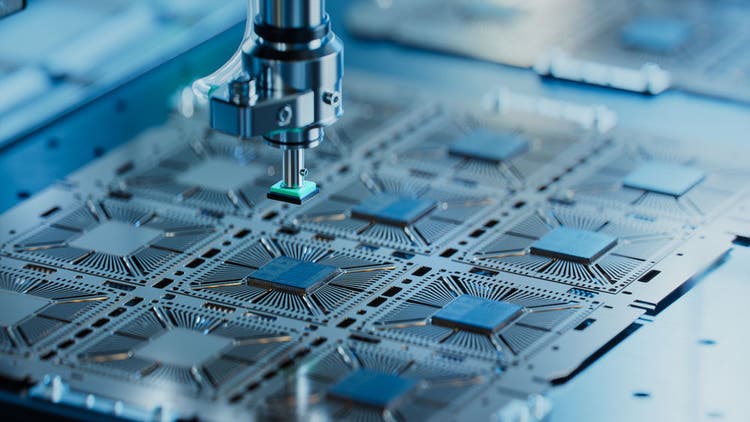
The semiconductor startup industry is being injected with billions of dollars in capital investment as global semiconductor sales are expected to surge to over $1.3 trillion in 2026.
CRN takes a deep dive into 10 of the coolest semiconductor startup companies that are unveiling new chip innovation and capturing millions from investors this year.
This includes chip and tech startups Axelera AI, Tenstorrent, NextSilicon, Fractile, Etched, d-Matrix, Cornelis, Xsight Labs, Lightmatter and MatX.
[Related: Cloud Star DoiT On Buying Startups, AI ‘Tokenomics’ Shift And AWS BVR Competency]
Before jumping into these 10 startups paving the semiconductor highway of the future, here’s a look at the global semiconductor market today.
Global Semiconductor Market To Hit $1.3 Trillion In 2026
Global semiconductor revenue is projected to exceed $1.3 trillion in 2026, showing the highest growth rate in the last two decades, according to IT research firm Gartner.
Gartner forecasts semiconductor revenue will grow 64 percent annually in 2026, with memory revenue expected to increase threefold.
“Amid high demand for AI processing, data center networking and power, and memory price inflation, the semiconductor industry is projected to achieve a third consecutive year of double-digit growth in 2026—a milestone that underscores the sector’s pivotal role in the AI technology stack,” said Rajeev Rajput, senior principal analyst at Gartner, in a statement.
Here are the 10 coolest semiconductor startups of 2026 that you need to know about in one of the hottest markets in the world right now.

Axelera AI
Top Executive: Fabrizio Del Maffeo, CEO
Axelera AI develops purpose-built AI hardware acceleration technology for computer vision and generative AI applications focused on edge computing and data centers.
With an edge-first architecture that addresses AI’s critical energy and cooling constraints, Axelera AI has deployment across more than 500 customers, including in telecommunications, aerospace and the enterprise.
The startup’s Europa and Metis platforms deliver high-performance AI inference solutions that enable deployment at scale within real-world power and thermal budgets.
The Netherlands-based startup this year announced a funding round of $250 million, attracting over $450 million in equity, grants and venture debt since launching in 2021.
Through its Partner Accelerator Network launched in 2025, Axelera AI provides a partner ecosystem approach that ensures accessibility and rapid deployment.

Cornelis
Top Executive: Lisa Spelman, CEO
Cornelis delivers high-performance semiconductor and networking offerings that accelerate AI and high-performance computing workloads.
The Wayne, Pa.-based startup’s technology enables lossless, congestion-free networking that reduces training time, improves inference and maximizes compute utilization.
In June, the startup launched Cornelis CN5000, a 952-node supercomputer cluster, built with Dell PowerEdge servers, Intel Xeon processors and Cornelis CN5000 Omni-Path fabric purpose-built for the most demanding workloads.
On the channel front, the company this year expanded its global partner ecosystem with new federal systems integrators and distribution channels to broaden access to its CN5000 offerings for the channel to deliver scalable AI and high-performance computing infrastructure with improved application performance and lower infrastructure cost.

d-Matrix
Top Executive: Sid Sheth, CEO
d-Matrix is a pioneer in low-latency AI inference for data centers with a focus on inference accelerator innovation.
The Santa Clara, Calif.-based startup provides inference accelerators, its JetStream networking accelerators, Aviator software and rack-scale offerings called SquadRack to deliver sustainable AI inference at data center scale.
In April, d-Matrix acquired GigaIO’s data center business, a systems engineering organization with deep expertise in rack-scale infrastructure and high-performance interconnects.
Last month, d-Matrix launched Corsair, an inference accelerator platform that is now in full production. The startup said Corsair is meeting commitments from cloud hyperscalers, neoclouds and frontier AI labs seeking faster, more interactive AI experiences at scale.

Etched
Top Executive: Gavin Uberti, CEO
Etched launched out of stealth mode in June by unveiling its Sohu chip and over $1 billion in signed customer contracts.
Etched.ai develops custom chips optimized specifically for transformer models, recently reaching a valuation of $5 billion.
The San Jose, Calif.-based startup said it built a new class of inference systems, co-designed throughout the entire stack to deliver best-in-class throughput and latency, cutting costs and improving the power efficiency of AI to unlock inference at scale.
The startup opened a Taiwan factory and built a data center, test house and NPI prototyping lab at its headquarters—with a path to gigawatt-scale in 2027.
The startup has raised a total of $800 million so far.
Fractile
Top Executive: Dr. Walter Goodwin, CEO
Fractile is building chips aimed at removing every bottleneck to running large AI models at a global scale.
In May, the London-based startup raised $220 million in a Series B funding round that will fund the development and commercialization of its upcoming AI inference chips.
The startup is developing chips that use in-memory compute, an approach that allows processors to run calculations directly in computer memory.
News reports indicate that Anthropic is in discussions with Fractile regarding the purchase of the startup’s inference chips when the hardware becomes available in 2027.
In February, the startup unveiled plans to invest $135 million to boost its U.K. operations, including the creation of a new hardware engineering facility.

Lightmatter
Top Executive: Nicholas Harris, CEO
Lightmatter is the owner of Passage, a 3-D-stacked silicon photonics engine, as well as Guide, a VLSP light engine, which connects thousands to millions of processors.
The Mountain View, Calif.-based startup said it is striving to lead a revolution in AI data center infrastructure, enabling the next giant leaps in human progress.
Designed to eliminate critical data bottlenecks, Lightmatter’s technology delivers top-notch bandwidth density and energy efficiency for advanced AI and high-performance computing workloads with the goal to fundamentally redefine the architecture of next-generation AI infrastructure.
Lightmatter has raised a total of $850 million across multiple funding rounds. The startup now has a valuation of $4.4 billion.
MatX
Top Executive: Reiner Pope, CEO
AI chip startup MatX built an LLM chip, MatX One, that delivers high throughput and low latency.
The Mountain View, Calif.-based startup recently announced a $500 million Series B funding round to accelerate production of its MatX One flagship processor. MatX is striving to build processors up to 10 times better at training large language models (LLMs) compared with Nvidia's GPUs.
The new funding will help MatX produce its chips with TSMC, with plans to start shipping them in 2027.
The startup said its MatX One chip is based on a splittable systolic array, while also getting high utilization on smaller matrices with flexible shapes.
The startup was founded by two former Google engineers, Pope and Mike Gunter.

NextSilicon
Top Executive: Elad Raz, CEO
NextSilicon builds computing infrastructure for algorithmically complex workloads with its flagship Maverick-2 chip designed to speed up precision scientific computing tasks.
The Israel-based startup’s Maverick-2 accelerator chip uses a runtime reconfigurable dataflow architecture to deliver up to 10X performance over leading GPUs at less than half the power, with no requirement to rewrite existing applications.
NextSilicon has raised over $300 million across multiple funding rounds.
In June, the company unveiled plans to productize its Arbel RISC-V core processor into a 64-core and a 128-core enterprise-grade processor to deliver top performance for agentic tools. The Arbel RISC-V core is expected to be available in early 2028.

Tenstorrent
Top Executive: Jim Keller, CEO
Tenstorrent is an AI compute company led by Keller— the architect of some of the most popular chipsets, including Apple’s A4/A5 chips and AMD Zen, as well as Tesla's Full Self-Driving chip.
The Santa Clara, Calif.-based company builds RISC-V-based AI processors and systems for developers, enterprises and sovereign infrastructure.
In addition to servers and workstations, Tenstorrent licenses its TT-Ascalon RISC-V CPU and Tensix AI cores to chip designers including Samsung and LG.
The startup has raised over $1 billion with operations now throughout North America and Asia.
Lats month, Tenstorrent launched its new TT-Ascalon S— a new compute-dense RISC-V CPU for agentic AI.

Xsight Labs
Top Executive: Yossi Meyouhas, CEO
Xsight Labs is a fabless semiconductor startup that provides intelligent connectivity offerings for hyperscalers, edge computing and AI data center networks.
The Israel-based startup said its technology and networking chips deliver exponential bandwidth growth and versatility while lowering power and total cost of ownership.
Xsight, in collaboration with Edgecore Networks, recently launched what it says is the industry’s first PCIe add-in card—delivering 800 Gbps throughput for PCIe 5.0 Host Systems that incorporates 64 Arm N2 Cores in a low-power PCIe AIC form factor.
The startup is currently seeking to raise $300 million.
In December, the company signed an agreement for the supply of network chips for Starlink’s next generation of satellites.