Dell CEO: Partners Key To Delivering On The ‘Profound Opportunity’ In AI
‘Every company is trying to figure out how to apply this technology best inside their business, and this is where partners and solution providers can play an enormous role. … But it is a new thing, right? You have to spend time to learn and add value. These solutions just don’t spontaneously create themselves,’ says Dell Technologies founder, Chairman and CEO Michael Dell.
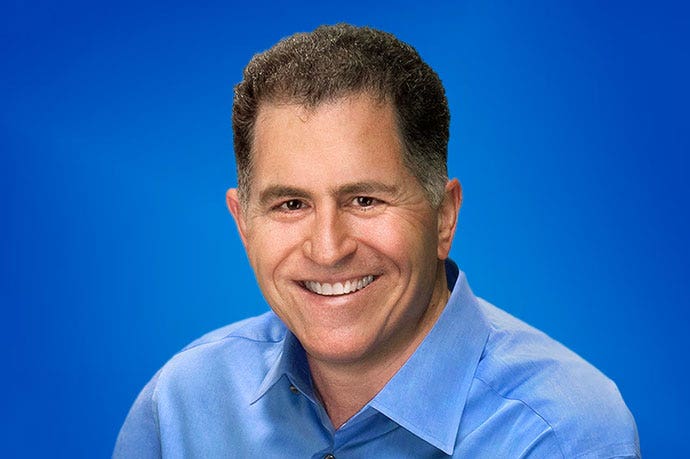
Between PCs, storage, server, networking and rack solutions, every Dell Technologies product is tied to what founder, Chairman and CEO Michael Dell called “the largest market opportunity of our lifetime.”
“I think we’re seeing a really profound opportunity and change occurring in the industry with AI, and Dell has obviously thrown our engineering and innovation engine into that to enable it and lead,” Dell told CRN in a recent interview. “It is the largest market opportunity that we’ve seen in our lifetimes, and certainly our partner ecosystem is key to that. It drives about half of our revenues and enables all sorts of unique, transformative solutions across the world with our customers.”
Dell introduced the Dell AI Factory in early 2024, which it touted as a data-center-to-the-edge validated architecture that contained everything customers would need to begin transforming their own data into AI insight.
“Today, AI is the central topic. When you meet with customers. It’s not the No. 1 topic. It’s No. 1, 2 and 3,” he said. “And there’s a lot to be done there. And understanding the vertical intricacies of every business, the regulatory, the security, how do you organize the data? What are the right models? What problems are you trying to solve? Fundamentally, what’s the best way to go about doing that? This is where partners can add a ton of value.”
Dell’s AI business has grown to $20 billion, with more than 3,000 customers and 6,700 more customers in the pipeline, along with six consecutive quarters of combined compute and storage revenue growth.
“And we’ve led in compute for 33 consecutive quarters and in storage for 94 consecutive quarters, divided by four. That’s a long time,” Dell said. “And then, of course, we’ve got the whole AI PC thing as the next wave of productivity. We’re excited about all the opportunities ahead.”
The one area Dell has not dominated is the PC space, which is where the company got its start. While Dell is No. 1 in commercial PCs globally, it does not fare as well in consumer or the long tail of commercial customers looking for cheaper devices.
Dell Vice Chairman and Jeff Clarke recently took over that division with a plan to aggressively take share among PC customers in education and in entry-level commercial accounts, which represent the lower 75 percent of the PC business. Dell renamed its PCs last year, opting for Dell, Dell Pro and Dell Pro Max to align with different user types.
Clarke is focused on gaining share in PCs and fired his first shot at doing so in August with the launch of two Dell Pro Essential models priced as low as $300.
Michael Dell is quick to point out that Dell leads all competitors by revenue and profit in PCs.
“There’s really three things you could do in a business, right?” Dell told CRN. “You can have revenues, you can have profits, and you can have units. Dell is No. 1 in revenues. Dell is number No. 1 in profits. We’re not No. 1 in units. And so I would rather be No. 1 in revenues and profits than No. 1 in units.”
That said, Dell told CRN to expect the company he started with PCs to take more unit market share. But don’t expect the company to announce another blockbuster acquisition anytime soon.
“Obviously, in 2016, we made a very large acquisition,” he said referring to the $67 billion EMC purchase. “But I don’t really see a need for large acquisitions right now.”
During the interview, Dell was joined by Chief Partner Officer Denise Millard, who addressed the finer points of some partner-facing questions.
Here is CRN’s interview with Michael Dell and Millard.
You mentioned six quarters of storage growth. Over the last six quarters, if I just look at the storage line, there’s been some choppiness there. It hasn’t all been runaway growth. It’s been single-digit growth with some quarters of losses.
Dell: I think the thing you need to look at there is, VxRail is no longer a thing. It was a thing a couple of years ago, and it’s a lot less of a thing now. And so the thing that’s been growing tremendously is the Dell IP in storage. And you could say, more accurately, the Dell EMC IP in storage.
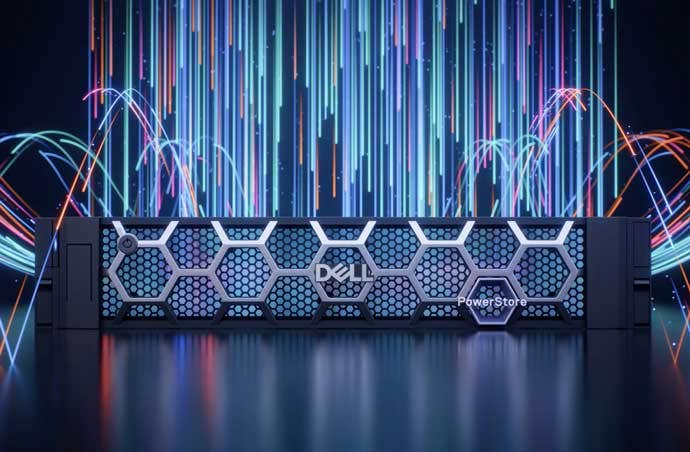
And so, yes, you’re right when you look at aggregate top line. But if you take out VxRail, which is clearly not all Dell IP, you’ve seen tremendous growth right in the fat of the bat, if you will, with PowerStore and again, double-digit growth. The first digit is not a ‘1’.
It’s gobbling up share and growing, and it’s an enormous engagement for the partners.
Denise, why don’t you talk a little bit about what you’re seeing there?
Millard: It’s probably the No. 1 topic that we’re covering with partners.
We’re launching a new transition incentive program that really helps, and it’s tied to Dell Private Cloud. So we’re helping partners transition their customers from Dell VxRail to a disaggregated infrastructure built either on PowerStore or PowerFlex.
To Michael’s point, that is really enabling them to operate in an open ecosystem. They don’t have to be locked into a specific hypervisor. Many customers are actually deploying a multi-hypervisor environment, and that really aligns well with Dell’s strategy and the role that our partners can play.
So, we are launching a program that is driven to help that transition, but also to give partners greater profitability and the resources to help those customers transition. So it’s not just about incentives for the partners as well as rebates. Where, from a customer standpoint, we know the cost to serve and then the cost to migrate and learn new capabilities is equally important.
So, there’s no-cost training. There’s migration services. There’s an opportunity for trade-in and buy-back programs, along with our really compelling financial services. So we feel like we have a well-rounded strategy. We have the products that sit behind it, and now we’ve put a program in place to help support it.

On the revenue front, you boosted guidance last month to $107 billion, which would be a record high. The last time you had a record was 2023 with $102 billion. And you’ve had a number of workforce reductions since then, around 20,000, in terms of overall head count reduction since then. So you’ve managed to do a lot more with less. What’s been the philosophy behind the restructuring, and what can partners take away from that?
Dell: Well, I think every company is figuring out how to be more efficient all the time. When we issued our first annual report in 1989, we had $257 million in revenue and 1,200 employees. If we had the same revenue per employee now that we did then, we’d have 510,000 people.
Obviously, we don’t, right? If we did we probably wouldn’t be in business if we had 510,000 people. So every company is figuring out how to be more productive, efficient, effective and grow, and that’s what we do.
In terms of customers, I think it’s 6,700 in the pipeline for enterprise customers, just on AI. I’m sure there are a number of channel partners that are involved at some level with some of those. Can you talk about what those channel partners are doing to involve themselves? What do they look like? How do they win in those deals and become enmeshed with Dell when it comes to that pipeline?
Millard (pictured): So, let me try to talk through this. We announced at Dell Tech World a couple of years ago a big focus on our high-potential, highly capable partners who are investing around AI.
So it starts with the engineering focus that Michael shared. Our AI factory is all about the end-to-end framework and enabling partners to operationalize across the data center, co-location, from workstation to AI PCs, to cloud to edge.
And a big part of the role that Dell is playing and what we’re doing with our partners around enabling them is starting with the validated designs, No. 1. No. 2 is making sure that we bring the full potential of the ecosystem together and then supporting them as they build out their own capability around delivering AI outcomes.
The average customer has not deployed AI at scale, and those are new skills that are required. At the same time, we’re seeing a tiering of partners. Not all partners are participating at the same level because, quite frankly, it costs a lot, and they have to make investments in those new skills.
So we think about the AI journey in terms of, how do we enable them up front, in terms of training and enablement. We’ve done a lot to support our partners through our Partner Academy to support that with a new data- and AI-focus area through the prevalidated designs that are T-shirt-size. We make it easier for them to bring those solutions to market, and we’re doing that with a ‘good, better, best’ approach for both Nvidia and AMD stacks.
It’s really about, ‘How do we get those repeatable deployments?’ Because customers who want to invest, they want a predictable outcome. They want a time-to-value proposition that the combination of our partners, along with Dell, is going to bring to the table.
We’re partnering with them on AI Accelerator Workshops, which is all about really understanding the service capability that Dell brings to the table. And as they build out their own, how do we complement each other in the market?
And then as some of the use cases become more mature, and you’ve seen us make a number of announcements, whether it’s Google Gemini, other announcements that we’ve made, where partners can take those and deploy them within our ecosystem.
So we feel like we’re in a really good place. Michael mentioned we’re seeing enterprises start to turn on, and that’s really where we need our partners to play a much bigger role as we go into our new fiscal [year], and that’s the plan that we’re building.
Dell: Yes. I mean, every company is trying to figure out how to apply this technology best inside their business, and this is where partners and solution providers can play an enormous role.
And as Denise mentioned, we have been seeing some very nice progress. We’ve got these blueprints and starter kits and reference platforms and all these tools that help the partner community get going. But it is a new thing, right? You have to spend time to learn and add value. These solutions just don’t spontaneously create themselves.
One of the talking points that’s emerged, whether it’s Gartner coming out with its ‘trough of disillusionment’ study or Forrester saying some people are going to be pushing AI spending back to 2027. We had the MIT Media Lab study that said 95 percent of AI projects fail. So there’s a lot of rollout problems that folks are encountering as they build out AI.
Dell: And a big part of our blueprints and all that is how do you ensure success, right? We’ve learned a lot, and I think one of the reasons we’re succeeding is because we have a repeatable model that is working, and you know that drives its own momentum.
How much time do you have to actually see an ROI for some of the enterprises that are taking this on? How much time do they have to see an ROI before they stop aggressively investing in AI, the spending that’s been driving this momentum?
I’m not seeing anybody really stop investing in AI, so that would be news to me, and I’m studying this pretty carefully.
I’m sure. I’m not suggesting that they’re doing it. What I’m suggesting is that based on some of the studies that have come out have said, ‘Look, there is a clock ticking for this to return money.’ If you’re an enterprise and you’ve invested millions of dollars into some of this infrastructure, there is a clock ticking to get some of that money back.
Dell: Sure. Look, there’s kind of a right way to do this and the other way to do it, and we’re pretty careful to make sure that our partners and customers have the right order of operations in their organizations to drive success. And we are seeing lots of success in the projects that we’re involved in. And I think we’re just really at the early stages of adoption here. And all indications are [that] it’s going to keep going.
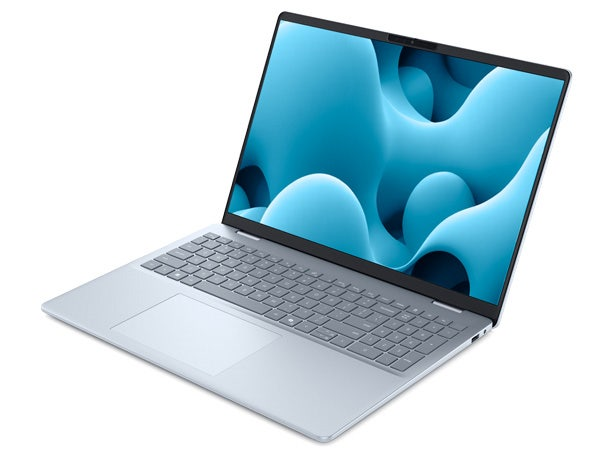
Everybody says one of the things that is critical to AI adoption is getting it right at the endpoint on the PC. Jeff Clarke has taken over that division. There are these different buying personas between commercial and consumer. The chattering class is saying that you should spin off PCs and go all- n on infrastructure.
Dell: (laughs) You can be like HP. We could split it into two companies.
Is that a possibility? Do you ever think there will be such a day?
Dell: I don’t get enough advice.
Do you ever see that as a possibility? Will Dell ever spin off its PCs?
Dell: No plans to do that.
So, how do you plan to reclaim that top spot in PCs?
Dell: In revenues?
In market share, you guys are No. 3. I mean, it goes Lenovo, HP and Dell.
Dell: In revenue share?
No, I’m talking in terms of shipments.
Dell: Well, there’s really three things you could do in a business, right? You can have revenues, you can have profits, and you can have units. Right? Dell’s No. 1 in revenues, Dell’s No. 1 in profits. We’re not No. 1 in units. And so I would rather be No. 1 in revenues and profits than No. 1 in units.
But you made changes to the PC division for a reason, right?
Dell: You can expect we’re going to be growing our unit share while we maintain our share in revenues, our No. 1 share in revenues and No. 1 share in profits.
One thing about PCs is we are No. 1 in commercial PCs. And No. 1 in commercial PCs worldwide, OK? And that’s probably more relevant to your readers. You know, consumer is fine, but we’ve never been super-focused on consumer.
I saw an interview with Dell Infrastructure Solutions Group President Arthur Lewis. He made this point that I thought was really good. He said there’s basically five prongs to a conversation around AI: There’s use case, data, model, architecture and infrastructure. Dell used to come in on the bottom to help with the architecture and infrastructure. So now Dell is coming in during the early part of the conversation. What stage do you see partners coming into that conversation? And how can they move up the stack on that?
Dell: When you have thousands of partners, it’s a multi-speed world. So some of them are fantastic at solving all of the layers of the solution that a customer may need to engage in. And some of them are not. And so what we want to do is advance those capabilities and make it easy for them to grow.
But let’s remember, a couple years ago, nobody was doing this. So it is building new skills, building new capabilities.
We have this discussion all the time with the partners, right? If you’re doing exactly what you were doing five years ago, you’re probably out of business. So we all have to keep evolving our ability to add value and stay relevant for customers.
This is kind of core to business: ‘What are the problems that your customers have, and how can you help them solve them?’
Today, AI is the central topic when you meet with customers. It’s not the No. 1 topic. It’s No. 1, 2 and 3. And there’s a lot to be done there. And understanding the vertical intricacies of every business, the regulatory, the security, how do you organize the data? What are the right models? What problems are you trying to solve? Fundamentally, what’s the best way to go about doing that? This is where partners can add a ton of value.
I would say, in terms of the use cases, there are about six big categories that are the most successful and represent the significant majority of the activity. It’s content creation, it’s code generation, which also involves improving old code and making it more reliable. Digital assistance, digital twins, computer vision—which is particularly relevant in advanced manufacturing and retail logistics—and then design and integration.
And in each of those, we have a whole slew of starter kits, blueprints, resources to help partners get going and, of course, underlined with the world’s leading infrastructure company with PowerScale, ObjectScale, PowerEdge, No. 1 shares across all compute and storage.
HPE just closed its acquisition of Juniper this year. Lenovo is buying Infinidat. I haven’t seen Dell really do much in terms of M&A. I’m just curious is that on the agenda here for the next 12 months to 18 months? Are there any sort of things that you’re looking for out there in the marketplace?
Dell: Yes, well, you know, we did an acquisition. If you saw, let’s see. Yeah, it was $12.4 billion. We bought back 169 million of our own shares. Look, I mean, we’re growing organically, very quickly, we’re investing. You’ll see some small acquisitions. Obviously, in 2016, we made a very large acquisition, but I don’t really see a need for large acquisitions right now.
I’ve seen you mention this in a couple of interviews. You said there’s basically three customers for AI. There’s the tier-two CSPs, there’s the sovereign AI folks, and then there’s enterprise. When I think of a CSP like CoreWeave, and I’m not asking you to comment on them, but they would also be serving the enterprise in some capacity around some of the same infrastructure that you provide. So is there a competition there? How should we look at the competition versus cooperation between Dell, the CSPs and your enterprise customers?
Dell: I think this gets back to where are the workloads. And just like with cloud, you have hybrid cloud and multi-cloud, I think the same is going to be true with AI. We do see growth in inference sort of taking over here, and the inference is likely to follow where the data is.
So you go back to storage, because storage is the fuel for inference, attaching inference on to all that data storage that Dell has leading share in. This is like peanut butter and jelly. Everything goes together here. You’ve got the compute, you’ve got the storage, you’ve got the AI, and, the answer, it’s going to be both.
It’s going to be [on-premises] and [colocation], and it’s going to be in cloud providers as well. But again, go back and look at our server networking business, [which] grew 58 percent last year, 69 percent last reported quarter. Those are pretty stout numbers, right? And so it’s going to happen everywhere.
Millard: I would just add to that as part of our CSP program. Our role there is to make sure that CSPs build out a service stack on a Dell stack.
Whether they decide that they want a sovereign solution, they don’t have a data center and they go to the CoreWeaves of the world, or whether they build that in their own data center or in a colo on a Dell stack. I mean, that’s a win-win either way.
We sell with our partners. We have a full go-to-market framework for that, to Michael’s point. So I don’t see it really selling against. I think it’s more about where the customer wants to put the data and that we’re giving them options. In all cases, we can serve their solutions.
There’s the CoreWeaves of the world, but then there’s the integrators and some of the smaller CSPs who’ve yet to build out a full GPU stack. But what they are doing is building dedicated stacks, smaller, for specific deployments for customers.
So they’re doing the managed services, which they’re great at. They’re building that on a Dell stack, and they’re building that aligned, typically, to a key vertical that they’re supporting a customer base around. So I do think we have a really robust model there and we make sure that we’re selling with those partners, not against them.
Dell: Ultimately, I think the reason why we’re winning disproportionately is our engineering leadership and innovation, the services that go with that, the technical support, the financing with [Dell Financial Services], the deployment, delivery and installation.
It’s not just the products themselves. It’s the cooling, the networking, the cabling, the optics, maintenance, everything that goes around these things, because they are the most complicated things that humans have ever built so far.