NinjaOne Targets Growing MSP Workloads With New AI, Automation Tools
Over the last 12 months, NinjaOne has delivered more than 43 releases and 600 new capabilities, enhancements and products.
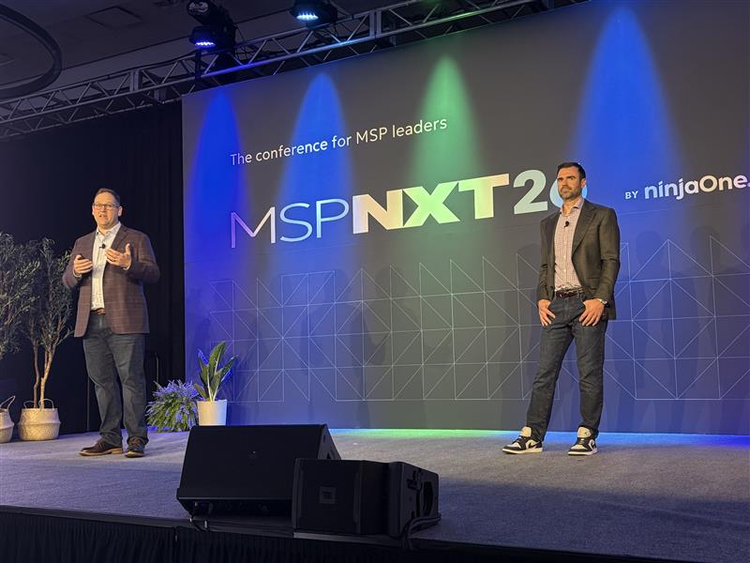
NinjaOne launched a number of new products to help MSPs manage growing device fleets, strengthen security and automate routine work without adding staff.
Announced at the Austin, Texas-based vendor’s inaugural MSP NXT conference in the Austin last week, the company unveiled Katana AI, an agentic AI technician that helps IT teams diagnose issues, identify root causes and recommend remediation steps using device telemetry, alerts and historical data. Also launched was NinjaOne MCP, a secure orchestration layer that enables external AI agents to access NinjaOne data and take action using existing permissions and governance controls.
Additionally, its vulnerability management, browser management and dynamic policies offerings address frequent software vulnerabilities, browser-based security risks and complex device configurations.
[Related: NinjaOne CEO: We’re Hiring 1,000 Employees, Doubling Channel Spend In 2027]
Matt Hastings, SVP of product management at NinjaOne, (pictured right) said the company has made the largest investment in its product organization in its history, adding more than 300 people across engineering and product management. Over the past 12 months, NinjaOne has delivered more than 43 releases and 600 new capabilities, enhancements and products, he said.
“We want to be here to deliver everything we can and help you in every single way we can,” Hastings said to an audience full of MSPs. “More people means more capacity. More capacity means faster delivery for you. We never have to slow down innovation on RMM to launch a new product.”
NinjaOne’s vulnerability management tool helps MSPs identify and remediate security weaknesses. Using endpoint telemetry and AI-driven analysis, it continuously detects vulnerable software and integrates directly with NinjaOne’s patching engine.
“Ultimately, what this means for you is real-time vulnerability visibility, no scans,” Hastings said. “There’s no scans, there’s no CPU spikes, there’s no end users complaining that their computer is running slow. And finally, faster remediation. Vulnerabilities flow into our autonomous patching engine that helps you get updates out to your endpoints faster without causing downtime and that operational risk.”
NinjaOne partner John Douglass said the rollout of vulnerability management capabilities gives techs greater visibility into potential security risks across client environments.
“It’s been great because it gives us one pane of glass that we can go into for the techs,” Douglass, president and CEO of Wichita, Kansas-based Pileus Technologies, told CRN. “They can see what’s going on in real time, as far as vulnerabilities or potential vulnerabilities on our client systems.”
NinjaOne browser management gives MSPs visibility into browser extensions, visited URLs and AI tools used by employees, with inventory, risk scoring and blocking capabilities. That can help MSPs identify malicious extensions and limit unauthorized applications, according to Peter Bretton, VP of product strategy at NinjaOne.
“You don’t have to go through the change management process of forcing them into a new browser, changing how they interact with the web and the tools they have today,” Bretton (pictured left) said. “You can manage the browser that they use and protect them wherever they work. It’s the same console you use today with essentially zero setup, essentially zero deployment and none of the change management that makes browser management so difficult.”
Another announcement, dynamic policies, simplifies configuration across diverse client environments. Rather than requiring techs to create and maintain multiple policies for different device configurations, the feature adjusts settings according to device state, role, tags, custom fields or assigned users.
Hastings said the event-driven approach updates configurations as device conditions change, while zero-touch onboarding automatically applies the appropriate settings when devices come online. Effective policy views also help techs understand which policies govern a device and why.
“Dynamic policies bring five new features for managing the complex and heterogeneous environments at scale by letting you target configuration based on the device’s state,” Hastings said. “Ultimately, dynamic policies let technicians manage more endpoints faster and at scale.”
NinjaOne Katana, another announcement, brings AI-powered assistance directly into workflows. Bretton described it as an agentic technician with platform-wide context that can answer questions, investigate problems, prioritize alerts, generate reports and help resolve issues. It can also use existing standard operating procedures to guide techs through tasks and turn remote-session summaries into knowledge base articles.
Katana is supported by NinjaOne’s Model Context Protocol (MCP) integration, which allows external AI agents and productivity tools to access NinjaOne capabilities and connect them with other systems MSPs already use.
Bretton said MSPs cannot hire their way out of the growing workload as client device counts and service expectations only increase.
“I’ve never seen a client ask for less for the same price. They’re always going to ask for more, and automation and AI are the answer to that,” he said. “Ultimately, it’s like having your best tech, who’s gone through the NinjaOne Academy, sitting next to every single one of your technicians, making them faster, making them better and ensuring your clients are happier.”