The 10 Coolest MSP Tools Of 2026 (So Far)
From Petra Security to Inforcer to CyberFox, here are the 10 of the coolest MSP tools right now.

When it comes to software products, MSPs aren’t looking for more tools, they’re looking for better ones.
Across service management, cybersecurity, Microsoft 365 administration, backup, automation and documentation, the strongest platforms are not simply adding another product to the stack. Instead, they are helping MSPs reduce complexity, standardize service delivery and turn day-to-day operations into something that can scale.
HaloPSA, Syncro XMM and Rewst reflect the push to bring more workflows, tickets, automation and customer management into fewer places. Inforcer points to the growing importance of managing Microsoft 365 tenants consistently.
Security is also taking a more practical shape. Cybersecurity startup Petra Security is focused on stopping business email compromise and Microsoft 365 account takeovers; and Cynomi is moving vCISO services toward continuous security governance, connecting vulnerability findings, remediation, compliance evidence and customer reporting to name a few.
Even legacy MSP categories are being reworked around efficiency and profitability. Together, these tools point to an MSP market that is more and more focused on platforms that help them work faster, prove value to customers and grow without adding unnecessary complexity.
Here are the 10 hottest MSP tools of 2026, so far.
HaloPSA
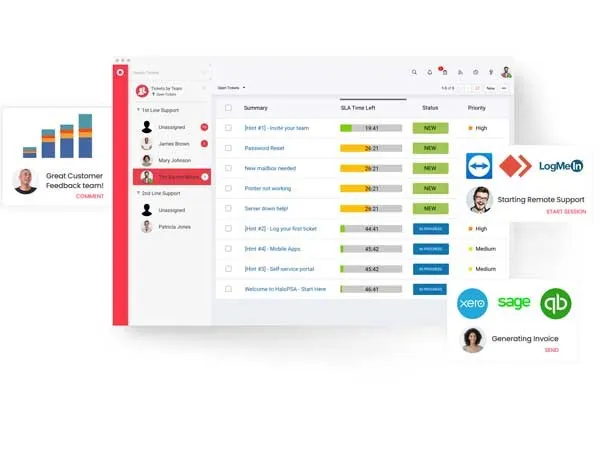
HaloPSA has become a platform many MSPs are building their operations around instead of simply adding to an existing stack. Halo combines ticketing, service management, CRM, billing, project management and reporting in one application. The goal is to reduce the number of handoffs between tools and give technicians a single place to manage daily work.
The company has continued to expand its integration catalog, making it easier to connect with RMM platforms, documentation products, security vendors and accounting software. That gives partners the flexibility to build workflows around the products they already use instead of replacing them.
Another reason Halo continues to gain attention is the pace of product development. New features and customer requests tend to reach the platform quickly, giving MSPs confidence that the product is moving alongside the market. That approach has helped Halo win business from MSPs looking for an alternative to legacy PSA platforms.

Petra Security
Petra Security is built around one of the most expensive and persistent security problems facing MSP customers: business email compromise.
The startup focuses on detecting and stopping sophisticated account takeovers inside Microsoft 365 environments. Rather than relying only on suspicious IP addresses or other traditional indicators, Petra uses machine learning, behavioral analysis and context across user activity to identify signs of compromise.
Petra can detect threats such as business email compromise, token theft and MFA bypass attempts, then help shut down malicious access and remove persistence mechanisms such as rogue inbox rules or attacker-added MFA methods.
The platform also gives MSPs forensic timelines that show how an attack started, what the attacker accessed and how the incident was remediated. Those summaries can be shared with customers, helping MSPs explain what happened in business terms while showing the value of faster detection and response.

Cynomi
Cynomi is expanding from a virtual CISO platform into a broader security governance system for MSPs that need to manage customer security posture continuously.
The company’s latest platform expansion brings vulnerability findings, remediation planning, compliance evidence and customer reporting into one workflow.
A key part of the expansion is new vulnerability management integrations with tools including Tenable, Rapid7 InsightVM, CrowdStrike Falcon Spotlight, SentinelOne Singularity Vulnerability Management, Tanium Exposure Management, Upwind and Qualys. Cynomi also added scheduled scans and a centralized files repository so MSPs can keep security posture data current and organize the documentation needed for audits and compliance reviews. The platform’s CISO Intelligence layer and AI Findings Coworker turn incoming scan data into prioritized remediation updates that partners can review before implementation.

Slide
Slide is positioning backup as an MSP-first category built around simpler operations, predictable economics and faster recovery. The platform is designed to help MSPs protect customer endpoints and servers while keeping deployment, monitoring and day-to-day management straightforward for technicians. For MSPs, that means fewer manual checks and faster visibility into backup health.
Slide has also drawn attention for focusing on pricing and partner profitability at a time when backup costs continue to rise. Its message to MSPs is that data protection should be easier to package, support and sell without creating unpredictable costs on the back end.
Inforcer
Inforcer is built for MSPs that are trying to standardize their Microsoft 365 business instead of managing every customer tenant as a one-off project.
The platform helps MSPs build and deliver Microsoft 365 at scale by applying consistent configurations, monitoring drift and automating tenant management across customers. Rather than making policy, security and administrative changes one environment at a time, MSPs can use Inforcer to bring customer tenants in line with defined standards.
That approach is becoming more important as Microsoft adds more security, endpoint, data management and AI capabilities. Inforcer’s roadmap is focused on helping MSPs unlock more value from Microsoft tools, including prevention and detection, Intune, SharePoint, Purview and Copilot readiness.
CyberFox
CyberFox is building out a broader cybersecurity platform for MSPs and SMBs, with a focus on making advanced security easier to deploy, support and sell through the channel.
The company has long centered its platform around privileged access management and password management, helping MSPs control admin rights, centralize credentials and reduce identity-related risk. More recently, CyberFox expanded that vision with AI-powered DNS filtering and the acquisition of Timus Networks, adding secure access service edge capabilities such as secure remote access, web protection, adaptive policy controls and always-on connectivity.
For MSPs, CyberFox offers a way to build recurring cybersecurity services around privileged access, passwords, DNS filtering and secure connectivity.

Cavelo
Cavelo’s attack surface management platform gives MSPs visibility into customer environments by discovering assets, identifying sensitive data, mapping access and surfacing areas of exposure. That helps MSPs move customer conversations away from tool bundles and toward exposure, risk reduction and business accountability.
Its Flash offering also gives partners a way to use risk reports as part of prospecting and sales conversations. Beyond visibility, Cavelo has expanded toward remediation, including tools to help MSPs address misconfigurations and turn findings into action.
Rewst
Rewst has become one of the most visible automation platforms in the MSP market because it helps MSPs connect the tools they already use and turn repetitive work into repeatable workflows.
The platform’s low-code approach lets MSPs build automations for user onboarding, ticket routing, customer provisioning, maintenance and other routine tasks without relying only on custom scripts. By coordinating steps across PSA, RMM, security, documentation and other systems, Rewst helps technicians avoid bouncing between disconnected applications.
Rewst has also continued to expand its ecosystem through integrations and marketplace availability, giving partners more ways to use automation without adding unnecessary complexity or agents to every environment.
Syncro XMM
Developed in collaboration with Microsoft, Syncro’s XMM brings RMM, PSA and Microsoft 365 multitenant management into one cloud-based platform. It integrates with Microsoft Secure Score, Defender Antivirus and Entra ID so MSPs can monitor compliance, manage security baselines and strengthen customer environments from a single interface.
The platform also includes service automation, ticketing and AI-enhanced threat detection and ticket triage. The company also extended that Microsoft-centric strategy into cloud backup for Microsoft 365 and Entra ID, adding recovery for users, groups, roles, policies and collaboration data directly into the XMM workflow.
Lexful
Lexful is a documentation and knowledge management platform, giving MSPs a central place to store, structure and search customer information, standard operating procedures, technical notes, credentials, checklists and internal processes so technicians can find what they need.
MSPs can use it to document customer environments, organize repeatable workflows, support onboarding and keep service standards consistent across technicians and teams.
Lexful helps MSPs improve ticket response, train new employees faster and support more standardized service delivery across a growing customer base.