As Agentic AI Has ‘True Impact’ On The Contact Center, The Opportunity Is ‘Yesterday’ For Partners: Cisco Execs
‘I would challenge all of our partners that if your contact center business isn’t a disproportionate … percentage of your overall collaboration practice, in five years you might not have a collaboration practice so dig in and start getting sharp on contact center,’ Kristyn Hogan, Cisco’s global vice president of collaboration partner sales, tells CRN at WebexOne 2025.
Contact center, fueled by a smattering of new AI features, is a new area of growth for Cisco Systems and the tech giant wants to “attack” it with the help of its channel partners, Kristyn Hogan, global vice president of collaboration partner sales at Cisco, told CRN at WebexOne 2025.
“I tell our partners, ‘If you do not have a contact center practice today, the time is yesterday to start building one together with us,’” she said.
Cisco’s cloud contact center business right now is growing at 2X the market, Hogan added.
“I would challenge all of our partners that if your contact center business isn’t disproportionate—like 30- plus, 50-plus percentage of your overall collaboration practice—in five years you might not have a collaboration practice so dig in and start getting sharp on contact center," she said.
[Related: Cisco WebexOne 2025: The Agentic AI Collaboration Updates Unveiled]
The contact center opportunity, Hogan said, is underpinned by Cisco’s AI story. The company at its WebexOne 2025 event in San Diego this week rolled out a series of updates to its customer experience/contact center portfolio that included advanced AI features and integrations for more seamless end-user and agent experiences, San Jose, Calif.-based Cisco said.
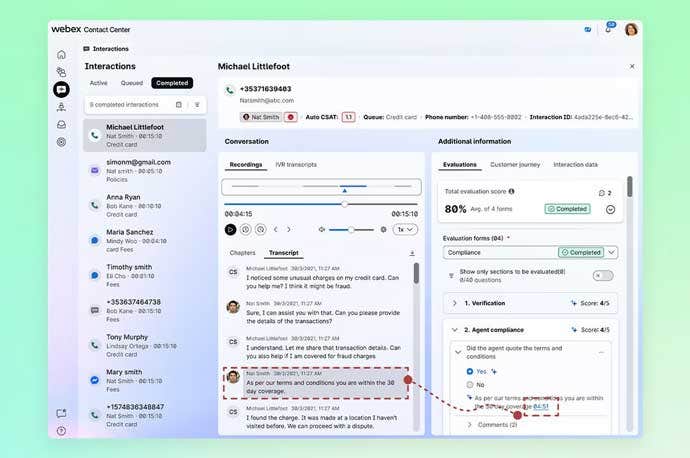
Specifically, the tech giant unveiled the Webex AI Quality Management (QM) tool that lets supervisors view, assess and coach their entire contact center workforce—including AI and human agents—through a single, integrated platform. AI QM is planned to be generally available in the first quarter of 2026.
On the integration front, the company unveiled Webex Contact Center for Salesforce. As part of Salesforce’s Bring Your Own Contact Center as a Service (CCaaS) program, this integration will let businesses build customer experiences using Webex and Salesforce CRM data. The integration is currently in early access, with general availability planned for the first quarter of 2026. Cisco also unveiled an integration with Webex Contact Center and Amazon Lex, Amazon Web Services’ technology that lets users build chatbots using voice and text. By integrating the two, customers using AWS have the flexibility to build Amazon Lex virtual agents with Cisco’s AI receptionist capabilities to deflect or route inbound calls, improve caller intent recognition and accelerate resolution of live interactions with an agent, Cisco said. This integration is available immediately.
AI is already having a “true impact” on the contact center today, said Anurag Dhingra, Cisco’s senior vice president and general manager of enterprise connectivity and collaboration.
“This is not just a theoretical possibility for that industry. It is happening today, both [with] agentic AI starting to do autonomous handing of calls and interactions, but also as a companion to the human agents who are providing customer experience,” he said.
The contact center doesn’t exist in isolation on an island. Integrations, said Dhingra, are the name of the game.
“You need integrations in back-office systems. You need integrations with front-office systems—all sorts of systems of record that play into providing an amazing customer experience. And now, many of those systems of records are becoming agentic themselves. … Technology vendors have to embrace that future where the way to integrate with all of these systems of record is agent-to-agent communication—our AI collaborating with somebody else’s AI—and in order for that to work we have to build the products with that in mind,” he said.
Dhingra said that creating an ecosystem of agents that work well together in service of customer experience is a “huge” opportunity for partners.
World Wide Technology, one of Cisco’s top partners, has seen its own contact center business grow significantly in the last couple of years, said Joe Berger, vice president of digital experiences at St. Louis-based WWT.
Many of the initial use cases for AI that WWT is seeing lend themselves to contact center opportunities, Berger said.
“It’s an easy place to start. The reason is most people who run contact centers know a lot of their numbers in terms of agent handle time, how quickly they can get a call resolved [and] call wrap-up. AI is solving for a lot of those things. You can quickly define, ‘What is the ROI of implementing some of these new tools?’ he said. “Our contact center team been very busy over the past two years with AI coming into the fold.”
Cisco’s collaboration business is very heavily partner-led with between 90 percent and 95 percent of business coming in through the channel each quarter, Hogan said.