Cisco Launches New Silicon One Chip To ‘Satiate’ Rising AI Data Center Demands
The latest chip that’s part of the Cisco Silicon One portfolio comes as AI places new and unprecedented demands on the data center, according to the tech giant.
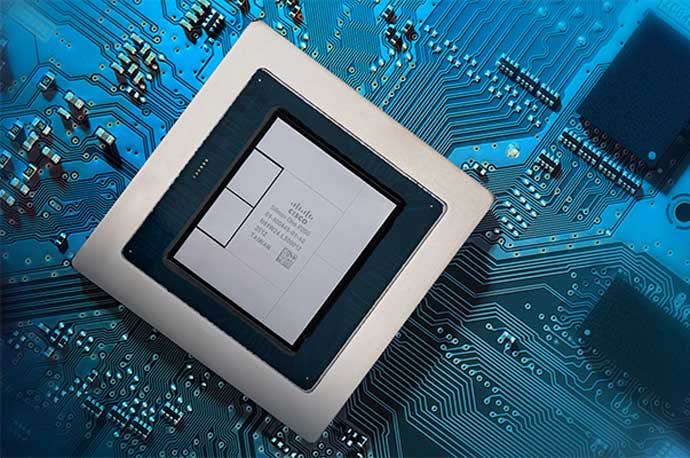
With AI workloads growing faster than the data centers that host them, Cisco Systems is unveiling its latest Silicon One chip for efficiently and securely connecting AI-ready data centers, the tech giant said Wednesday.
The new Silicon One P200 chip, the Cisco 8223, boasts what the company said is the industry’s most optimized routing system for AI networking that can enable interconnect bandwidth scale of more than 3 Exabits per second.
The latest chip comes as AI places new and unprecedented demands on the data center, Jeetu Patel, Cisco’s president and chief product officer, said at the company’s WebexOne event last month.
[Related: Cisco Webex, Soon With AI Canvas, Proves Reality Of ‘Better Together’ Story: Executives]
Increasing AI adoption is raising demand and power constraints for data centers while introducing new security threats. In fact, AI is currently being constrained by data center limitations, Patel said. It’s a constraint that Cisco is working to solve, he added.
“At Cisco, we’ve been thinking long and hard about the key kind of impediments that might actually stall the adoption of AI. … The first one is what we call an ‘infrastructure constraint.’ There’s just simply not enough power in the world, or compute capacity or network bandwidth, to satiate the needs of AI,” he said during his keynote at WebexOne 2025.
To keep up with increasing power demands to train AI workloads, enterprises are migrating data centers to remote locations where more power is readily available, said Martin Lund, executive vice president of Cisco’s Common Hardware Group, in a blog post about the new chip.
“This migration requires unprecedented bandwidth to interconnect massive AI clusters over large distances. These huge AI training runs can last months and are incredibly costly, and any network downtime risks leaving a billion-dollar data center idle,” he said.
The Cisco 8223 has been built for these new requirements as the only 51.2-terabit-per-second Ethernet fixed router on the market that is ready to tackle the intense traffic of AI workloads between data centers, according to Cisco.
At the heart of the technology is Cisco Silicon One P200 routing silicon, the latest innovation in the Cisco Silicon One portfolio that was launched six years ago. Silicon One is a scalable, programmable unified networking architecture that has been deployed at five of the six top hyperscalers, according to Cisco.
“That’s why we built the Cisco 8223, powered by Cisco Silicon One P200. …The Cisco 8223 is purpose-built for scale-across networking demands. With industry-leading power efficiency, scalability and security features, it’s engineered to handle what’s next," Lund said.
The Cisco 8223 is now available in the fixed 8223 system, and the P200 silicon itself will be deployable in modular platforms and disaggregated chassis, according to the company. The Cisco Nexus portfolio will also support systems running NX-OS based on the P200 in the near future, Cisco said.